


Archive Updates
Track the latest additions to the ADAM Archive. Browse files by the date they were added to see what's new in our collection.
Select Date to View Files
11/04/2026[240]11/03/2026[279]10/28/2026[170]09/10/2026[36]07/26/2026[127]06/19/2026[47]06/11/2026[72]05/12/2026[51]03/19/2026[72]03/10/2026[88]02/19/2026[86]02/07/2026[49]01/07/2026[57]12/31/2025[93]12/22/2025[32]12/17/2025[123]09/21/2025[138]04/07/2025[87]02/07/2025[16]01/25/2025[19]01/24/2025[19]01/14/2025[160]12/21/2024[41]12/18/2024[135]
Files Added on 11/04/2026
| Name | Publisher | Size | Actions | Screenshots (Only Partially Available In Some Browsers) |
|---|---|---|---|---|

Every ColecoVision magazine adaptation in this folder in one download: 239 games adapted from programs published in COMPUTE!'s Gazette magazine, made by Amy Studio/Amy Purple (Bienvenu). Each ROM inside carries its archive name, Title (Year) (Maker) (Gazette).rom. _Index.txt pairs every ROM with its original release file name, which records the publication number, original author and magazine issue.
|
Amy Studio/Amy Purple (Bienvenu) | 1643kb | — |
|

A word search where every guess counts. Ten words are hidden in a field of 20 by 15 letters, and no two words cross. Put the cursor on a letter and press the button: if it belongs to a hidden word it lights up, GOOD ANSWER, and your energy goes up by one; if not, you lose one energy and see TRY ANOTHER. Energy starts at 7 and also drains away at random moments, while now and then a CLUE names a word you have not touched yet. Light all the letters of all ten words to win and see your time. The level sets how the words run: forwards only, then backwards too, then diagonally as well. If your energy runs out, the words you missed are shown in red.
Controls: Use either controller. The stick moves the cursor and a side button marks the letter under it. On the title, push up and down to choose and press a button to start. ColecoVision version credited in the source to Claude (an AI made by Anthropic) for Amy Studio, in Amy, the language by Amy Bienvenu, 2026: a reimagined adaptation of the published rules. From COMPUTE!'s Gazette, February 1986: original Commodore 64 program by Ron Wilson. Amy Studio's second build of this program, released alongside the first (#108 in this collection). This is a modern homebrew adaptation, not a commercial Coleco release. Original Amy Studio release file: 112 - LEXITRON - by RON WILSON - COMPUTE! Gazette - February 1986.rom |
Amy Studio/Amy Purple (Bienvenu) | 11kb | 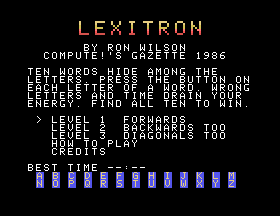 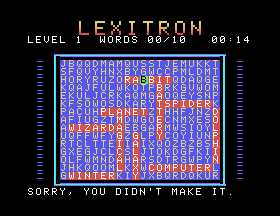 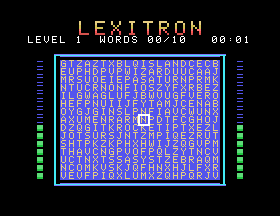 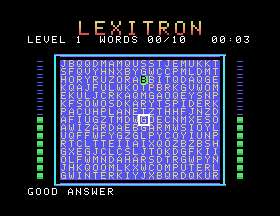 |
|
|
A letter-recognition game. A counter runs through the alphabet and stops on a letter, and that letter then drops down a walled brick chute. Dial the matching letter and press the button to blast it before it reaches the floor; the higher up you catch it, the better your time. A wrong shot freezes the dial for half a second, and three wrong shots lose the letter, as does letting it land. Before you start, choose a level from 1 to 9 for the speed of the fall and a number of letters from 10 to 90. An arrow marks your highest catch. The game ends with your score, high score, highest possible score, an efficiency rating and an average time, where 1 is good and 22 is bad.
Controls: Use either controller. The stick turns the dial, left and right one letter and up and down five, and either button shoots. On the title, push up and down to choose and left and right to set the level or the number of letters; a button starts. ColecoVision version credited in the source to Claude (an AI made by Anthropic) for Amy Studio, in Amy, the language by Amy Bienvenu, 2026: a reimagined adaptation of the published rules. From COMPUTE!'s Gazette, December 1984: original Commodore 64 program (no author named in the issue). Amy Studio's second build of this program, released alongside the first (#107 in this collection). This is a modern homebrew adaptation, not a commercial Coleco release. Original Amy Studio release file: 071 - LETTER ATTACK! - by Author not named - COMPUTE! Gazette - December 1984.rom |
Amy Studio/Amy Purple (Bienvenu) | 9kb | 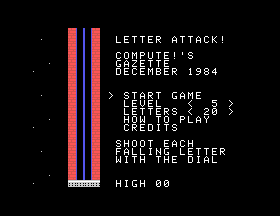 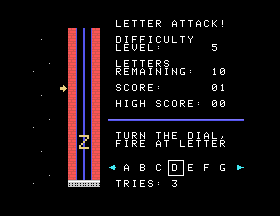 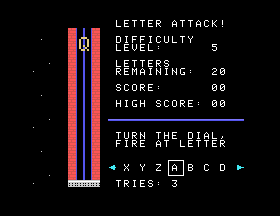 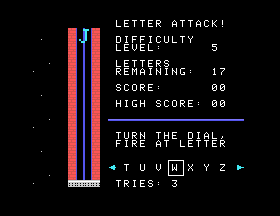 |
|
|
A loose reinterpretation of Treasure Diver with its own look and rules. You steer a small submarine in eight directions, down from the calm water at the surface to a treasure chest drifting slowly along the seabed among coral, algae and boulders. Touch the chest for 200 points; after a moment a new one appears somewhere else along the bottom. Your air runs down all the time and refills only at the surface. Five sharks roam the deep water: patrol sharks drift between depth lanes and turn at the edges, while hunters chase you in bursts and then break off, giving you a window to escape. Each shark hit adds to your leak, up to five, so your air drains faster from then on. Running out of air costs one of your three lives, and your best score is kept.
Controls: Push the stick to swim in eight directions. Hold the fire button while moving for a double-speed escape boost, which uses energy and recharges when you let go. On the title, press fire to dive. ColecoVision version credited in the source to ChatGPT (an AI made by OpenAI) for Amy Studio, in Amy, the language by Amy Bienvenu, 2026: an artistic reinterpretation inspired by Treasure Diver, whose look and rules deliberately differ from the original. From COMPUTE!'s Gazette, May 1988: original Commodore 64 program by Brian Casey. A companion build to Treasure Diver (Claude). This is a modern homebrew adaptation, not a commercial Coleco release. Original Amy Studio release file: 184 - Treasure Diver- Ocean Expedition - by Brian Casey - COMPUTE! Gazette - May 1988.rom |
Amy Studio/Amy Purple (Bienvenu) | 12kb | 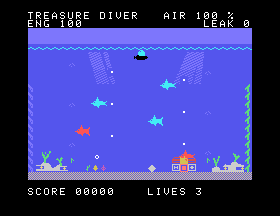 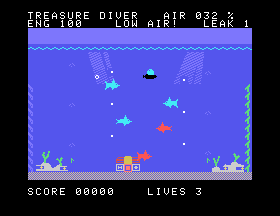 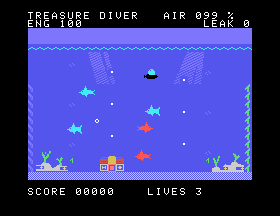 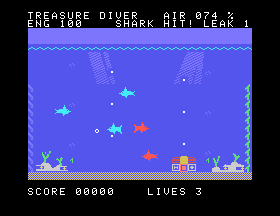 |
|
|
You pilot a little floating bathysphere with a face at its porthole, and when you let go of the stick it bobs back up. A treasure chest drifts along the sandy bottom in the current; dive down and touch it to burst it open for 200 points times the dive number, and a new one sinks in. Air drains from the meter at the top, from green through yellow to red, and refills only at the surface or from bubbles rising out of vents in the seabed, worth 10 points each. Grey sharks weave along their lanes while black sharks hunt you down. Every bite dents the sphere for good and makes it leak air faster. Every third chest takes you a dive deeper, with more and faster sharks. Run out of air and the sphere pops; you have three.
Controls: Push the stick to steer the bathysphere; let go and it rises slowly. The fire button gives a burst of speed that burns air three times as fast, and the second button pauses. The game speed, 1 (fastest) to 4 (slowest), is chosen from a menu with the stick. ColecoVision version credited in the source to Claude (an AI made by Anthropic) for Amy Studio, in Amy, the language by Amy Bienvenu, 2026: a reimagined adaptation of the published rules. From COMPUTE!'s Gazette, May 1988: original Commodore 64 program by Brian Casey. A new game written from the article's rules; the original was machine language and its listing was not used. Amy Studio also released Treasure Diver: Ocean Expedition, a ChatGPT reinterpretation. This is a modern homebrew adaptation, not a commercial Coleco release. Original Amy Studio release file: 183 - Treasure Diver (Claude) - by Brian Casey - COMPUTE! Gazette - May 1988.rom |
Amy Studio/Amy Purple (Bienvenu) | 12kb | 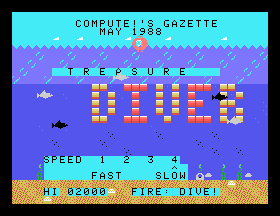 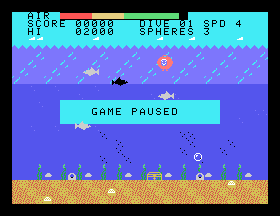 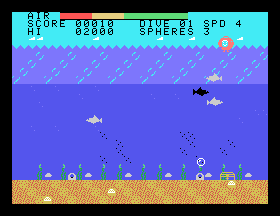 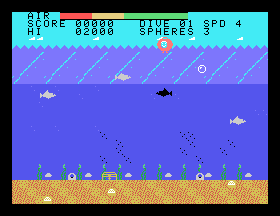 |
|
|
Two players, BLACK and WHITE, share a field with a lava vent between them. Lava creeps out of the vent one cell at a time in every direction, and a player it reaches, or who steps into it, is burnt and loses one of five lives; then a new round begins. The button switches building on and off: while building, a player moves more slowly and drops a brick on every step taken. A brick holds the lava back only for a while, glowing hotter through four colours as the lava presses on it before it melts and flows on. If both players are burnt at once, both lose a life. Whoever still has lives at the end wins, and going out together is a draw. A single player can take BLACK against a computer-controlled WHITE.
Controls: Joystick only. BLACK uses controller 1 and WHITE controller 2; in a one-player game either controller moves BLACK. The stick walks and a button switches building on or off. On the title, push up and down to choose a line, left, right or a button to change it, and press a button on START. ColecoVision version credited in the source to Claude (an AI made by Anthropic) for Amy Studio, in Amy, the language by Amy Bienvenu, 2026: a reimagined adaptation of the published rules. From COMPUTE!'s Gazette, September 1988: original Commodore 64 program (no author named in the issue). Amy Studio's second build of this program, released alongside the first (#109 in this collection). Machine-language program from the issue's disk. This is a modern homebrew adaptation, not a commercial Coleco release. Original Amy Studio release file: 195 - LAVA FLOW - by Author not named - COMPUTE! Gazette - September 1988.rom |
Amy Studio/Amy Purple (Bienvenu) | 9kb | 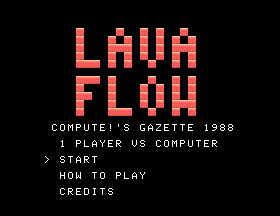 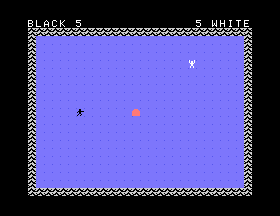 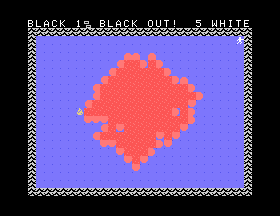 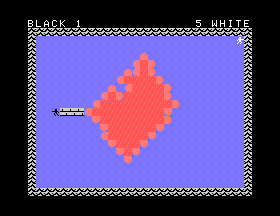 |
|
|
An alien saucer that cannot be harmed patrols over a city at night, letting plasma bombs fall, a hundred a wave. Fly your chopper and shoot the bombs with its pulse laser, which fires the way the chopper faces; each bomb scores 10. A bomb that reaches the glowing force dome burns a hole in it, and one that falls through a hole hits the city, which sinks a storey. Six hits destroy the city: no bonus, and the wave starts again. Stop the whole wave and the city is saved, scoring 100 for every storey left, and the next wave is faster. A bomb or the saucer wrecks the chopper; the pilot bails out, and while parachutes are left a new chopper comes. After the third the game is over.
Controls: Use controller 1 or 2. The stick flies the chopper, which turns to face left or right, and either button fires. On the title, up and down choose a line, left and right choose the wave, and a button selects. ColecoVision version credited in the source to Claude (an AI made by Anthropic) for Amy Studio, in Amy, the language by Amy Bienvenu, 2026: a reimagined adaptation of the published rules. From COMPUTE!'s Gazette, August 1986: original Commodore 64 program by Mike Sedore. This is a modern homebrew adaptation, not a commercial Coleco release. Original Amy Studio release file: 126 - Chopper 1 - by Mike Sedore - COMPUTE! Gazette - August 1986.rom |
Amy Studio/Amy Purple (Bienvenu) | 12kb | 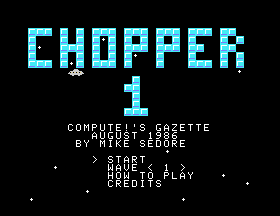 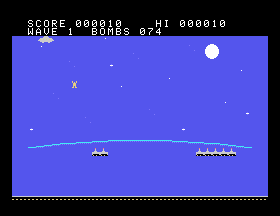 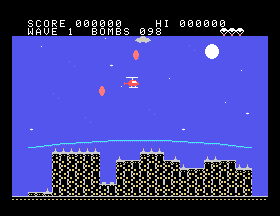 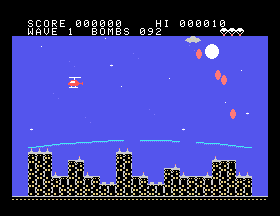 |
|
|
A barn has four wooden lofts, each split by an open shaft down the middle. A hen drops from the roost down the shaft, over and over, a little faster after every catch. Your farmer runs along the lofts: take a run-up of at least five steps, then hold the button to leap into the shaft and grab her. She must meet your arms; bump her with your feet and she squawks, and the game is over. Miss her and you fall into the pit, which also ends the game. Trapdoors drop you to the loft below, and you can't climb back. Each hen caught scores ten points for every second left on the 60-second clock, which then starts again. When the clock runs out the game is over. The best score is kept with initials.
Controls: Use either controller. Push the stick left or right to run, and hold a side button to jump after a run-up of five steps. On the title, up and down choose and a button starts. ColecoVision version credited in the source to Claude (an AI made by Anthropic) for Amy Studio, in Amy, the language by Amy Bienvenu, 2026: a reimagined adaptation of the published rules. From COMPUTE!'s Gazette, November 1985: original Commodore 64 program (no author named in the issue). Printed for both the Commodore 64 and VIC-20. This is a modern homebrew adaptation, not a commercial Coleco release. Original Amy Studio release file: 104 - Chicken Catcher - by Author not named - COMPUTE! Gazette - November 1985.rom |
Amy Studio/Amy Purple (Bienvenu) | 9kb | 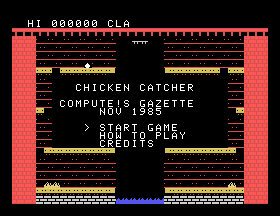 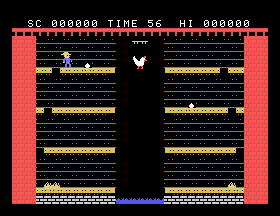 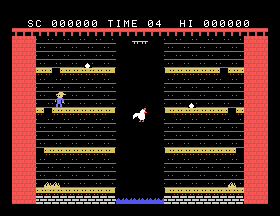 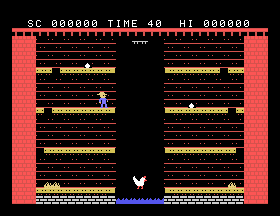 |
|
|
A row of little characters stands on the street. One after another, from left to right, a letter or a digit falls toward each of them. Stop it before it lands: six cards under the street show the falling character and five others, and you must pick the matching card. The sooner you stop it, the more it scores. Pick a wrong card and that card is crossed out and the character can no longer be stopped. A character that a falling letter reaches is struck down for good and a tombstone takes its place, and the sweep skips it from then on. The sweep goes round again and again, a little faster each time, until no character is left and the game is over. Choose a speed from 0 to 9. The high score is kept.
Controls: Use either controller. Push left or right to move the cursor over the cards and press either button to pick one. On the title, up and down choose, left and right set the speed, and a button starts. ColecoVision version credited in the source to Claude (an AI made by Anthropic) for Amy Studio, in Amy, the language by Amy Bienvenu, 2026: a reimagined adaptation of the published rules. From COMPUTE!'s Gazette, June 1985: original Commodore 64 program (no author named in the issue). Printed for both the Commodore 64 and VIC-20; the original was a keyboard typing game. This is a modern homebrew adaptation, not a commercial Coleco release. Original Amy Studio release file: 090 - Character Assassination - by Kent Brewster - COMPUTE! Gazette - June 1985.rom |
Amy Studio/Amy Purple (Bienvenu) | 9kb | 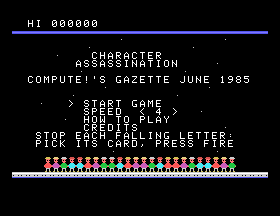 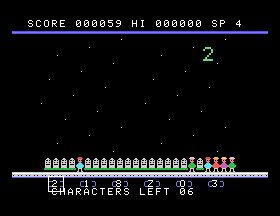 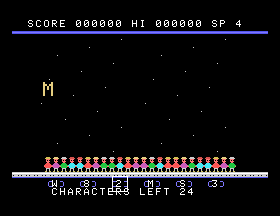 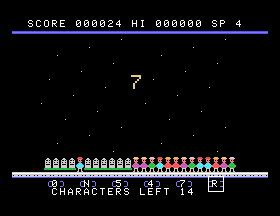 |
|
|
A memory game for two players, or one against the computer. Twelve numbered squares, three across and four down, hide six pairs of three-letter words such as CAT, HAT and INK. On your turn, open one square and then another. If the two words are the same it is a MATCH: you score a point, both squares fill with your colour, red for player 1 and green for player 2, and you go again. If not, it is NO MATCH: the squares close and the other player takes a turn. Remember what has been shown, since every opened square is a clue for both players. After the sixth pair the game is over and the player with the most pairs wins, or it is a tie. The computer opponent remembers only some of what it sees.
Controls: Use either joystick. The stick slides the cursor between squares and either button opens one. On the title, the stick chooses PLAYER 1 / PLAYER 2 or PLAYER 1 / COMPUTER and a button starts. ColecoVision version credited in the source to Claude (an AI made by Anthropic) for Amy Studio, in Amy, the language by Amy Bienvenu, 2026: a reimagined adaptation of the published rules. From COMPUTE!'s Gazette, October 1983: original Commodore 64 program (no author named in the issue). The same game was printed for the Commodore 64 and the VIC-20. This is a modern homebrew adaptation, not a commercial Coleco release. Original Amy Studio release file: 014 - WORD MATCH - by Andy Van Duyne - COMPUTE! Gazette - October 1983.rom |
Amy Studio/Amy Purple (Bienvenu) | 10kb | 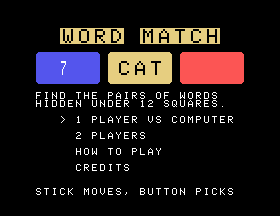 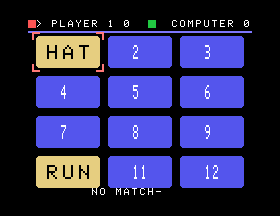 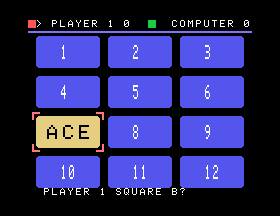 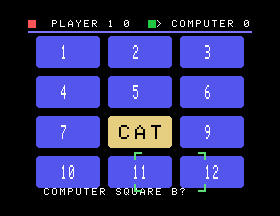 |
|
|
A timed word-search game. Ten words, drawn at random from one of six themes, ANIMALS, FOOD, SPORTS, SPACE, OCEAN or COMPUTER, are hidden in a 10 x 10 grid of letters, running across, down or diagonally, forwards or backwards. They are asked for one at a time, longest first. Move the box to the word's first letter and mark it, then to its last letter and mark it again. Quick answers score more: within the skill level's time a word is worth 100 points, within twenty times that 10, and later less; the panel shows what the word is worth now. A wrong answer shows NO and marks the word's real place in red before the next word comes. Found words stay green. After ten words the game ends with your score.
Controls: Use either controller. The stick moves the box (diagonals too); the left button marks the first and last letter of the word and the right button lets go. On the setup page, push up and down to choose a line and left and right to change it. ColecoVision version credited in the source to Claude (an AI made by Anthropic) for Amy Studio, in Amy, the language by Amy Bienvenu, 2026: a reimagined adaptation of the published rules. From COMPUTE!'s Gazette, July 1983: original Commodore 64 program (no author named in the issue). The disk copy was retyped by a reader around 1988. This is a modern homebrew adaptation, not a commercial Coleco release. Original Amy Studio release file: 005 - WORD HUNT - by Eric Jansing and Bob Meyers, Jr - COMPUTE! Gazette - July 1983.rom |
Amy Studio/Amy Purple (Bienvenu) | 14kb | 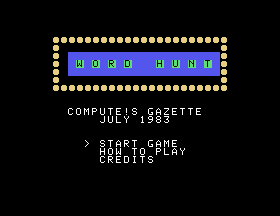 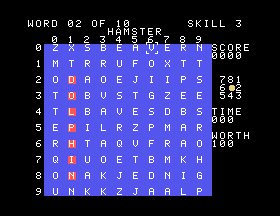 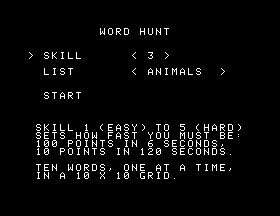 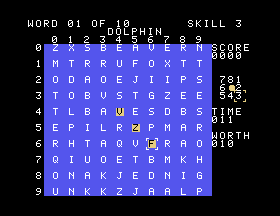 |
|
|
A word-guessing game. A word of 3 to 10 letters is chosen at random from 100 and shown as blank slots, and you guess it a letter at a time, picking from the alphabet on screen. A letter that is in the word appears in every slot where it belongs. You have 30 seconds for each guess, shown as a number and a shrinking bar; let the clock run out and the guess is lost. Under ORIGINAL rules you get the word's length plus five guesses, and every guess counts. Under EASY, the default, the first letter is shown at the start, letters you find are free, and only misses count, eight allowed. Fill every slot to win; otherwise the word is shown. Either way the time taken is your score, and the title counts the words solved.
Controls: Joystick and either button; the keypad is not used. Push left or right to step through the letters, up or down to switch rows, and press a button to guess the letter in the box. On the title, push left or right to choose EASY or ORIGINAL rules. ColecoVision version credited in the source to Claude (an AI made by Anthropic) for Amy Studio, in Amy, the language by Amy Bienvenu, 2026: a reimagined adaptation of the published rules. From COMPUTE!'s Gazette, December 1984: original Commodore 64 program (no author named in the issue). The same game was printed for the Commodore 64 and the VIC-20 with 8K. This is a modern homebrew adaptation, not a commercial Coleco release. Original Amy Studio release file: 072 - WORD GUESS - by David W. Rose - COMPUTE! Gazette - December 1984.rom |
Amy Studio/Amy Purple (Bienvenu) | 11kb | 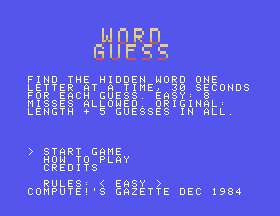 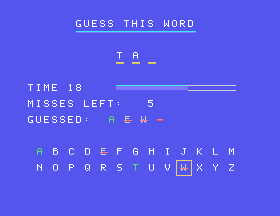 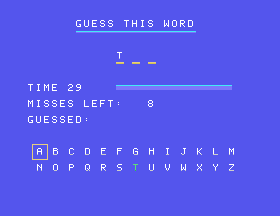 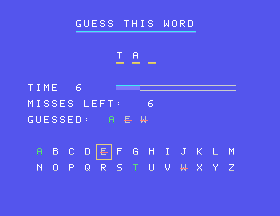 |
|
|
A word-search puzzle. Words are hidden in a 20 x 20 grid of letters, running across, down or diagonally, forwards or backwards, and the words to find are listed beside the grid. Choose a theme, ANIMALS, FOOD, SPORTS, SPACE or COMPUTER, and how many words to hide, from 5 to 20. Move the box to the first letter of a word and mark it, then to the last letter and mark it again; the line you are marking shows in yellow. A found word turns green in the grid and in the list, while a wrong try locks the controls for a second. Find them all to win. With a time limit set, the clock counts down and any words not found are shown in red when it runs out; without one, the time taken counts up.
Controls: Use either controller. The stick moves the box (diagonals too); the left button marks the first and last letter of a word and the right button lets go. On the setup page, push up and down to choose a line and left and right to change it. ColecoVision version credited in the source to Claude (an AI made by Anthropic) for Amy Studio, in Amy, the language by Amy Bienvenu, 2026: a reimagined adaptation of the published rules. From COMPUTE!'s Gazette, December 1987: original Commodore 64 program (no author named in the issue). The listing ran on both the Commodore 64 and the 128. This is a modern homebrew adaptation, not a commercial Coleco release. Original Amy Studio release file: 171 - WORD FIND - by Keith Murray - COMPUTE! Gazette - December 1987.rom |
Amy Studio/Amy Purple (Bienvenu) | 13kb | 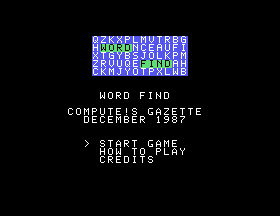 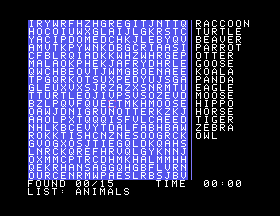 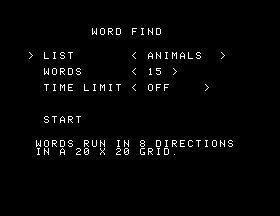 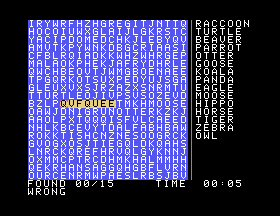 |
|
|
Guide your multicoloured raft down eight rocky rivers as quickly as you can. The river sweeps past from right to left; push up and down to steer the raft across it, right to speed up and left to slow down. Rocks, crocodiles and hovercraft are in the way, and any hit loses the raft; you have the raft and two spares, and after a crash the river starts again a little way back. The faster you go the more points you score, and every crocodile or hovercraft you get past is worth 100. Each river is longer than the last, and LEVEL COMPLETE follows each one. After all eight the course starts again from the first river while the level number goes on climbing. The best score is kept on the title.
Controls: Use controller 1 or 2. Push up and down to move the raft across the river, right to speed up and left to slow down. On the title, push up and down to choose START or HOW TO PLAY and press a button. ColecoVision version credited in the source to Claude (an AI made by Anthropic) for Amy Studio, in Amy, the language by Amy Bienvenu, 2026: a reimagined adaptation of the published rules. From COMPUTE!'s Gazette, November 1989, page 20: original Commodore 64 program by Tim Hanson. This is a modern homebrew adaptation, not a commercial Coleco release. Original Amy Studio release file: 225 - WHITE WATER - by Tim Hanson - COMPUTE! Gazette - November 1989.rom |
Amy Studio/Amy Purple (Bienvenu) | 20kb | 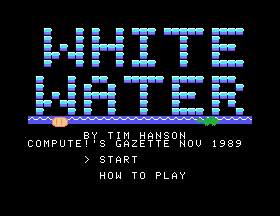 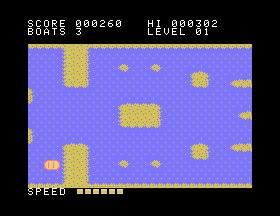  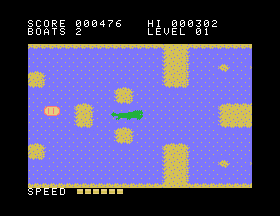 |
|
|
A brick-breaking game with a bird for a paddle. The Whirlybird flies back and forth across the top of the screen, spinning all the time, and bounces its eggs down into layers of coloured bricks below. Hold the stick left or right to speed the bird up; let go and it slows to a stop, and a sidebeam at either edge turns it round. Each brick is worth a point and each egg the bird bounces back down 10, and the stick at the moment of impact steers the egg. An egg that flies past the bird costs 10 points. Round bricks bring the bird swooping down to set a new sidebeam above the bricks and give a free egg. Clear every brick for a 50-point bonus; the game ends when the bricks or the eggs run out.
Controls: Use joystick 1 or 2. Hold left or right to speed the bird up that way; let go and it slows to a stop. A button releases each egg and works the menus, where the number of eggs can be set from 1 to 255. ColecoVision version credited in the source to Claude (an AI made by Anthropic) for Amy Studio, in Amy, the language by Amy Bienvenu, 2026: a reimagined adaptation of the published rules. From COMPUTE!'s Gazette, December 1985, page 42: original Commodore 64 program by Philip I. Nelson. This is a modern homebrew adaptation, not a commercial Coleco release. Original Amy Studio release file: 107 - WHIRLYBIRD - by PHILIP I. NELSON - COMPUTE! Gazette - December 1985.rom |
Amy Studio/Amy Purple (Bienvenu) | 9kb | 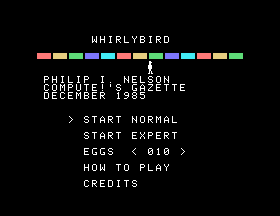 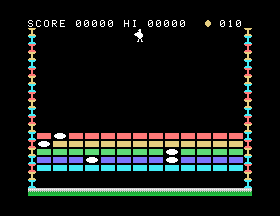 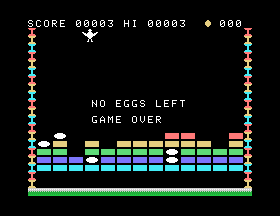 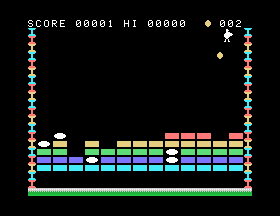 |
|
|
One-player pinball across 26 screens. Play the ball off the walls, the centre bumper and six flippers in three pairs, and knock out every Whammie to clear the screen. The ball passes straight through Whammies, worth 200 points each, and through drop targets, removing them; walls are worth 10. The centre drop target raises the bumper over the middle hole and puts targets in the side holes, which lower it again. Where the ball meets a flipper decides its angle, and a ball that falls between the flippers is lost. You have five balls and earn another for each screen cleared, with a bonus for every Whammie. Each screen brings new walls and more Whammies. Bump the machine to nudge the ball, but bump too hard and it tilts. A trainer mode gives unlimited balls.
Controls: Use either controller. The left button works the left flippers and the right button the right flippers; push the stick up to bump the machine. On the title, the stick chooses and changes the speed, starting screen and trainer mode, and either button selects. ColecoVision version credited in the source to Claude (an AI made by Anthropic) for Amy Studio, in Amy, the language by Amy Bienvenu, 2026: a reimagined adaptation of the published rules. From COMPUTE!'s Gazette, September 1989, page 22: original Commodore 64 program by Rick Bauer. This is a modern homebrew adaptation, not a commercial Coleco release. Original Amy Studio release file: 223 - WHAM BALL - by RICK BAUER - COMPUTE! Gazette - September 1989.rom |
Amy Studio/Amy Purple (Bienvenu) | 10kb | 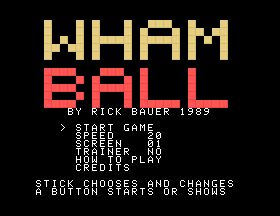 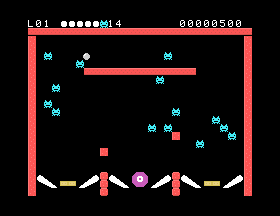 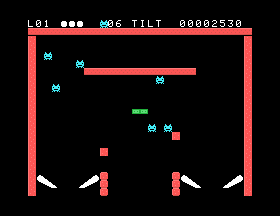 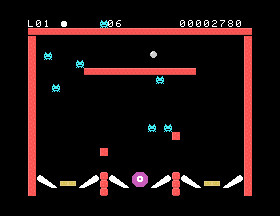 |
|
|
A picture puzzle. One of four pictures, a castle on a hill, a lighthouse, a hot-air balloon or a sailboat, is cut into rectangular pieces and mixed up. First choose the size of the pieces, from four very large ones to 140 small squares, and see the finished picture before it is shuffled. Move the flashing arrow to a piece and press to pick it up, then move to where it belongs and press again: the two pieces swap places. Picking the same piece again puts it back. You can look at the finished picture at any time. Put every piece in its place to win. Moves and time are counted, and the best result is kept for each picture, with more pieces counting ahead of a faster time.
Controls: Use either controller. The stick moves the arrow and works the menus; the left button picks up and places a piece, and the right button shows the finished picture. On the title, push up and down to choose START GAME, HOW TO PLAY or CREDITS. ColecoVision version credited in the source to Claude (an AI made by Anthropic) for Amy Studio, in Amy, the language by Amy Bienvenu, 2026: a reimagined adaptation of the published rules. From COMPUTE!'s Gazette, September 1986, page 65: original Commodore 64 program by Fred Karg. This is a modern homebrew adaptation, not a commercial Coleco release. Original Amy Studio release file: 132 - VIDEO JIGSAW - by Fred Karg - COMPUTE! Gazette - September 1986.rom |
Amy Studio/Amy Purple (Bienvenu) | 20kb | 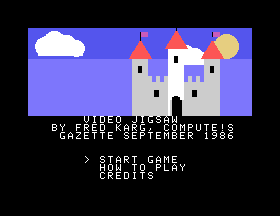 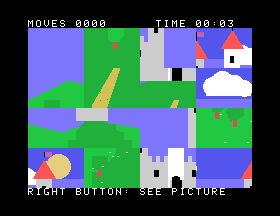 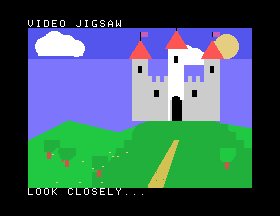 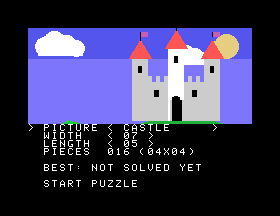 |
|
|
An adventure. A vampire terrorizes a small village in the mountains of eastern Europe, and the townspeople have fled. Explore the empty village, gather what you need, make stakes, then enter the old castle, find the vampire's coffin and drive a stake into him while he sleeps, or keep him from his coffin until the sun rises. A picture of each place sits above the story, with the day and the time always shown. Outside, you choose a verb and a noun from a menu to give each command. Inside the castle you walk its four floors, dark without a lantern, past rats and bats that bite. Watch the clock, your hunger and your weariness, deal with the wolves and a dog, and beware: at night the vampire walks the castle and hunts you.
Controls: Use either joystick. Outside, push up and down to choose a verb or a noun, push right or press the left button to move to the nouns, press the left button to carry out the command and the right button to go back. In the castle, the stick walks one step a push, the left button opens the menu and the right button closes it. ColecoVision version credited in the source to Claude (an AI made by Anthropic) for Amy Studio, in Amy, the language by Amy Bienvenu, 2026: a reimagined adaptation of the published rules. From COMPUTE!'s Gazette, May 1986, page 42: original Commodore 64 program by Marc Sugiyama. This is a modern homebrew adaptation, not a commercial Coleco release. Original Amy Studio release file: 119 - VAMPYRE HUNTER - by MARC SUGIYAMA - COMPUTE! Gazette - May 1986.rom |
Amy Studio/Amy Purple (Bienvenu) | 31kb | 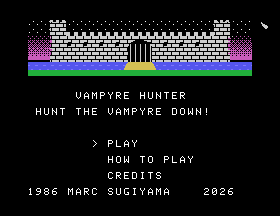 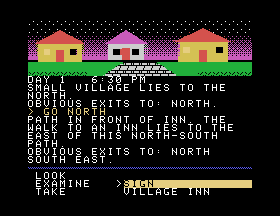 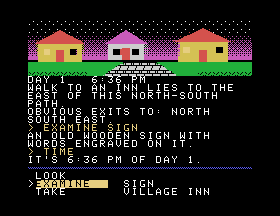 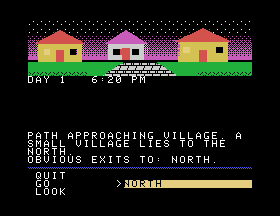 |
|
|
You run through a field of posts joined by green doors, chased by whirligigs. Walk into a door to swing it a quarter turn round the post at its far end; it swings only if the space it sweeps through is empty. Whirligigs cannot move doors, so swing the doors to shut one in: a whirligig that cannot move at all for a moment breaks up, worth 50 points, though two or more shut in together survive. Clear every whirligig to finish the level and score the time left on the bonus timer plus a level bonus; when that timer runs out, everyone speeds up. A touch from a whirligig costs a life. Each level adds a whirligig, up to seven, and from level 7 they get faster. Every second level cleared gives an extra life or 250 points.
Controls: Use joystick 1 or 2. The stick runs up, down, left and right; a button starts each round and works the menus. ColecoVision version credited in the source to Claude (an AI made by Anthropic) for Amy Studio, in Amy, the language by Amy Bienvenu, 2026: a reimagined adaptation of the published rules. From COMPUTE!'s Gazette, October 1985: original Commodore 64 program by Mark Tuttle and Kevin Mykytyn. This is a modern homebrew adaptation, not a commercial Coleco release. Original Amy Studio release file: 102 - TURNABOUT - by Mark Tuttle and Kevin Mykytyn - COMPUTE! Gazette - October 1985.rom |
Amy Studio/Amy Purple (Bienvenu) | 13kb | 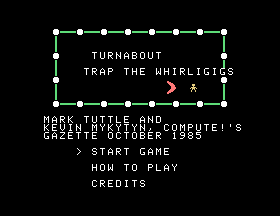 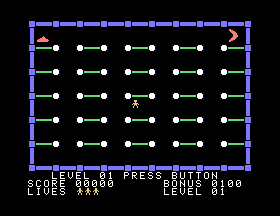 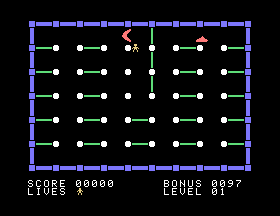 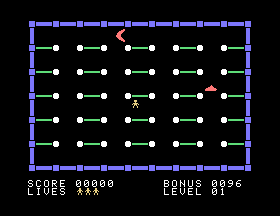 |
|
|
You speed through a trench in an earthquake fault toward evil King Krypos' lair. His kamikaze drone ships fly at you out of the far end of the trench, growing as they come, along with rolling debris. Steer your fighter left and right across the bottom of the trench and fire down its length, one shot at a time, or dodge out of the way. Each drone is worth 25 points and each rock 10, and clearing a wave earns a bonus. From level 2 some drones steer toward your lane, so standing still does not work. Every 250 points raises the level, with faster and more numerous drones. You start with three ships and earn one every 1000 points, up to seven. The waves never end; the game is over when your last ship is hit.
Controls: Use either controller. Push the stick left or right to steer the fighter and press either button to fire. On the title, push up and down to choose a starting level, HOW TO PLAY or CREDITS, and press a button. ColecoVision version credited in the source to Claude (an AI made by Anthropic) for Amy Studio, in Amy, the language by Amy Bienvenu, 2026: a reimagined adaptation of the published rules. From COMPUTE!'s Gazette, March 1984, page 52: original Commodore 64 program by Don Gibson. Combines the Commodore 64 listing with the level choice from the all-machine-language VIC-20 version. This is a modern homebrew adaptation, not a commercial Coleco release. Original Amy Studio release file: 040 - TRENCHFIRE - by Don Gibson - COMPUTE! Gazette - March 1984.rom |
Amy Studio/Amy Purple (Bienvenu) | 11kb | 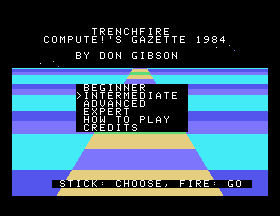 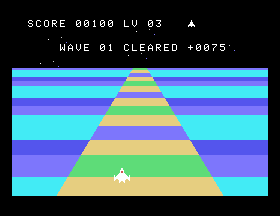 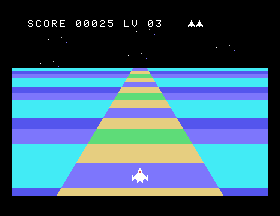 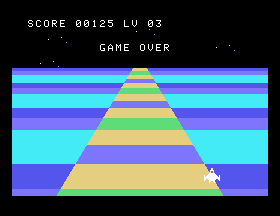 |
|
|
Your starship has lost its energy crystals and limps along in a low orbit over a planetoid on auxiliary power. Gravity pulls it down, and thrust raises or lowers the orbit. Drones fly in from the right and home in on the ship; each hit costs shield energy, and when the shields are gone the ship crashes. Now and then a plasma cannon on the surface fires a homing plasma ball that shields cannot stop: one touch destroys the ship, though the other drones keep away while it is out and its fuel soon runs low. Phasers destroy drones but cost energy and points. Over the large mountain range in a low orbit, hold the beam to pull up energy crystals and rebuild the shields. Survive two orbits to win; the score is the time flown minus the hits taken.
Controls: Use either controller. Push the stick up or down for thrust; the left button fires phasers and holding the right button beams up crystals. On the title, push up and down to choose, left and right to set the level, and press a button to start. ColecoVision version credited in the source to Claude (an AI made by Anthropic) for Amy Studio, in Amy, the language by Amy Bienvenu, 2026: a reimagined adaptation of the published rules. From COMPUTE!'s Gazette, October 1984: original Commodore 64 program by Andrew Beery. This is a modern homebrew adaptation, not a commercial Coleco release. Original Amy Studio release file: 063 - TREK - by Andrew Beery - COMPUTE! Gazette - October 1984.rom |
Amy Studio/Amy Purple (Bienvenu) | 16kb | 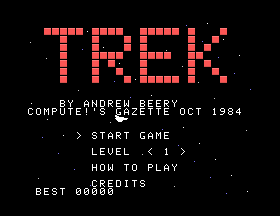 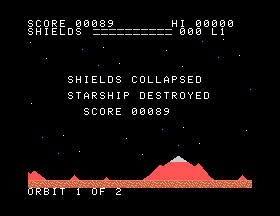 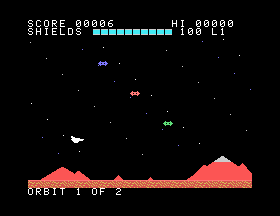 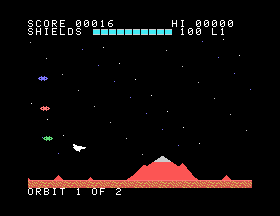 |
|
|
An addition tutor for small children, built around an apple tree. The apples in the tree are the top number of the problem and the apples on the ground are the bottom number; the child adds them and answers. A right answer brings a bird swooping down to pluck an apple from the tree and drop it into the basket. A wrong answer says TRY AGAIN, with no penalty, and shows the apples for the rest of that problem. Before starting, choose the highest sum, from 2 to 9, and whether the apples are always shown or only after a wrong answer. Ten apples in the basket end the game, which reports how many tries it took while the bird lands on the message.
Controls: Use either controller. Press the answer on the keypad, or push the stick left or right along the row of number keys and press a side button. The title settings are chosen the same way. ColecoVision version credited in the source to Claude (an AI made by Anthropic) for Amy Studio, in Amy, the language by Amy Bienvenu, 2026: a reimagined adaptation of the published rules. From COMPUTE!'s Gazette, March 1984, page 60: original Commodore 64 program by Janet Arnold. This is a modern homebrew adaptation, not a commercial Coleco release. Original Amy Studio release file: 039 - TREE TUTOR FOR TOTS (ttutor) - by JANET ARNOLD - COMPUTE! Gazette - March 1984.rom |
Amy Studio/Amy Purple (Bienvenu) | 12kb | 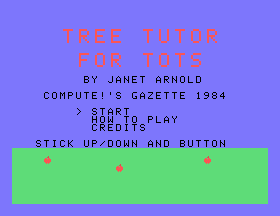 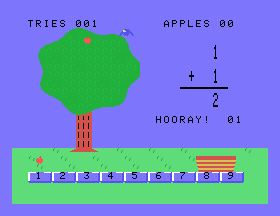 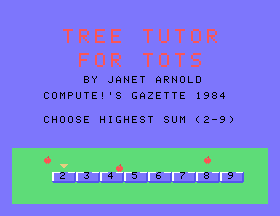 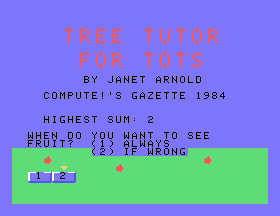 |
|
|
You hunt lost pirate treasure on a secluded island. Walk the hunter in eight directions to pick up gold coins and gold bars, worth more at higher skill levels. The treasure chest, worth the most, lies in a palm grove ringed by quicksand bogs: hold the button as you step onto a bog for an eight-in-ten chance of getting across, but step on without it, or get unlucky, and the bog swallows you. The pirates' spirits make the chest vanish and return now and then. Skulls, the spirits of ancient pirates, are death to touch, and some of them wander. Rum barrels make the hunter stagger. When nearly all the gold is gathered a new island appears, and more skulls begin to wander every second round. You have one life, and the game ends with your rounds and score.
Controls: Use either controller. The stick walks the hunter (hold it to keep walking); hold either button while stepping onto a bog. On the title, push up and down to choose, left and right to set the skill, and press a button to start. ColecoVision version credited in the source to Claude (an AI made by Anthropic) for Amy Studio, in Amy, the language by Amy Bienvenu, 2026: a reimagined adaptation of the published rules. From COMPUTE!'s Gazette, September 1984, page 110: original Commodore 64 program by Calvin Overhulser. This is a modern homebrew adaptation, not a commercial Coleco release. Original Amy Studio release file: 060 - TREASURE HUNT - by CALVIN OVERHULSER - COMPUTE! Gazette - September 1984.rom |
Amy Studio/Amy Purple (Bienvenu) | 11kb | 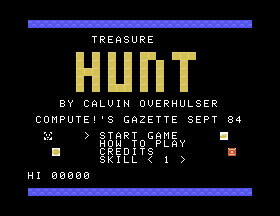 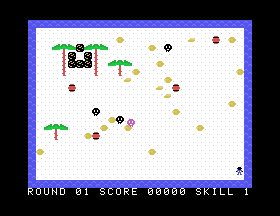 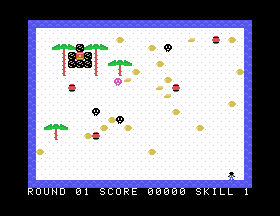 |
|
|
Two builders run fences across a walled yard, and the fences never stop growing: one length at a time, across or up and down, with the stick turning yours. A fence may not touch the outer wall, any fence, yours or your rival's, or the rocks scattered over the yard. When the other builder's fence crashes first, you win the round and score a point for every second it lasted; the first to 100 points wins. If the two meet head-on, or crash on the same step, the round goes to one of them at random. The speed is set from 0 to 9. PRACTICE is for one player alone: survive as long as you can over ten rounds, scoring more at higher speeds, for the high score. ONE PLAYER VS COMPUTER pits you against a computer builder.
Controls: In PRACTICE and VS COMPUTER, use either controller; with TWO PLAYERS, controller 1 is red and controller 2 is blue. The stick turns your fence. On the title, push up and down to choose a line, left and right to change it, and press a button on START GAME. ColecoVision version credited in the source to Claude (an AI made by Anthropic) for Amy Studio, in Amy, the language by Amy Bienvenu, 2026: a reimagined adaptation of the published rules. From COMPUTE!'s Gazette, January 1985: original Commodore 64 program by Jon Rhees. This is a modern homebrew adaptation, not a commercial Coleco release. Original Amy Studio release file: 076 - TRAP 'EM - by JON RHEES - COMPUTE! Gazette - January 1985.rom |
Amy Studio/Amy Purple (Bienvenu) | 9kb | 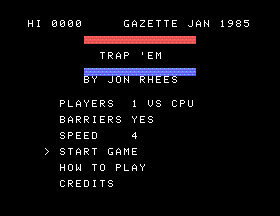 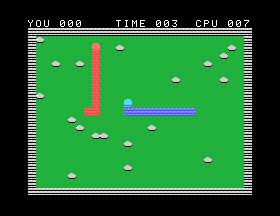 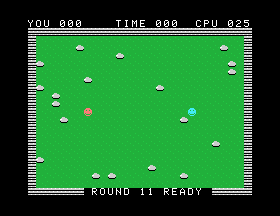 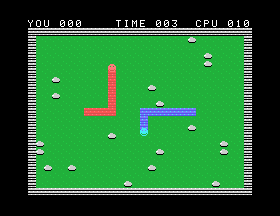 |
|
|
Purple Herbie waits in the top-left corner and home is the house in the bottom-right; your job is to build him a way home. Drive the tracker with the stick, holding the button to lay track behind you in straight lines, or let go to drive freely and erase any track you cross. Park the tracker on the house and Herbie rides the track home, picking up any gems and coins it touches and eating the track behind him. Gems, coins and getting home all score, with a 500-point bonus for a perfect round. Every few seconds a meanie sweeps across, turning track, gems and coins into deadly X's and freezing everything while it runs. Drive into an X, or fail to get Herbie home in time, and you lose one of three trackers.
Controls: Use either controller. The stick drives the tracker and holding a button lays track. On the title, push up and down to choose, left and right to change the level, and press a button. ColecoVision version credited in the source to Claude (an AI made by Anthropic) for Amy Studio, in Amy, the language by Amy Bienvenu, 2026: a reimagined adaptation of the published rules. From COMPUTE!'s Gazette, September 1985, page 69: original Commodore 64 program by Ned W. Schultz. This is a modern homebrew adaptation, not a commercial Coleco release. Original Amy Studio release file: 098 - TRACKER - by NED W. SCHULTZ - COMPUTE! Gazette - September 1985.rom |
Amy Studio/Amy Purple (Bienvenu) | 10kb | 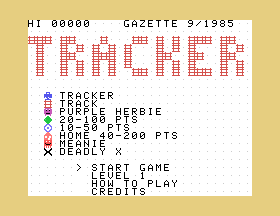 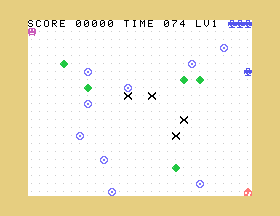 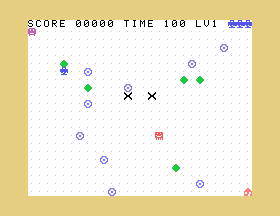 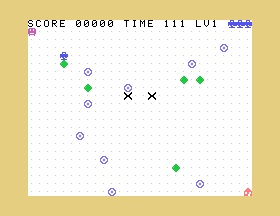 |
|
|
Two tank commanders, three tanks each, face off on an open field, white on the left and yellow on the right. Each round both commanders secretly write ten orders, choosing for each which tank it is for and whether it turns left, turns right, moves one space forward or fires. The orders stay hidden as grey blocks until they run. Then they play out step by step, one from each side a step, with the side that goes first swapping every round. A shell flies to the edge of the field and destroys the first tank in its way, friend or foe; tanks that collide are both destroyed, and orders for a lost tank are wasted. Destroy all three enemy tanks to win. Play a friend or a computer commander that never sees your orders.
Controls: Joystick only. Push up or down to choose which of your tanks the next order is for, left or right to choose turn left, turn right, move, fire or take back the last order, and press a button to write it down. In a one-player game either joystick commands the white tanks; with two players joystick 1 commands white and joystick 2 yellow, with a pass-the-controller screen before each turn. ColecoVision version credited in the source to Claude (an AI made by Anthropic) for Amy Studio, in Amy, the language by Amy Bienvenu, 2026: a reimagined adaptation of the published rules. From COMPUTE!'s Gazette, April 1990, page 35: original Commodore 64 program by Fred Karg. This is a modern homebrew adaptation, not a commercial Coleco release. Original Amy Studio release file: 235 - THINK TANK - by Fred Karg - COMPUTE! Gazette - April 1990.rom |
Amy Studio/Amy Purple (Bienvenu) | 15kb | 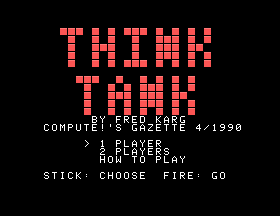 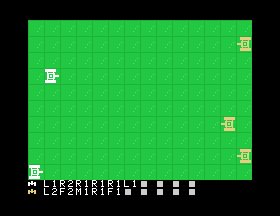 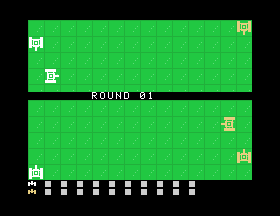 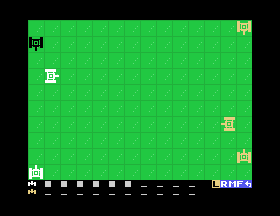 |
|
|
A toy for growing crystals, with a two-player contest added. Plant seeds or monads in up to eight colours on a 16 x 16 grid of water, then let the sun shine. Each generation every crystal grows one stage, from seed to monad to tetrad to shell, and then melts back to water. A tetrad sprouts up to four new seeds of its colour at right angles, but only on open water, out of the shadow of other tetrads and shells, and within the grid. Set the sun's speed, freeze, step one generation, scatter random seeds or turn on TRACE so melted crystals leave a mark. In the two-player game each player picks a colour and plants three crystals; the colour that wipes out the other wins, and a stalemate after 300 generations is a tie.
Controls: Use either controller. In planting, the stick moves the box over the grid, the left button plants the type and colour shown, and the right button switches to the menu (stick up and down to pick, left and right to change). While growing, the menu sets the sun's speed, freezes, steps and adds seeds. The keypad offers shortcuts, but everything can be done with the stick. ColecoVision version credited in the source to Claude (an AI made by Anthropic) for Amy Studio, in Amy, the language by Amy Bienvenu, 2026: a reimagined adaptation of the published rules. From COMPUTE!'s Gazette, January 1984, page 86: original Commodore 64 program by Todd Heimarck. This is a modern homebrew adaptation, not a commercial Coleco release. Original Amy Studio release file: 031 - TETRACRYSTALS OF VELURIA - by Todd Heimarck - COMPUTE! Gazette - January 1984.rom |
Amy Studio/Amy Purple (Bienvenu) | 12kb | 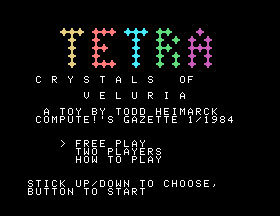 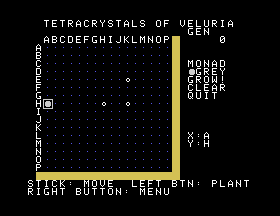 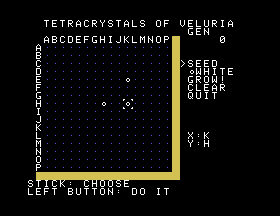 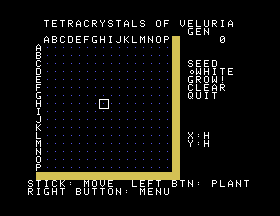 |
|
|
Two tanks face off in a walled field of blockades and mines, and neither ever stops: each keeps rolling the way it last pointed until a block or the wall stops it. Steer in eight directions, squeezing diagonally between blocks, and fire shells that fly up to ten spaces. Driving into a mine or the other tank, or landing a shell on either, sets off a blast that wipes out everything around it, blocks, mines, tanks and even the wall; a gap in the wall lets tanks and shells wrap round to the other side. If both tanks are caught, both score. The field is redrawn every round, and the first to 5 wins. The skill level sets the blocks and mines, and the speed is slow, medium or fast. Play a friend or the computer.
Controls: Joystick only. The stick turns the tank in eight directions and it keeps rolling; either button fires a shell the way the tank points, and holding it fires again as soon as the last shell is spent. In a one-player game either joystick drives the blue tank; with two players joystick 1 drives blue and joystick 2 drives red. ColecoVision version credited in the source to Claude (an AI made by Anthropic) for Amy Studio, in Amy, the language by Amy Bienvenu, 2026: a reimagined adaptation of the published rules. From COMPUTE!'s Gazette, April 1984: original VIC-20 program by Ken Gibbons and Curtis Rich. The article itself was about wiring a second joystick to the VIC-20's user port; the game was its demonstration program. This is a modern homebrew adaptation, not a commercial Coleco release. Original Amy Studio release file: 043 - TANK MANIA (tankm) - by K. Gibbons and C. Rich - COMPUTE! Gazette - April 1984.rom |
Amy Studio/Amy Purple (Bienvenu) | 14kb | 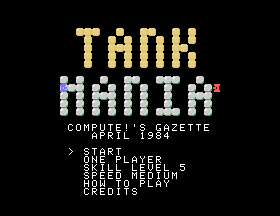 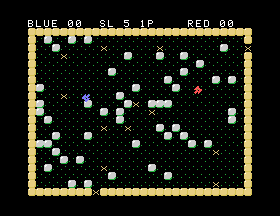 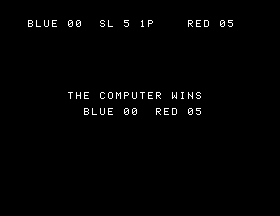 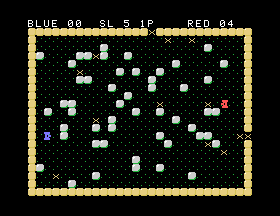 |
|
|
A strategy game on a 5 x 5 board. Yellow and red take turns, and on each turn you either PLACE one of your pieces on an empty square or SHIFT: pick any square and push its whole row left or right, or its whole column up or down, one step, with the piece pushed off the end coming back in at the other end. Shifts move both players' pieces and the empty squares, so a line can be made or broken in one move. You may not undo the last shift. Five of one colour in a row, column or long diagonal wins; five for both players at once is a draw, and so is a game that reaches 150 moves. In ONE PLAYER mode the computer plays red, looking one move ahead.
Controls: Use either controller for whichever player's turn it is. Push left or right to choose PLACE or SHIFT and press a button; move the cursor to a square and press a button; for a shift, push the stick the way the row or column should slide, or press a button to cancel. ColecoVision version credited in the source to Claude (an AI made by Anthropic) for Amy Studio, in Amy, the language by Amy Bienvenu, 2026: a reimagined adaptation of the published rules. From COMPUTE!'s Gazette, June 1986: original Commodore 64 program by Kevin Mykytyn and Mark Tuttle. This is a modern homebrew adaptation, not a commercial Coleco release. Original Amy Studio release file: 122 - SWITCHEROO - by Kevin Mykytyn and Mark Tuttle - COMPUTE! Gazette - June 1986.rom |
Amy Studio/Amy Purple (Bienvenu) | 11kb | 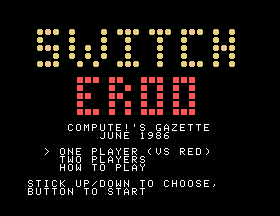 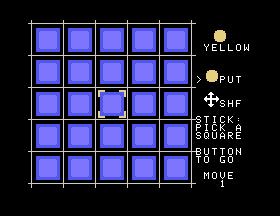 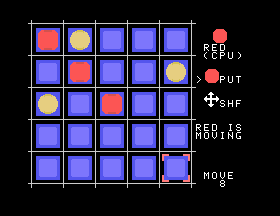 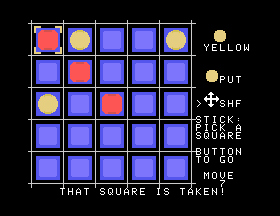 |
|
|
Two survivors duel in a city of 8 x 6 blocks full of monsters. Blue starts in the top-left corner and green in the bottom-right; each has five lives and ten shots a round. Walk the streets and fire the way you last walked. Four monsters wander out from the centre, and a monster, the hunter or a shot that touches a survivor kills him; a shot that meets a monster sends it back to the centre. Bonus signs appear on empty streets and fade: SWAP changes the survivors' places, SPEED doubles your pace, SHOTS refills your shots while you stand on it, and HUNTER sends a hunter that shots cannot stop after your rival. The last one with lives is the SURVIVOR; if both fall together, nobody survives. One player can face the computer.
Controls: Controller 1 walks the blue survivor and controller 2 the green one; in ONE PLAYER mode either controller walks blue. The stick walks and either button fires. On the title, push up and down to choose a line and press a button. ColecoVision version credited in the source to Claude (an AI made by Anthropic) for Amy Studio, in Amy, the language by Amy Bienvenu, 2026: a reimagined adaptation of the published rules. From COMPUTE!'s Gazette, March 1986: original Commodore 64 program (no author named in the issue). The original machine code also ran on the Commodore Plus/4 and 16. This is a modern homebrew adaptation, not a commercial Coleco release. Original Amy Studio release file: 115 - SURVIVOR - by Kevin Mykytyn and Mark Tuttle - COMPUTE! Gazette - March 1986.rom |
Amy Studio/Amy Purple (Bienvenu) | 13kb | 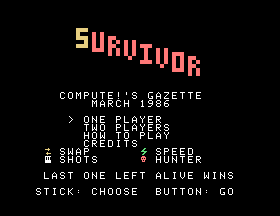 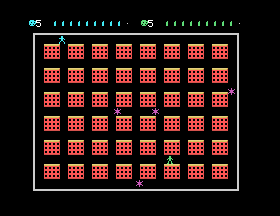 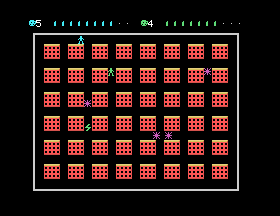 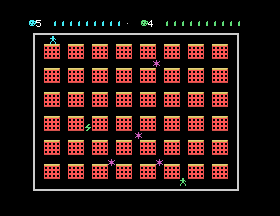 |
|
|
Sixteen coloured blocks hang in space in a 4 x 4 grid, and a sphere bounces from block to block on its own, up, down, left or right. You are the blinking flat square. Wherever you go you leave a trail of four discoloured blocks, your own and the three behind you, and the sphere cannot take off toward a discoloured block; you cannot move onto your trail either. Corner the sphere so that every side of it is a discoloured block or empty space, and you score a point for every unit left on the time bar, then move on to the next screen in new colours. Every third screen the sphere gets faster. If the time bar runs out you take a shock; the third shock ends the game. The high score is kept.
Controls: Use either controller. The stick moves the square one block. On the title, push up and down to choose and press a button to start. ColecoVision version credited in the source to Claude (an AI made by Anthropic) for Amy Studio, in Amy, the language by Amy Bienvenu, 2026: a reimagined adaptation of the published rules. From COMPUTE!'s Gazette, May 1988, page 26: original Commodore 64 program by Eric Haines. This is a modern homebrew adaptation, not a commercial Coleco release. Original Amy Studio release file: 182 - TRAP - by Eric Haines - COMPUTE! Gazette - May 1988.rom |
Amy Studio/Amy Purple (Bienvenu) | 12kb | 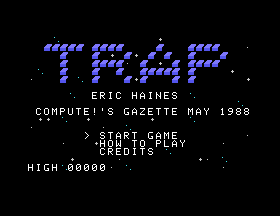 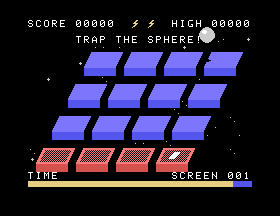 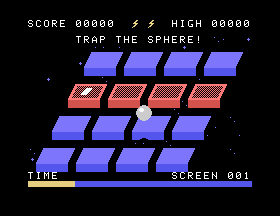 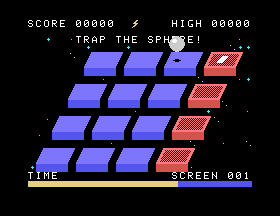 |
|
|
Two submarines duel in a mined sea against the clock. Steer your sub in eight directions and fire torpedoes straight ahead, or diagonally when the stick is held that way. Hitting the other sub scores 5. A destroyer crosses the surface every few seconds and drops depth charges on any sub it passes over; torpedoing it scores 3 and sinks it, but surfacing under it gives your opponent 5, and a depth charge that catches you gives them 3. Twelve mines float at random in the sea, and touching one gives your opponent a point. After any hit both subs go back to their starting corners. Set the speed to slow, medium or fast and the time to 1, 3 or 5 minutes; when time runs out the higher score wins. Play a friend or a computer sub.
Controls: Joystick only. The stick steers your sub in eight directions; either button fires a torpedo, and holding it fires again once the torpedo is spent. In a one-player game either joystick steers the yellow sub on the left; with two players joystick 1 steers the left sub and joystick 2 the right sub. ColecoVision version credited in the source to Claude (an AI made by Anthropic) for Amy Studio, in Amy, the language by Amy Bienvenu, 2026: a reimagined adaptation of the published rules. From COMPUTE!'s Gazette, September 1987: original Commodore 64 program (no author named in the issue). This is a modern homebrew adaptation, not a commercial Coleco release. Original Amy Studio release file: 160 - SUB ATTACK (subatk) - by Tai Bush - COMPUTE! Gazette - September 1987.rom |
Amy Studio/Amy Purple (Bienvenu) | 14kb | 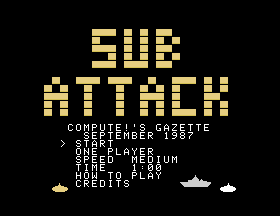 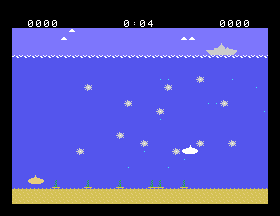 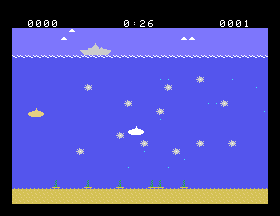 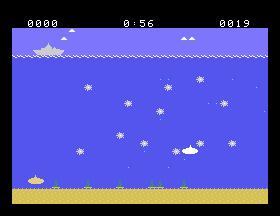 |
|
|
A dragon made of a trail of 15 stars slithers about the sky, and you move the Dragon Gun left and right along the bottom, firing upward. Only a shot on the dragon's head counts: that star falls away and the next one becomes the head. A shot that hits any other star ricochets down at a random slant, and a bouncing shot that reaches the gun destroys it, as does the dragon touching it. You have three guns, and losing one starts the dragon over with all 15 stars. The last star of a dragon is worth 20 points for the first two dragons of a level and 60 for the third. There are ten levels of three dragons, each level faster. A gun that stays still draws the dragon down onto it.
Controls: Use controller 1 or 2. Push left or right to move the gun; press either button to fire, one shot a press. On the title, push up and down to choose START, HOW TO PLAY or CREDITS and press a button. ColecoVision version credited in the source to Claude (an AI made by Anthropic) for Amy Studio, in Amy, the language by Amy Bienvenu, 2026: a reimagined adaptation of the published rules. From COMPUTE!'s Gazette, June 1986, page 54: original Commodore 64 program by Sean D. Wagle. This is a modern homebrew adaptation, not a commercial Coleco release. Original Amy Studio release file: 121 - STAR DRAGON (sdragon) - by Sean D. Wagle - COMPUTE! Gazette - June 1986.rom |
Amy Studio/Amy Purple (Bienvenu) | 12kb | 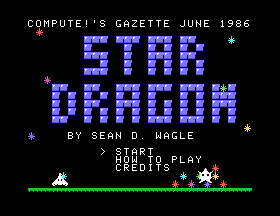 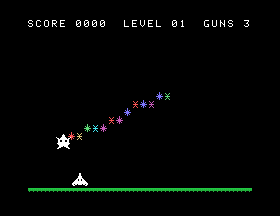 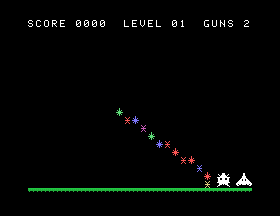 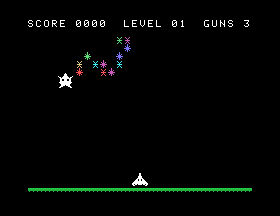 |
|
|
A sliding-tile puzzle. A picture is cut into a 3 x 3 grid, the bottom-right piece is taken out to leave a gap, and the other eight pieces are mixed by sliding them into the gap while you watch. Study the picture first, then slide pieces into the gap one at a time until the picture is whole again, in as few moves as you can. Only a piece next to the gap can move, and each slide counts as one move. Choose from four pictures, BULLSEYE, HAPPY FACE, E and 3-D BOXES, and a mix of 4, 10, 20, 30 or 60 slides; the small mixes suit young children. When every piece is home the last piece drops in and the game shows how many moves you took. The best score for each picture is kept on the title.
Controls: Use either joystick. Push the stick toward the side of the gap where a piece sits and that piece slides into the gap; pushes that move nothing are not counted. On the title, choose the picture and the size of the mix and press a button. ColecoVision version credited in the source to Claude (an AI made by Anthropic) for Amy Studio, in Amy, the language by Amy Bienvenu, 2026: a reimagined adaptation of the published rules. From COMPUTE!'s Gazette, March 1987: original Commodore 128 program by Michael Wiens and Kevin Black. This is a modern homebrew adaptation, not a commercial Coleco release. Original Amy Studio release file: 148 - TILE TRADER (ttrader) - by Michael Wiens and Kevin Black - COMPUTE! Gazette - March 1987.rom |
Amy Studio/Amy Purple (Bienvenu) | 15kb | 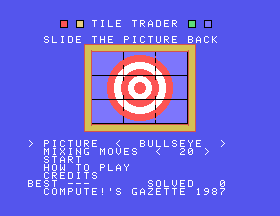 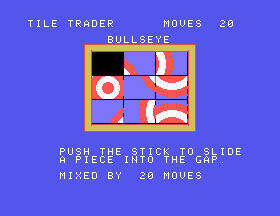 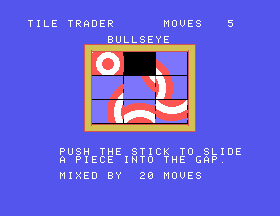 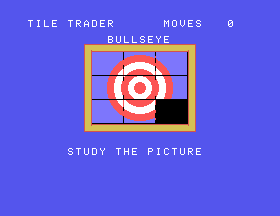 |
|
|
Two hands race along a row of six gumball machines, buying gumballs with coins. Each player starts with five quarters, five dimes, five nickels and five pennies. A coin buys as many gumballs as it is worth in cents, but a machine holds only 26 and gives just what is left when it runs short. Move to SELL to turn your gumballs back into coins, or to CHANGE to break a coin into smaller ones. Each machine takes ten coins, and the two hands cannot share a place. When all 60 slots are full, or no coin goes in for 30 seconds, the game ends. Your score is the gumballs you hold, plus your money in cents, plus every gumball you received. Play a friend or a computer hand at slow, medium or fast speed.
Controls: Joystick only. Push left or right to move your hand along SELL, machines 1 to 6 and CHANGE; push up or down to choose a quarter, dime, nickel or penny; press a button to put the coin in, sell or change. In a one-player game either joystick plays the left hand; with two players joystick 1 is the left (cyan) hand and joystick 2 the right (pink) hand. ColecoVision version credited in the source to Claude (an AI made by Anthropic) for Amy Studio, in Amy, the language by Amy Bienvenu, 2026: a reimagined adaptation of the published rules. From COMPUTE!'s Gazette, November 1987, page 48: original Commodore 128 program by Louis R. Fernandez. This is a modern homebrew adaptation, not a commercial Coleco release. Original Amy Studio release file: 166 - THE GUMBALL RALLY - by Louis R. Fernandez - COMPUTE! Gazette - November 1987.rom |
Amy Studio/Amy Purple (Bienvenu) | 13kb | 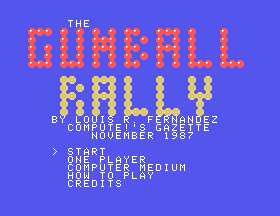 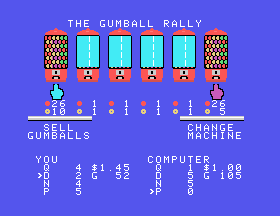 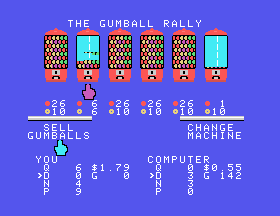 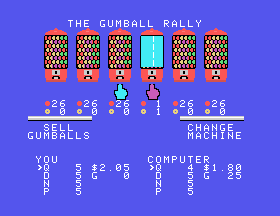 |
|
|
A logic puzzle. Nine black blocks, lettered A to I, sit in a 3 x 3 grid. Each number from 1 to 6 flips three blocks in its own secret way: a black block turns purple and a purple one turns back to black. Choose numbers one at a time, watch which blocks turn over, and work out what each number does, aiming to turn all nine purple in as few turns as you can. Choosing the same number again flips its blocks back and still costs a turn. The patterns are dealt fresh every game, and every board can be solved in three turns. HARDER uses the numbers 1 to 9, with each block belonging to three numbers. The title keeps the best number of turns for each mode and the count of boards solved.
Controls: Use either controller. Push the stick left or right to pick a number and press a button to enter it, or press the number straight on the keypad; on the title, choose the normal game or HARDER. ColecoVision version credited in the source to Claude (an AI made by Anthropic) for Amy Studio, in Amy, the language by Amy Bienvenu, 2026: a reimagined adaptation of the published rules. From COMPUTE!'s Gazette, December 1983: original Commodore 64 program by Andy VanDuyne. This is a modern homebrew adaptation, not a commercial Coleco release. Original Amy Studio release file: 026 - THINKING (think) - by Andy Van Duyne - COMPUTE! Gazette - December 1983.rom |
Amy Studio/Amy Purple (Bienvenu) | 11kb | 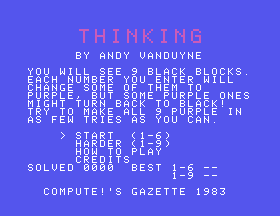 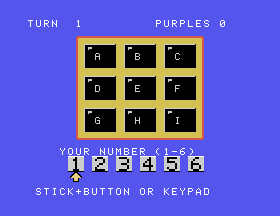 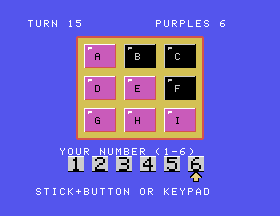 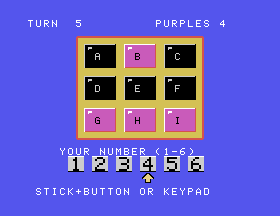 |
|
|
You are an explorer in a pharaoh's tomb, starting at the top left, and the treasure rests in the outer wall at the bottom right. Each turn you may step one cell in any of eight directions unless a block is in the way, and then one of the three guardians, chosen at random, takes a step toward you, unless a block stops it. Step on a guardian, or let one step on you, and you are caught: the game is over. You start each tomb with 500 gold, and every guardian step costs one piece. Reach the treasure and what is left is added to your score, then a new tomb is built and the score carries on. When the gold runs out the tomb is sealed and the guardians pass through the blocks.
Controls: Use either controller. The stick walks in eight directions; hold it to keep walking. On the title, up and down choose and a button starts. ColecoVision version credited in the source to Claude (an AI made by Anthropic) for Amy Studio, in Amy, the language by Amy Bienvenu, 2026: a reimagined adaptation of the published rules. From COMPUTE!'s Gazette, October 1984, page 58: original Commodore 64 program by Mike Scharland. This is a modern homebrew adaptation, not a commercial Coleco release. Original Amy Studio release file: 062 - THE TOMB - by MIKE SCHARLAND - COMPUTE! Gazette - October 1984.rom |
Amy Studio/Amy Purple (Bienvenu) | 8kb | 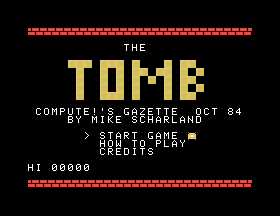 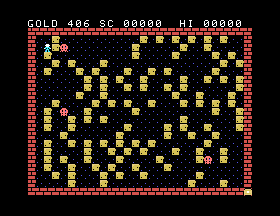 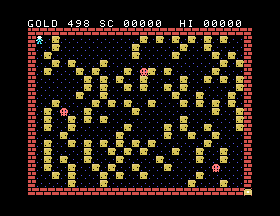 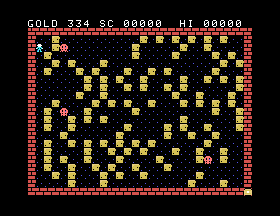 |
|
|
A worker walks the floor of a walled factory strewn with ice blocks while four sparks chase him. Walk into a block and, if the cell behind it is free, it slides until it hits something; if it hits a spark, the spark is frozen for 1,000 points. If the cell behind is a wall, a block or a spark, the block is crushed for 10 points. A frozen spark thaws after a second. A spark that reaches the worker, or a worker who walks into one, costs a life. Four freezes clear the level, with 25 points for each block left, a time bonus, an extra life and more blocks for next time. The clock counts down from 60 and runs faster each level; at zero, or with the last life gone, the game is over.
Controls: Use either controller. The stick walks the worker (hold it to keep walking) and pushes the blocks. A button starts from the title. ColecoVision version credited in the source to Claude (an AI made by Anthropic) for Amy Studio, in Amy, the language by Amy Bienvenu, 2026: a reimagined adaptation of the published rules. From COMPUTE!'s Gazette, June 1985, page 54: original Commodore 64 program by Clarence Din. This is a modern homebrew adaptation, not a commercial Coleco release. Original Amy Studio release file: 092 - THE FREEZE FACTORY - by CLARENCE DIN - COMPUTE! Gazette - June 1985.rom |
Amy Studio/Amy Purple (Bienvenu) | 10kb | 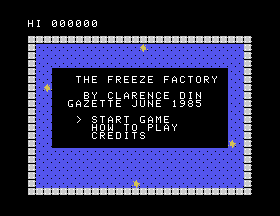 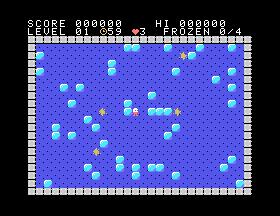 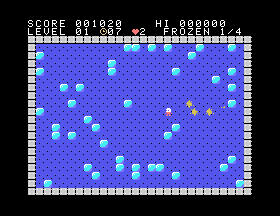 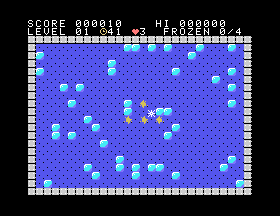 |
|
|
A fisherman stands at one end of his sailboat's deck, and one danger comes at a time, at random: a shark swimming in from the left or the right, or a raindrop falling on the left or right end of the boat. Go to that end and press the button at the right moment: against a shark you swing the oar down into the water for 75 points, and against rain you open the umbrella for 50. The oar can be swung as often as you like, but the umbrella can be raised only three times for each drop. A shark that reaches the boat, or a drop that reaches the fisherman or the deck, costs a fisherman. You start with three and earn one more every 2,000 points; each one speeds the dangers up. Choose one of four speeds.
Controls: Use either controller. Push left or right to go to that end of the boat, and press either button to swing the oar or open the umbrella. On the title, up and down choose, left and right change the speed, and a button starts. ColecoVision version credited in the source to Claude (an AI made by Anthropic) for Amy Studio, in Amy, the language by Amy Bienvenu, 2026: a reimagined adaptation of the published rules. From COMPUTE!'s Gazette, June 1984, page 58: original Commodore 64 program by David Lacey. This is a modern homebrew adaptation, not a commercial Coleco release. Original Amy Studio release file: 051 - THE FRANTIC FISHERMAN - by DAVID LACEY - COMPUTE! Gazette - June 1984.rom |
Amy Studio/Amy Purple (Bienvenu) | 10kb | 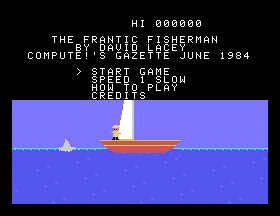 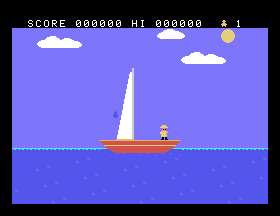 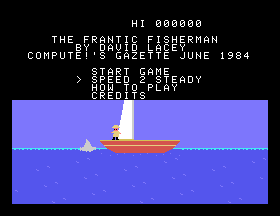 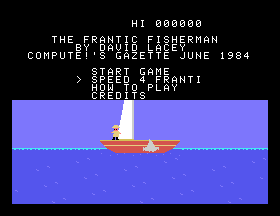 |
|
|
Someone has stolen the king's magic sword and hidden it in the enchanted land of dreams, and you walk screen by screen through forest, graveyard and castle to find it. Before leaving you may take magic items: the Boots of Brickwalking, the Wand of Secrets, the Singing Globe that sings higher nearer the sword, the Holy Cross, the Wand of the Way, the Purple and Blue Keys, an Axe and a Torch. More lie about the land, along with illusions and a globe of lies. Fluffers, a brick monster, creeping eyes, a bobcat, zombies and a blue thief roam the land, and the yellow disease reverses your steps. The true sword lies among three deadly false swords, all alike unless you carry the Wand of the Way. Touch the true one to win. You have four dream chances.
Controls: The stick moves you; diagonals do nothing. Either button freezes the monsters if you carry the cross; hold it for one second to give up. On the menus, up and down choose and a button selects. ColecoVision version credited in the source to Claude (an AI made by Anthropic) for Amy Studio, in Amy, the language by Amy Bienvenu, 2026: a reimagined adaptation of the published rules. From COMPUTE!'s Gazette, May 1985: original VIC-20 program by Brent Lackie. This is a modern homebrew adaptation, not a commercial Coleco release. Original Amy Studio release file: 089 - THE ENCHANTED JOURNEY (ejourn) - by BRENT LACKIE - COMPUTE! Gazette - May 1985.rom |
Amy Studio/Amy Purple (Bienvenu) | 16kb | 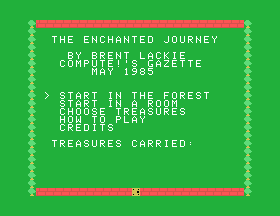 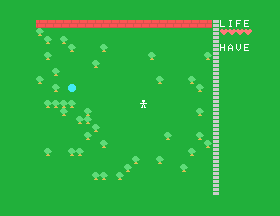 |
|
|
A hero explores a crypt of four tomb chambers, each guarded by four creatures of one kind: snakes, spiders, ghouls or bats. From the corridors, step into a door to enter a chamber; the door seals behind you, and the way out is the door on the far side. The creatures close in; the button throws a magic bolt the way you last walked, three a visit, one in the air at a time. A bolt that meets a creature ends it for 10 points, and the others speed up. Touch the chamber's treasure, a chest, chalice, shield or urn, to take it for 300 points. A creature's touch costs a life and the treasure from that visit. All four treasures out begins the next level; every fourth level gives a life and speeds everything up. You have five lives.
Controls: Use either controller. The stick walks and either button throws a bolt; hold it for one every half second. On the title, up and down choose a line and a button starts or shows the credits. ColecoVision version credited in the source to Claude (an AI made by Anthropic) for Amy Studio, in Amy, the language by Amy Bienvenu, 2026: a reimagined adaptation of the published rules. From COMPUTE!'s Gazette, February 1985, page 52: original Commodore 64 program by Ted Reynolds. This is a modern homebrew adaptation, not a commercial Coleco release. Original Amy Studio release file: 079 - THE FORBIDDEN CRYPT - by Ted Reynolds - COMPUTE! Gazette - February 1985.rom |
Amy Studio/Amy Purple (Bienvenu) | 11kb | 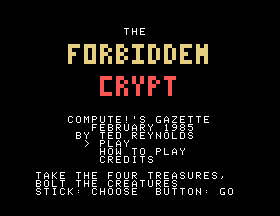 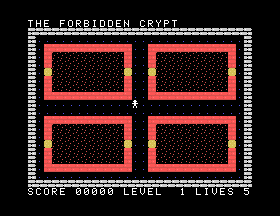 |
|
|
A farm management simulation. You run a 200-acre farm of five 40-acre fields for 1 to 25 years, starting with $20,000 in the bank. Each year you may read the market news and your finances and sell stored grain on the futures market, then plant wheat, corn or soybeans in each field and choose how much insecticide and herbicide to spread. The weather and the pests decide the yield, and the market decides the price. Planting the same crop twice running yields less, while wheat or corn after soybeans yields more. At harvest you sell what you want and store the rest, pay at least a third of your loan and pay the bills; a shortfall is covered by a loan at 12 percent up to $50,000, and beyond that you are bankrupt. Finish with $20,000 or more to win.
Controls: Use either controller. Push up and down to choose, left and right to change, and press a button to accept. When setting an amount, the right button jumps to the maximum (then the minimum) and the left button accepts. The keypad is not used. ColecoVision version credited in the source to Claude (an AI made by Anthropic) for Amy Studio, in Amy, the language by Amy Bienvenu, 2026: a reimagined adaptation of the published rules. From COMPUTE!'s Gazette, October 1985, page 44: original Commodore 64 program by Daniel M. Seurer. This is a modern homebrew adaptation, not a commercial Coleco release. Original Amy Studio release file: 101 - THE FARM GAME - by Daniel M. Seurer - COMPUTE! Gazette - October 1985.rom |
Amy Studio/Amy Purple (Bienvenu) | 31kb | 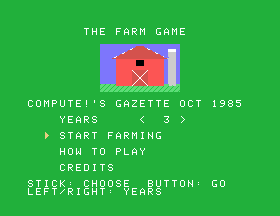 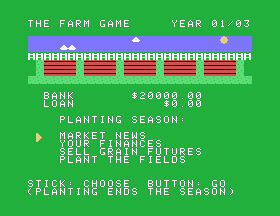  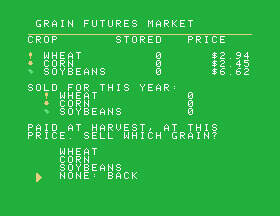 |
|
|
The First Annual Great Lakes Fish Off: two anglers walk the bank of a lake, cast where small ripples show a fish, and reel it in. Push the stick forward to cast, and the line runs out for as long as you hold it; once you let go it can only come in. Pull back to reel, and a fish bites when the end of the line passes it on the way in. Each catch adds a tally mark, and the first angler to eight catches wins. On the title, three hazard slots each add another fish, a clump of seaweed or a speedboat. Seaweed on the line must be landed before anything else will bite, and a speedboat that runs over your line hauls you into the drink to swim back. Play a friend or a computer angler.
Controls: Joystick only. Push left or right to walk along the bank (only while the line is in), push forward to cast and pull back to reel in. With one player, either joystick plays the blue angler on the left and the computer fishes on the right; with two, joystick 1 plays the left angler and joystick 2 the right. ColecoVision version credited in the source to Claude (an AI made by Anthropic) for Amy Studio, in Amy, the language by Amy Bienvenu, 2026: a reimagined adaptation of the published rules. From COMPUTE!'s Gazette, March 1989, page 38: original Commodore 64 program by Tai Bush. This is a modern homebrew adaptation, not a commercial Coleco release. Original Amy Studio release file: 211 - THE ANGLERS - by Tai Bush - COMPUTE! Gazette - March 1989.rom |
Amy Studio/Amy Purple (Bienvenu) | 13kb | 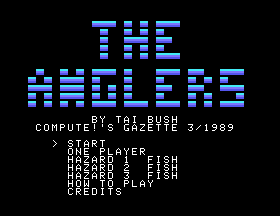 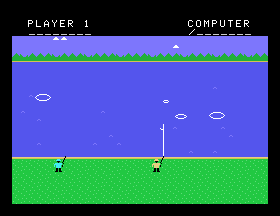 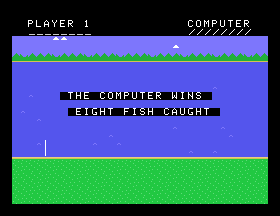 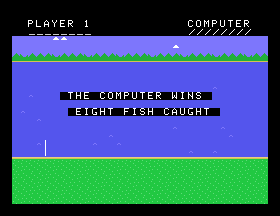 |
|
|
A sliding-tile puzzle on a six-by-six board of 36 square pieces. The computer mixes them with three random moves for each level, from 1 to 9, and you put them back so the board matches the pattern shown at the side. There are four games. In SHIFTS a row or column slides one piece along, the end piece wrapping round, until each row holds one colour again. SHUFFLE uses the same moves, but the pieces are lettered and numbered and every one must go back to its own square. ROTATE 1 turns a two-by-two block of four pieces, and ROTATE 2 turns the eight pieces round a three-by-three block. A timer runs and every move is counted. Hold the button and the computer solves it, which ends the game.
Controls: Use either controller. The stick moves the cursor; hold it to repeat. In SHIFTS and SHUFFLE, hold the button and push the stick to slide the cursor's row or column; in the ROTATE games, the button with right turns the block clockwise and with left anticlockwise. Hold the button alone for two seconds and the computer solves it. On the title, up and down choose GAME, LEVEL or START, left and right change, and a button starts. ColecoVision version credited in the source to Claude (an AI made by Anthropic) for Amy Studio, in Amy, the language by Amy Bienvenu, 2026: a reimagined adaptation of the published rules. From COMPUTE!'s Gazette, June 1988: original Commodore 128 program (no author named in the issue). This is a modern homebrew adaptation, not a commercial Coleco release. Original Amy Studio release file: 187 - SQUARE LOGIX - by Leonard Morris - COMPUTE! Gazette - June 1988.rom |
Amy Studio/Amy Purple (Bienvenu) | 11kb | 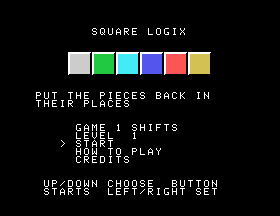 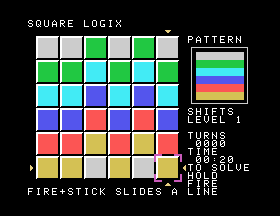 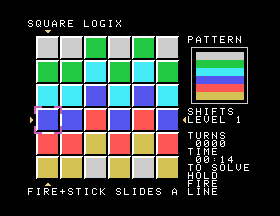 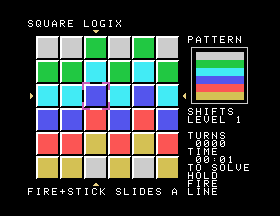 |
|
|
Two hovercraft, one blue and one green, duel in a walled arena with six spheroids. Push the stick to build up speed; the craft drifts, slows with friction and bounces faster off the walls. Mounds in the floor push things away, depressions push and pull, and a swirling teleporter throws whatever crosses it to a random place. Touch a plain red spheroid to pick it up, then press the button with a direction to throw it. A thrown spheroid takes your colour and is armed for a while, bouncing faster and faster; if it touches the other craft, that craft blows up and the round restarts. Each player has nine craft, and the one who loses all nine loses the battle. Choose OPEN, LATTICE, DIAMONDS, CYCLONE, QUADRATE or RANDOM, and play a friend or the computer at EASY or NORMAL.
Controls: Controller 1 drives the blue craft and controller 2 the green; in ONE PLAYER mode either controller drives blue. The stick pushes the craft, and a button with a direction throws the spheroid you carry. On the title, up and down choose a line, left and right change it, and a button starts. ColecoVision version credited in the source to Claude (an AI made by Anthropic) for Amy Studio, in Amy, the language by Amy Bienvenu, 2026: a reimagined adaptation of the published rules. From COMPUTE!'s Gazette, June 1990, page 34: original Commodore 64 program by Kevin Dixon. This is a modern homebrew adaptation, not a commercial Coleco release. Original Amy Studio release file: 239 - SPHEROIDS - by Kevin Dixon - COMPUTE! Gazette - June 1990.rom |
Amy Studio/Amy Purple (Bienvenu) | 14kb | 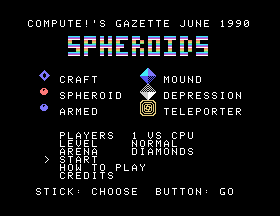 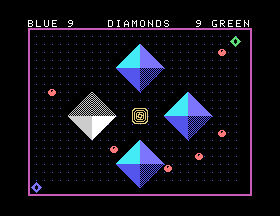 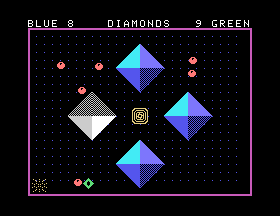 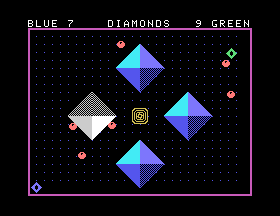 |
|
|
Four snakes crawl over a grid of dots, drawing lines as they go, and whoever draws the fourth side of a square fills it and scores it. You do not steer a snake move by move; you program it. A snake looks at which sides around its dot already have lines, and the first time it meets a situation it asks you WHICH WAY?. From then on it always goes that way in that situation by itself. Each turn a snake makes up to ten moves by its rules, and answering a new question ends its turn. Each snake can be a player or the computer. The game ends when every snake is going round in circles, when nothing new is drawn for three rounds, or when every square is filled. The most squares wins.
Controls: Use either controller. The stick answers WHICH WAY?, and the stick and a button drive the menus. The keypad is not used. ColecoVision version credited in the source to Claude (an AI made by Anthropic) for Amy Studio, in Amy, the language by Amy Bienvenu, 2026: a reimagined adaptation of the published rules. From COMPUTE!'s Gazette, June 1985: original Commodore 64 program (no author named in the issue). This is a modern homebrew adaptation, not a commercial Coleco release. Original Amy Studio release file: 091 - SQUARES - by Douglas Fish - COMPUTE! Gazette - June 1985.rom |
Amy Studio/Amy Purple (Bienvenu) | 9kb | 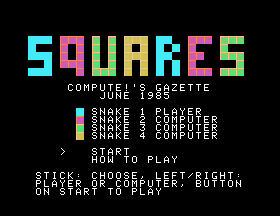 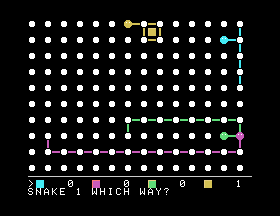 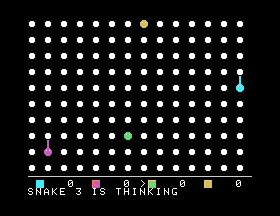 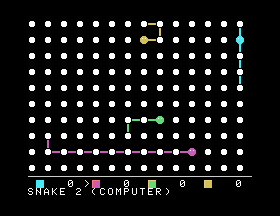 |
|
|
Spies wait on the left cliff of an alien prison camp, kept in by a pit. You fly the Laser Striker: shoot the aliens that chase it, dock with the supply satellite crossing the top for bricks and repairs, and drop bricks into the pit until the bridge is complete. Then the spy walks across and the next, wider pit begins. Aliens that collide with the craft damage it, and the cyan and blue ones drop charges that break bricks. The craft's colour shows its damage, from grey to yellow to flashing red; at 100 percent it sinks and crashes, ending the game. Aliens score 5 to 50 points, a brick 20, a bridge 200 and a spy across 750 times the pit number. Cross all eight pits and the spy reaches base for 10,000 points.
Controls: Use controller 1 or 2. The stick flies the craft, which sinks slowly when left alone. The button with left or right fires the phaser that way, and the button with down drops a brick; the left button alone fires the way the craft last moved and the right button alone drops a brick. Release the button between shots or drops. ColecoVision version credited in the source to Claude (an AI made by Anthropic) for Amy Studio, in Amy, the language by Amy Bienvenu, 2026: a reimagined adaptation of the published rules. From COMPUTE!'s Gazette, April 1988, page 24: original Commodore 64 program by John Dalton. This is a modern homebrew adaptation, not a commercial Coleco release. Original Amy Studio release file: 180 - SPY DEFENSE (spydef) - by John Dalton - COMPUTE! Gazette - April 1988.rom |
Amy Studio/Amy Purple (Bienvenu) | 13kb | 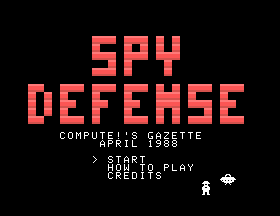 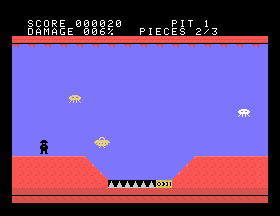 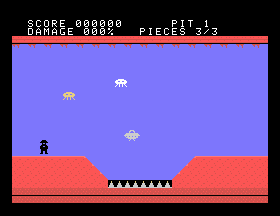 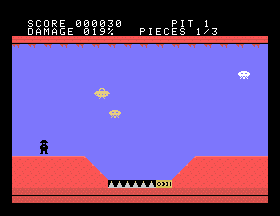 |
|
|
Your tank is stranded in the desert, out of fuel, and enemy soldiers and jeeps close in from the horizon on every side. Push left or right to swivel the turret all the way round as the ridge line slides past, and up or down to raise or lower the gun: the higher it points, the farther the shell bursts, and a small mark shows where it will land. A shell that bursts on an enemy destroys it for 25 points, and a new one appears on the horizon. Each kill makes the enemies a little faster. An enemy that gets close fires a warning burst in front of your tank on its side; one that gets closer still destroys the tank. You have three tanks. Choose level 1 to 3 to set the enemies' speed.
Controls: Use controller 1 or 2. Push left or right to turn the turret, up to raise the gun (farther) and down to lower it (nearer); either button fires. On the title, up and down choose the level and a button starts. ColecoVision version credited in the source to Claude (an AI made by Anthropic) for Amy Studio, in Amy, the language by Amy Bienvenu, 2026: a reimagined adaptation of the published rules. From COMPUTE!'s Gazette, February 1989, page 26: original Commodore 64 program by Anthony Bertram. This is a modern homebrew adaptation, not a commercial Coleco release. Original Amy Studio release file: 209 - TANK AMBUSH - by Anthony Bertram - COMPUTE! Gazette - February 1989.rom |
Amy Studio/Amy Purple (Bienvenu) | 12kb | 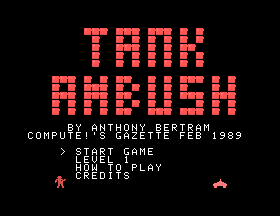 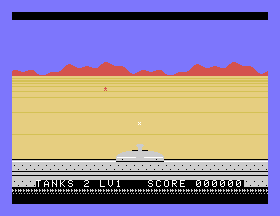 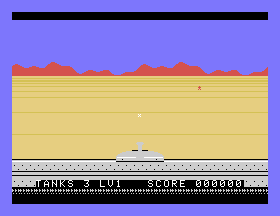 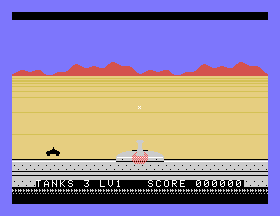 |
|
|
You sit in your tank behind a gunsight while enemy tanks drive across the battlefield from the left, each on a row of its own. Move the sight and fire: your shell leaves the gun barrel and flies straight to the sight, shrinking as it goes, then bursts there, so you must lead the target. A tank under the sight when the shell bursts is destroyed for 10 points. A tank that gets all the way across fires at you and costs one point of armor. First choose your tank: the TIGER has strong armor but a slow sight, the SHERMAN weak armor but a fast sight, the T-34 between. Enemies speed up as you score. With no armor left the screen cracks, a survival bonus is added and your rank, from TRAITOR to MARSHAL, is shown.
Controls: Use either controller. The stick moves the sight and either button fires; it may be held down. On the title and the tank choice, up and down choose and a button starts. ColecoVision version credited in the source to Claude (an AI made by Anthropic) for Amy Studio, in Amy, the language by Amy Bienvenu, 2026: a reimagined adaptation of the published rules. From COMPUTE!'s Gazette, November 1984, page 64: original Commodore 64 program (no author named in the issue). This is a modern homebrew adaptation, not a commercial Coleco release. Original Amy Studio release file: 067 - SUPERTANK - by Boris Litinsky - COMPUTE! Gazette - November 1984.rom |
Amy Studio/Amy Purple (Bienvenu) | 12kb | 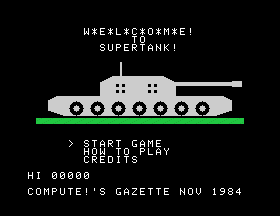 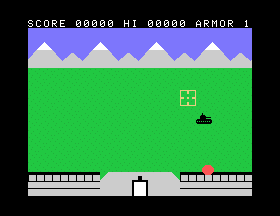 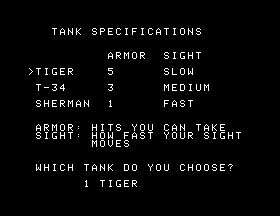 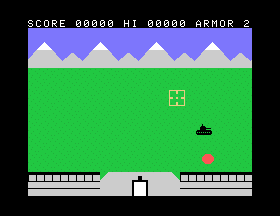 |
|
|
An educational quiz on the 50 United States and their capitals. Each question asks either for the capital of a state or for the state a capital belongs to. Slide the pencil down a list of six answers and press the button to pick one; a green tick marks the right answer and a red cross a wrong pick. A right answer takes the state out of the round. A wrong answer shows the right one and the state stays in to be asked again, and so does HELP, the seventh line, which simply shows the answer. The right, wrong and help counts are kept after every question, with the number of states to go. Rounds of 10, 25 or all 50 states. Finish with no wrongs and no helps for a perfect score.
Controls: Use either controller. Push up and down to move the pencil and press either button to answer or go on. On the title, up and down choose START, HOW TO PLAY or CREDITS, left and right set the number of states, and a button goes. The keypad is not used. ColecoVision version credited in the source to Claude (an AI made by Anthropic) for Amy Studio, in Amy, the language by Amy Bienvenu, 2026: a reimagined adaptation of the published rules. From COMPUTE!'s Gazette, September 1983, page 82: original Commodore 64 program (no author named in the issue). This is a modern homebrew adaptation, not a commercial Coleco release. Original Amy Studio release file: 011 - STATES & CAPITALS TUTOR - by Enoch L. Moser - COMPUTE! Gazette - September 1983.rom |
Amy Studio/Amy Purple (Bienvenu) | 9kb | 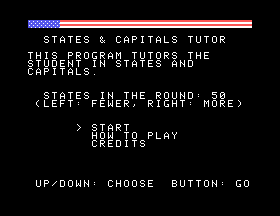 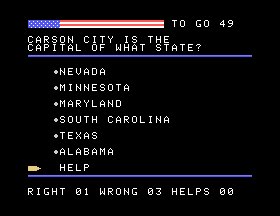 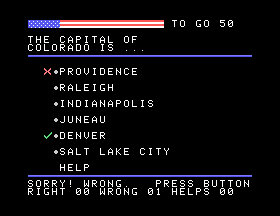 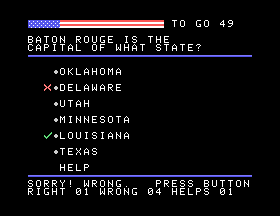 |
|
|
An educational spelling game. Critter, a purple fuzzball with antennae that writes as it crawls, shows you a word for a moment and then asks HOW DO YOU SPELL THAT WORD? Turn the letter wheel with the stick and press the button to pick each letter, then pick the check mark when you are done. Push up to see the word again, which wipes what you picked, or down to erase the last letter. You get one try a word: a right answer brings THAT IS RIGHT, VERY GOOD!, a wrong one shows the correct spelling. Choose a game of 8 or 16 words, drawn from 48 built-in everyday words, easier ones first. At the end Critter shows how many you got right and wrong and says goodbye.
Controls: Use either controller. The stick turns the letter wheel, up shows the word again and down erases the last letter; either button picks. The keypad is not used. ColecoVision version credited in the source to Claude (an AI made by Anthropic) for Amy Studio, in Amy, the language by Amy Bienvenu, 2026: a reimagined adaptation of the published rules. From COMPUTE!'s Gazette, June 1984: original Commodore 64 program (no author named in the issue). This is a modern homebrew adaptation, not a commercial Coleco release. Original Amy Studio release file: 050 - SPELLING CRITTER - by Bob Nickel - COMPUTE! Gazette - June 1984.rom |
Amy Studio/Amy Purple (Bienvenu) | 9kb | 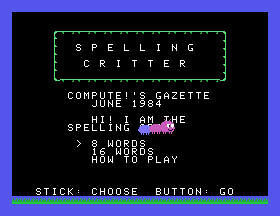 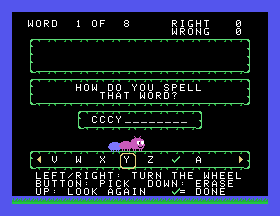 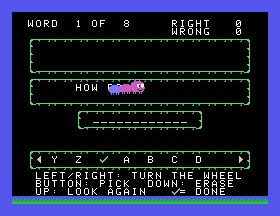 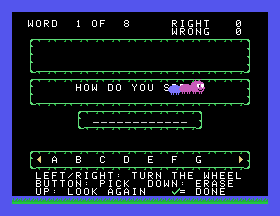 |
|
|
A falling-block puzzle turned on its side. Each piece appears in the middle of the box and drifts left or right a column at a time until it hits the wall or the blocks already there. Move it up and down, turn it, or drop it at once. A column filled from top to bottom vanishes for 10 points, and the blocks between it and the middle close up toward the wall; each piece placed scores 1. The game ends when a new piece cannot move from where it appears. Title settings change the game: DIFFICULTY and SPEED from 1 to 19, pieces that turn by themselves, a box that rolls up a row before every piece, and single-sided play where every piece goes left. New kinds of piece appear and the steps quicken as you play.
Controls: Joystick only. Push up and down to move the piece, press the left button to turn it and the right button, or push the stick the way the piece is going, to drop it. In DOUBLE-SIDED games, hold left or right as a piece appears to send it that way. On the title, up and down choose a line, left and right change a setting, and a button starts. ColecoVision version credited in the source to Claude (an AI made by Anthropic) for Amy Studio, in Amy, the language by Amy Bienvenu, 2026: a reimagined adaptation of the published rules. From COMPUTE!'s Gazette, February 1990: original Commodore 64 program (no author named in the issue). This is a modern homebrew adaptation, not a commercial Coleco release. Original Amy Studio release file: 231 - QEWB - by Author not named - COMPUTE! Gazette - February 1990.rom |
Amy Studio/Amy Purple (Bienvenu) | 10kb | 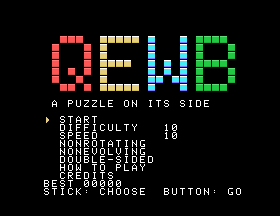 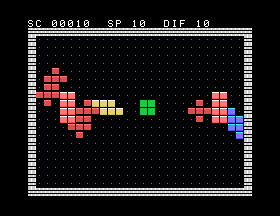 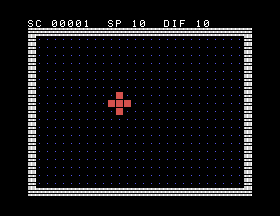 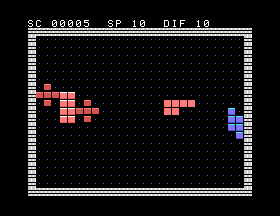 |
|
|
A space worm of six round segments loops across the sky, and your dart-shaped ship moves in a band at the bottom of the screen, firing one shot at a time straight up. Each shot that hits the worm scores 1 point, and every eight hits the worm loses its tail segment for 10 points. When the head goes the level is cleared for 100 points, and a new worm arrives on a new path, in new colours and often stretched longer. From time to time the worm's head drops a spore aimed at your ship; a shot destroys a spore, and a ship that keeps moving dodges them. Touching the worm or a spore costs a ship, and you have five.
Controls: Use controller 1 or 2. The stick moves the ship and either button fires; hold it for a stream of single shots. On the title, up and down choose START, HOW TO PLAY or CREDITS, and a button chooses. ColecoVision version credited in the source to Claude (an AI made by Anthropic) for Amy Studio, in Amy, the language by Amy Bienvenu, 2026: a reimagined adaptation of the published rules. From COMPUTE!'s Gazette, April 1989: original Commodore 64 program (no author named in the issue). Known from the April 1989 disk; no printed page or article has been identified. This is a modern homebrew adaptation, not a commercial Coleco release. Original Amy Studio release file: 213 - SPACE WORMS - by Author not named - COMPUTE! Gazette - April 1989.rom |
Amy Studio/Amy Purple (Bienvenu) | 14kb | 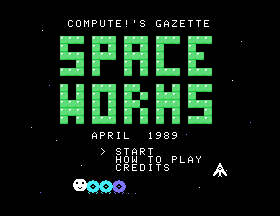 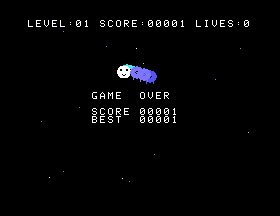 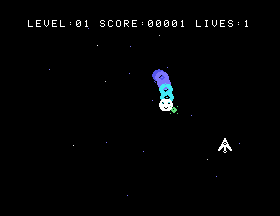 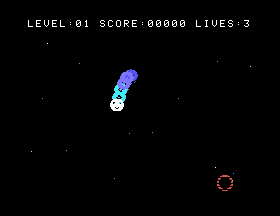 |
|
|
One-on-one ice hockey seen from above. Each side has a skater and a goalie: the stick steers your skater and moves your goalie up and down at the same time. Skate over the loose puck to take it, then hold the button to wind up a shot and let go to shoot; the longer the wind-up, the harder the shot, and a full slap shot lifts the puck over the sticks. Without the puck, the button body-checks the other skater, knocking the puck loose and costing him balance; a skater knocked down must recover before he can skate again. Blue shoots at the right goal, red at the left. Play a TIME game of 1 to 99 minutes or a GOAL game of 1 to 99 goals against a friend or the computer; a tied timed game goes to OVERTIME.
Controls: Controller 1 plays blue; controller 2 or the computer plays red. The stick skates and moves your goalie up and down; the button shoots (hold it to wind up) or, without the puck, body-checks. On the title, up and down choose a line, left and right change it, and a button on TIME GAME or GOAL GAME starts. ColecoVision version credited in the source to Claude (an AI made by Anthropic) for Amy Studio, in Amy, the language by Amy Bienvenu, 2026: a reimagined adaptation of the published rules. From COMPUTE!'s Gazette, October 1989: original Commodore 64 program by John Fedor. This is a modern homebrew adaptation, not a commercial Coleco release. Original Amy Studio release file: 224 - SLAP SHOT - by JOHN FEDOR - COMPUTE! Gazette - October 1989.rom |
Amy Studio/Amy Purple (Bienvenu) | 18kb |   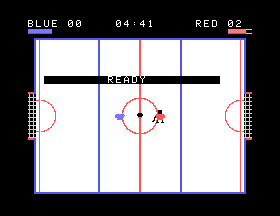 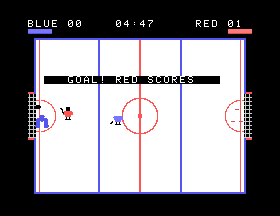 |
|
|
Two arrowhead ships, one blue and one green, duel in a walled arena with four rocks in a column down the middle. Turn your ship through sixteen headings and thrust; it keeps drifting with no friction and bounces off the walls. Shots bounce off the walls too, and you have one at a time: you can fire again only when it has run its course, even after a hit. A hit on the other ship scores 1 point and kicks it along. A ship that touches a rock explodes and the other player scores 20, then everything goes back to its start. The match lasts one to five minutes at one of three speeds, and the higher score wins. Play a friend or, in ONE PLAYER mode, a computer pilot in the green ship.
Controls: Controller 1 flies the blue ship and controller 2 the green ship; in ONE PLAYER mode either controller flies the blue ship. Push left and right to turn, up to thrust, and press either button to fire. On the title, up and down choose a line, left and right change it, and a button starts. ColecoVision version credited in the source to Claude (an AI made by Anthropic) for Amy Studio, in Amy, the language by Amy Bienvenu, 2026: a reimagined adaptation of the published rules. From COMPUTE!'s Gazette, January 1986, page 48: original Commodore 64 program by Bryan Files. This is a modern homebrew adaptation, not a commercial Coleco release. Original Amy Studio release file: 109 - SPACE ARENA - by Bryan Files - COMPUTE! Gazette - January 1986.rom |
Amy Studio/Amy Purple (Bienvenu) | 14kb |  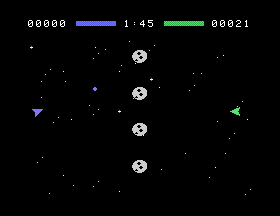 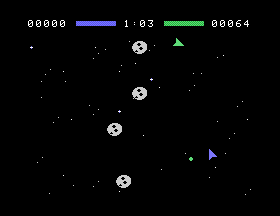 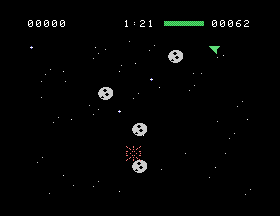 |
|
|
One or two snakes slither around a walled pit with five minutes on the clock. Mice run out of six holes in the walls; steer your snake onto them to eat them, scoring 30 points and growing one longer each time. A snake never stops moving, and running into a wall or a snake, your own included, ends the round: the pit is set up again while the clock keeps running. With two players a crash gives the other player 20 points; alone you lose only time. Nothing moves until the stick is pushed. Choose one of five speeds on the title. When the clock runs out the game ends, and with two players the winner is named.
Controls: With one player, use either controller; with two, player 1 uses controller 1 and player 2 controller 2. The stick steers. On the title, up and down choose a line, left and right change it, and a button starts or shows HOW TO PLAY or the credits. ColecoVision version credited in the source to Claude (an AI made by Anthropic) for Amy Studio, in Amy, the language by Amy Bienvenu, 2026: a reimagined adaptation of the published rules. From COMPUTE!'s Gazette, December 1987: original Commodore 64 program (no author named in the issue). This is a modern homebrew adaptation, not a commercial Coleco release. Original Amy Studio release file: 170 - SNAKE PIT - by Michael L. Hall - COMPUTE! Gazette - December 1987.rom |
Amy Studio/Amy Purple (Bienvenu) | 12kb | 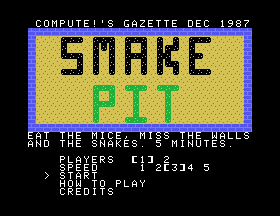 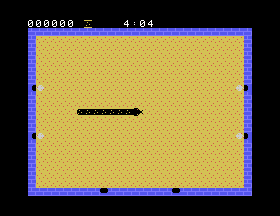 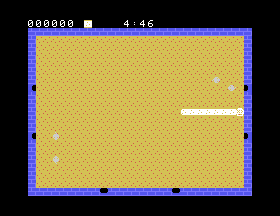 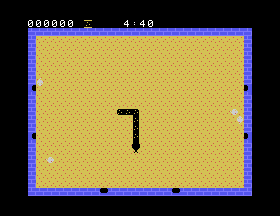 |
|
|
A four-in-a-row strategy game against the computer on a rack of eight slots, each eight places deep. Choose a slot and your piece drops to the lowest free place in it. You win with four of your pieces in a line, across, up and down or diagonally, or by putting a piece in the top row, marked in red; the computer wins the same ways, so the top row matters as much as any line. Before each game you choose who goes first and the level, from 1 to 4, which sets how many moves the computer looks ahead; at level 4 it can think for a few seconds. A match is first to three games, with the score shown.
Controls: Use controller 1. Push left or right to choose a slot and press a button to drop the piece. In the menus, up and down choose a line, left and right change it, and a button picks. ColecoVision version credited in the source to Claude (an AI made by Anthropic) for Amy Studio, in Amy, the language by Amy Bienvenu, 2026: a reimagined adaptation of the published rules. From COMPUTE!'s Gazette, August 1986: original Commodore 64 program (no author named in the issue). This is a modern homebrew adaptation, not a commercial Coleco release. Original Amy Studio release file: 128 - SLOTS - by Roger Sliva - COMPUTE! Gazette - August 1986.rom |
Amy Studio/Amy Purple (Bienvenu) | 10kb | 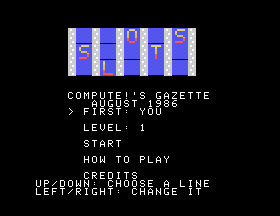 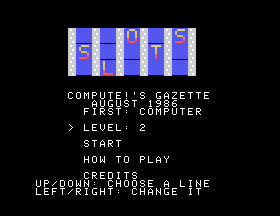 |
|
|
In 2023 you man a laser cannon on the launch deck of an orbiting colony. Four frisboids fly the same looping path one behind the other, dropping pellets, at most three at a time. Slide the cannon left and right and fire upward; a shot flies on through what it hits. Each frisboid is worth 5 points, and shooting all four clears the wave. Five waves make a level, followed by a SHOT BONUS of 5 points for each shot under 60 fired in it. A pellet on the cannon costs one of your five cannons and restarts the wave on a new path; you gain one more cannon on reaching level 5. With the HEAT SEEKER option switched on, from level 4 a blue pellet homes in on the cannon. The game ends when the last cannon is lost.
Controls: Use either controller. Push left or right to move the cannon and press either button to fire; hold it to keep firing. On the title, up and down choose PLAY, HEAT SEEKER or CREDITS, and a button confirms or switches HEAT SEEKER on or off. ColecoVision version credited in the source to Claude (an AI made by Anthropic) for Amy Studio, in Amy, the language by Amy Bienvenu, 2026: a reimagined adaptation of the published rules. From COMPUTE!'s Gazette, July 1985, page 46: original Commodore 64 program by Jeff A. Lapkoff. This is a modern homebrew adaptation, not a commercial Coleco release. Original Amy Studio release file: 094 - SPACE GALLERY - by Jeff A. Lapkoff - COMPUTE! Gazette - July 1985.rom |
Amy Studio/Amy Purple (Bienvenu) | 10kb | 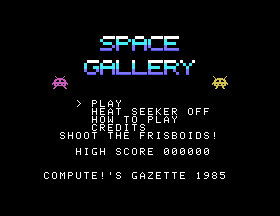 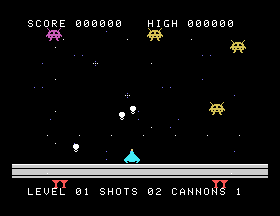 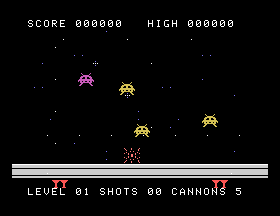 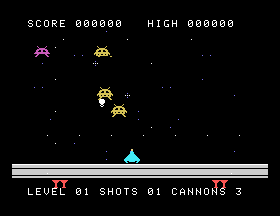 |
|
|
Fly your rocket up from the bottom of the screen and dock it under the space station drifting across the top. Six lanes of freighters cross in between, alternate lanes going opposite ways. The rocket always climbs: push up to climb faster and down to slow down, though it never stops, and push left or right to build up sideways speed, which it keeps until you push the other way. Touch a freighter, the station's side or the girders at the edges, or fly past the top, and the rocket is lost; come in too fast and it crashes too. Nose gently into the docking port from below to dock. You have five rockets and earn a bonus rocket every three dockings. Choose EASY or levels 1 to 3.
Controls: Use either controller. The stick flies the rocket; push up to launch each one. On the title, up and down choose, left and right set the level, and a button starts. ColecoVision version credited in the source to Claude (an AI made by Anthropic) for Amy Studio, in Amy, the language by Amy Bienvenu, 2026: a reimagined adaptation of the published rules. From COMPUTE!'s Gazette, August 1985: original Commodore 64 program (no author named in the issue). This is a modern homebrew adaptation, not a commercial Coleco release. Original Amy Studio release file: 095 - SPACE DOCK - by Author not named - COMPUTE! Gazette - August 1985.rom |
Amy Studio/Amy Purple (Bienvenu) | 9kb | 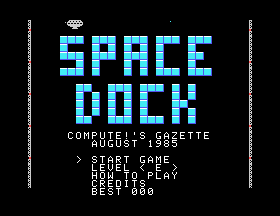 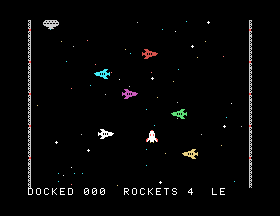  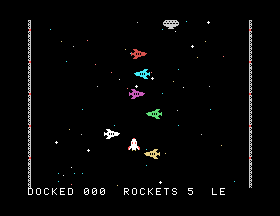 |
|
|
Saucers drift down out of space a row at a time toward the landing pads on the ground. Your patrol ship stays in the middle of the screen: push up and down to climb and descend, and left or right to turn and then fly along the ground as it scrolls beneath you. The button fires a laser along your row the way you face, hitting the first saucer in its path. Every shot uses a bomb from your AMMO bar; when it is empty, set down on a landing pad and hold down to load up again, with fewer bombs each time. Each saucer that reaches the ground has landed, and five landed saucers end the game. At 500 points and every 300 after, the supply ship takes one landed saucer away. Choose a level from 1 to 5.
Controls: Use either controller. Push the stick up or down to move the ship, left or right to turn and fly along the ground, and press either button to fire. On the title, up and down choose, left and right set the level, and a button starts. ColecoVision version credited in the source to Claude (an AI made by Anthropic) for Amy Studio, in Amy, the language by Amy Bienvenu, 2026: a reimagined adaptation of the published rules. From COMPUTE!'s Gazette, July 1984: original Commodore 64 program (no author named in the issue). Not the Ahoy! game of the same name; a different game. This is a modern homebrew adaptation, not a commercial Coleco release. Original Amy Studio release file: 055 - SPACE PATROL (gpatrol) - by Salvador Alcantara - COMPUTE! Gazette - July 1984.rom |
Amy Studio/Amy Purple (Bienvenu) | 11kb | 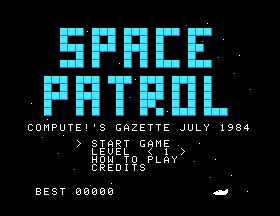 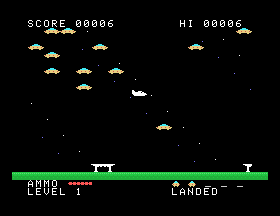 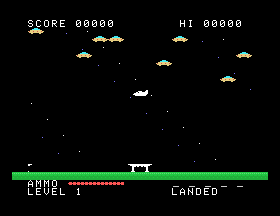 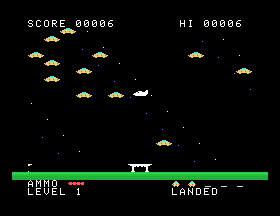 |
|
|
You are a ranger driving a snowcat up the slope to the Mount Crumb ski lodge to rescue skiers. Trees come down the course at you; steer left and right around them, because touching one is a crash and ends the run. The snowcat shifts gears by itself, from second at the start to third after 10 seconds and fourth after 50, and the trees come faster with each gear. Hold the button to brake: the trees slow to a crawl, but the distance stops counting while the clock keeps running. Cover the 400 units of DISTANCE TO GO and the lodge comes into view. The score is the seconds under 300 times half the distance covered, plus a bonus for reaching the lodge that grows with the level, chosen from 1 to 9.
Controls: Use either controller. The stick steers left and right; hold either side button to brake. On the title, up and down choose, left and right set the level, and a button starts. ColecoVision version credited in the source to Claude (an AI made by Anthropic) for Amy Studio, in Amy, the language by Amy Bienvenu, 2026: a reimagined adaptation of the published rules. From COMPUTE!'s Gazette, August 1984, page 62: original Commodore 64 program by Andy Keplinger. This is a modern homebrew adaptation, not a commercial Coleco release. Original Amy Studio release file: 058 - SNO-CAT - by ANDY KEPLINGER - COMPUTE! Gazette - August 1984.rom |
Amy Studio/Amy Purple (Bienvenu) | 12kb | 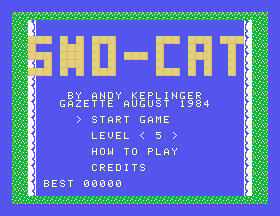 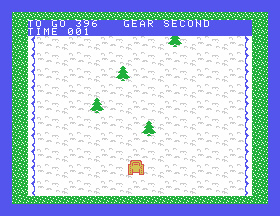 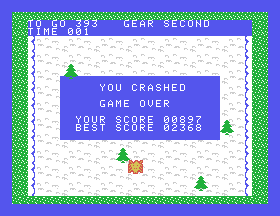 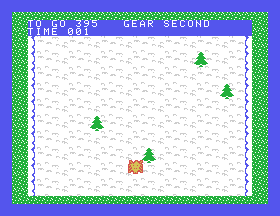 |
|
|
An educational arithmetic drill. On the title you set it up: addition or subtraction, 2 to 6 digits, carrying or borrowing allowed or not, and 5 to 9 problems. Each problem is set out in columns on an LED read-out panel. Dial your answer digit by digit, starting from the units column and working left as on paper, then press the button to check it. You have three tries and four minutes for each problem. A right answer sends the robot walking along the conveyor belt and back, and scores more for longer problems and fewer misses. A problem missed three times, or timed out, shows its answer and costs the robot one of its three batteries; losing all three ends the game. Solve every problem to win.
Controls: Use either controller. During play, push up and down to dial the digit under the cursor, left and right to move the cursor, and press either button to check the answer. On the title, up and down choose a line, left and right set it, and a button starts. ColecoVision version credited in the source to Claude (an AI made by Anthropic) for Amy Studio, in Amy, the language by Amy Bienvenu, 2026: a reimagined adaptation of the published rules. From COMPUTE!'s Gazette, July 1984: original Commodore 64 program (no author named in the issue). This is a modern homebrew adaptation, not a commercial Coleco release. Original Amy Studio release file: 054 - ROBOT MATH - by Bob Stewart - COMPUTE! Gazette - July 1984.rom |
Amy Studio/Amy Purple (Bienvenu) | 11kb | 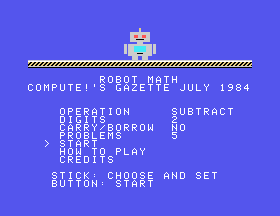 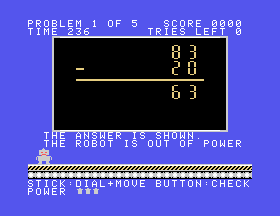 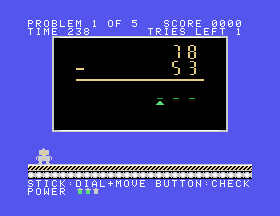 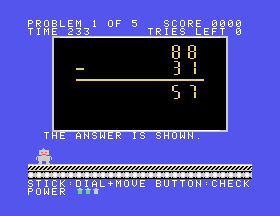 |
|
|
An educational spelling game. Choose easy, medium or hard words; each list holds 25. A word appears on a card for a moment and is hidden, and you spell it back by picking letters from a grid of the alphabet, then picking the return arrow to check it. The red X wipes what you have picked so you can start the word again at no cost. You start with 75 points and every wrong spelling costs one and shows the word again; after three wrong tries the correct spelling is typed out letter by letter and the next word comes. A bee hovers by the letter you are on. After the 25th word the game asks WASN'T THAT FUN? and shows your score.
Controls: Use either controller. The stick moves around the letter grid and either button picks a letter, the red X or the return arrow. The keypad is not used. ColecoVision version credited in the source to Claude (an AI made by Anthropic) for Amy Studio, in Amy, the language by Amy Bienvenu, 2026: a reimagined adaptation of the published rules. From COMPUTE!'s Gazette, December 1983: original Commodore 64 program (no author named in the issue). This is a modern homebrew adaptation, not a commercial Coleco release. Original Amy Studio release file: 023 - SPELLING BEE - by Daniel Bonachea - COMPUTE! Gazette - December 1983.rom |
Amy Studio/Amy Purple (Bienvenu) | 10kb | 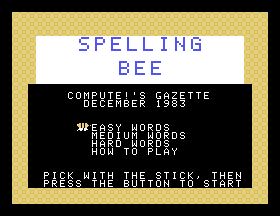 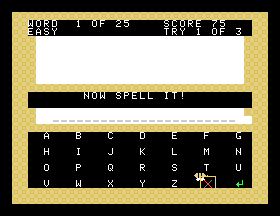 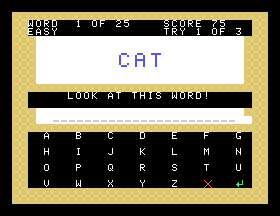 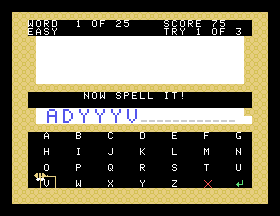 |
|
|
The Dark Castle has 16 rooms in a 4 x 4 grid. Walk, climb ladders and jump from ledge to ledge to find the lost royal heir. Moving belts carry you along, and you change rooms by walking off a side or climbing off the top or bottom. Keys open locked gates, one key each. Treasures score: cherries 50, flowers 100, bells 200 and an extra life, keys 500, and every gate opened 1000. Pink marshmallows kill. The roving ones vanish when they hit you, and the stationary ones stay. A fall of more than about two and a half rows, or out of the bottom of a room, kills too. A fire in the heir's room flares and dies down. After a death you restart where you entered the room. Six lives.
Controls: Use the joystick. Push left or right to walk and up or down to climb; either side button jumps. On the title and credits pages a button goes on. ColecoVision version credited in the source to Claude (an AI made by Anthropic) for Amy Studio, in Amy, the language by Amy Bienvenu, 2026: a reimagined adaptation of the published rules. From COMPUTE!'s Gazette, January 1990, page 50: original Commodore 64 program by Ligia Latino. This is a modern homebrew adaptation, not a commercial Coleco release. Original Amy Studio release file: 229 - ROYAL RESCUE - by LIGIA LATINO - COMPUTE! Gazette - January 1990.rom |
Amy Studio/Amy Purple (Bienvenu) | 22kb | 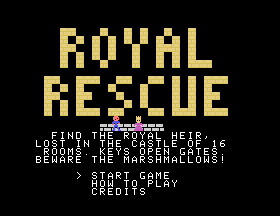 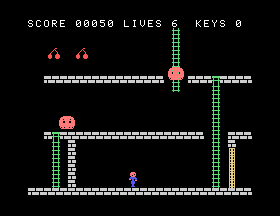 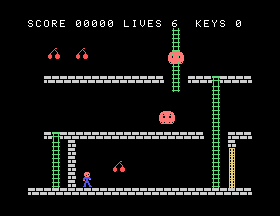 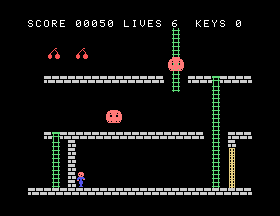 |
|
|
A murder mystery of logic. Lord Crumbly has been shot at his country house, and five other people are staying there. The murderer is the only one who had a motive, a gun and the opportunity. Grill the household: each time, one of them tells you something about another. One of the five is a compulsive liar who always says the opposite of the truth, and nobody tells you who. A CASEBOOK records every statement heard, page by page for each suspect. Accuse when you are sure; a wrong accusation and you are framed for the murder yourself. A game is five cases, and the end shows the cases solved, the clues used and a rank.
Controls: Use the joystick and side buttons. Up and down move the cursor over GRILL THE SUSPECTS, CASEBOOK and ACCUSE, and either button chooses. In the casebook, left and right turn the pages and a button goes back. When accusing, left and right move the magnifying glass, the left button accuses, and the right button goes back. ColecoVision version credited in the source to Claude (an AI made by Anthropic) for Amy Studio, in Amy, the language by Amy Bienvenu, 2026: a reimagined adaptation of the published rules. From COMPUTE!'s Gazette, July 1985: original Commodore 64 program (no author named in the issue). This is a modern homebrew adaptation, not a commercial Coleco release. Original Amy Studio release file: 093 - SLEUTH - by Author not named - COMPUTE! Gazette - July 1985.rom |
Amy Studio/Amy Purple (Bienvenu) | 13kb | 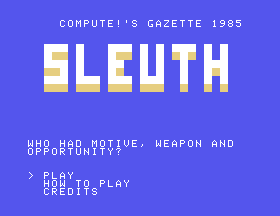 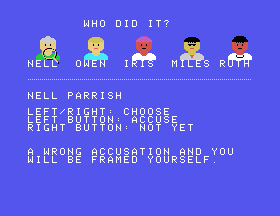 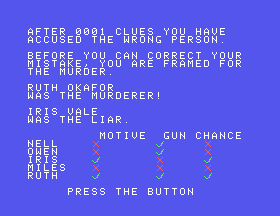 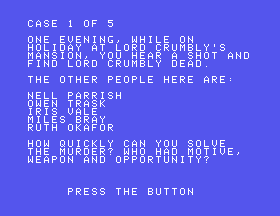 |
|
|
A skeet-shooting game. Four PULL balloons sit at the corners of the field. Move the arrow onto one and press a button, and a clay pigeon flies from a trap house, alternately the right one and the left one. Inside the field the pointer is a gun sight, and you get one shot per pigeon. The pigeon shrinks as it flies away and climbs at one of three angles. SCORE counts hits and OUT OF counts throws. Pull from an upper balloon and hit the pigeon while it is still large, or from a lower one and hit it when it is tiny, for a GREAT SHOT!, spoken aloud. OPTIONS sets 10, 20, 50 or 100 pigeons and three speeds. At the end it shows your hit percentage, then offers PLAY AGAIN or QUIT.
Controls: Use either controller. The stick moves the pointer, faster after a moment, and a side button pulls on a balloon, shoots in the field or chooses OPTIONS, PLAY AGAIN or QUIT. In the options box, up and down choose, left, right or a button change, and a button on OK closes it. ColecoVision version credited in the source to Claude (an AI made by Anthropic) for Amy Studio, in Amy, the language by Amy Bienvenu, 2026: a reimagined adaptation of the published rules. From COMPUTE!'s Gazette, May 1988, page 57: original Commodore 64 program by Roger M. Pingleton, Jr.. A GEOS desk accessory for the Commodore 64 and 128 from the GEOS column, not a standalone game. This is a modern homebrew adaptation, not a commercial Coleco release. Original Amy Studio release file: 181 - SKEET - by Roger M. Pingleton, Jr - COMPUTE! Gazette - May 1988.rom |
Amy Studio/Amy Purple (Bienvenu) | 13kb | 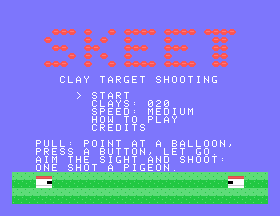 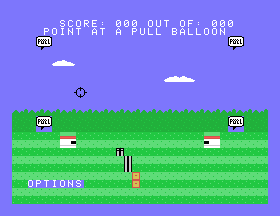 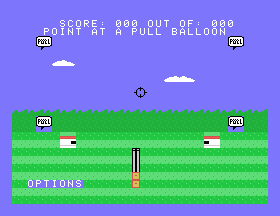 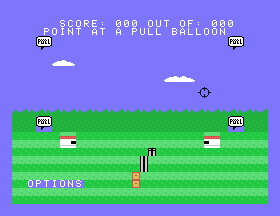 |
|
|
A two-player duel on a square board scattered with mirrors. A ball starts in the middle each round and runs one cell at a time, bouncing off the mirrors: straight ones turn it back, slanted ones turn it a quarter. ROWS, in yellow, slides whole rows left or right, and COLUMNS, in red, slides whole columns up or down. Both wrap around, and neither may slide the line the ball is in. Shift the mirrors so the ball escapes your way. A ball leaving by a side scores for ROWS, and one leaving by the top or bottom scores for COLUMNS. A ball still on the board after 200 cells is a draw. The board stays between rounds, and first to 5 points wins. Three speeds, and one player can face a computer COLUMNS.
Controls: Controller 1 is ROWS: up and down move the row cursor and left and right slide the row. Controller 2 is COLUMNS: left and right move the column cursor and up and down slide the column. On the title, up and down choose a line, left and right change it, and a button picks. ColecoVision version credited in the source to Claude (an AI made by Anthropic) for Amy Studio, in Amy, the language by Amy Bienvenu, 2026: a reimagined adaptation of the published rules. From COMPUTE!'s Gazette, March 1986, page 40: original Commodore 64 program by Kevin Mykytyn and Mark Tuttle. The listing ran on the Commodore 64 and Plus/4. This is a modern homebrew adaptation, not a commercial Coleco release. Original Amy Studio release file: 114 - SHIFTER - by Kevin Mykytyn and Mark Tuttle - COMPUTE! Gazette - March 1986.rom |
Amy Studio/Amy Purple (Bienvenu) | 11kb | 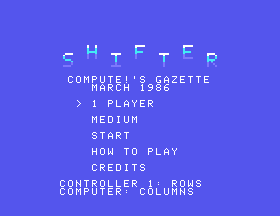 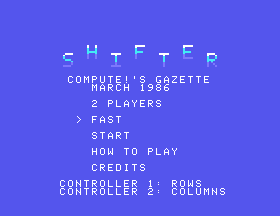 |
|
|
An educational matching activity for young children. A shape appears on the left, and four shapes sit in boxes on the right. Move the pointer to the box with the matching shape and press the button. A right match brings YES! THAT'S RIGHT! and a new round. A wrong pick turns that shape grey and lets the child try again. Six shapes are used: a red square, a purple plus, a black right triangle, a blue pyramid, a green circle and a yellow star, and each round shuffles four of them into the boxes. A game is ten rounds. A match on the first try earns a gold star and a later one a grey star. From round 6, all shapes are drawn in one colour, so only the shape can be matched. Eight gold stars wins SHAPE MASTER!
Controls: Use either controller. The joystick moves the pointer from box to box and a side button picks; a button starts from the title and goes on after each round. ColecoVision version credited in the source to Claude (an AI made by Anthropic) for Amy Studio, in Amy, the language by Amy Bienvenu, 2026: a reimagined adaptation of the published rules. From COMPUTE!'s Gazette, June 1984: original Commodore 64 program (no author named in the issue). One BASIC listing for the Commodore 64 and VIC-20. This is a modern homebrew adaptation, not a commercial Coleco release. Original Amy Studio release file: 049 - SHAPE MATCH - by Michael Reich - COMPUTE! Gazette - June 1984.rom |
Amy Studio/Amy Purple (Bienvenu) | 10kb |   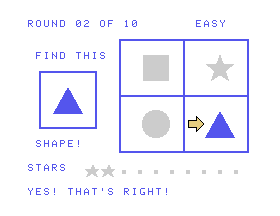 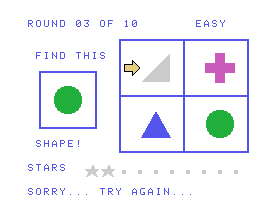 |
|
|
A squash-style rally for two players, BLACK and WHITE. Both run freely around the court in eight directions. The ball flies diagonally, bounces off the brick front wall and both side walls, and leaves the court at the back. Touching the ball sends it back toward the front wall and gives it the other player's colour, so the ball's colour always shows who must play it next. When the ball leaves the court, the player whose colour it has loses the point. The point's winner serves. Every five points the level rises and the ball speeds up, and long rallies speed it up too. A racket that stays still too long does not return the ball. First to 21 wins. One player can face a computer WHITE.
Controls: Controller 1 plays BLACK and controller 2 plays WHITE. The stick moves and a button serves. On the title, up and down choose a line, left and right change it, and a button starts. ColecoVision version credited in the source to Claude (an AI made by Anthropic) for Amy Studio, in Amy, the language by Amy Bienvenu, 2026: a reimagined adaptation of the published rules. From COMPUTE!'s Gazette, October 1987: original Commodore 64 program (no author named in the issue). From the Gazette disk (machine language). This is a modern homebrew adaptation, not a commercial Coleco release. Original Amy Studio release file: 164 - SCHNIP - by David Florance - COMPUTE! Gazette - October 1987.rom |
Amy Studio/Amy Purple (Bienvenu) | 11kb |  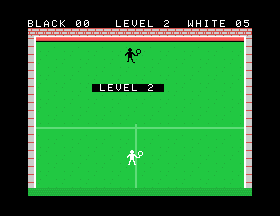 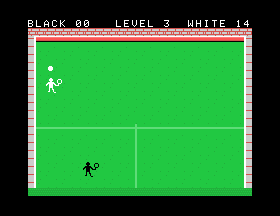 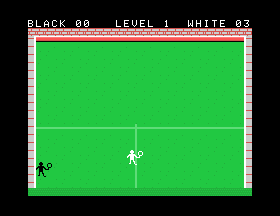 |
|
|
A detective logic puzzle. A line-up of 2 to 8 places stands under the names JIM, BOB, ABE, ROB, BUD, SAM, TOM and DAN, and each place holds one of eight suspects, all different. Put a suspect in every place and accuse. The TRUTH METER shows how many are the right suspect in the right place, in red, and how many are a right suspect in the wrong place, in green. Each accusation costs a point of the case's score; line them all up right to solve the case. A case whose score reaches zero is lost. A career is eight cases, and the line-up grows when you solve a case with plenty of score to spare. The final rank is the average rating of the eight cases, up to GRAND SLEUTH.
Controls: Use either controller. On the title, up and down choose START or CREDITS and a button selects. In play, left and right move the cursor, up and down change the suspect, and either button accuses. After a case, a button goes on. ColecoVision version credited in the source to Claude (an AI made by Anthropic) for Amy Studio, in Amy, the language by Amy Bienvenu, 2026: a reimagined adaptation of the published rules. From COMPUTE!'s Gazette, May 1990: original Commodore 64 program (no author named in the issue). This is a modern homebrew adaptation, not a commercial Coleco release. Original Amy Studio release file: 238 - SHEERLUCK - by Author not named - COMPUTE! Gazette - May 1990.rom |
Amy Studio/Amy Purple (Bienvenu) | 11kb | 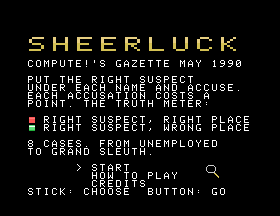 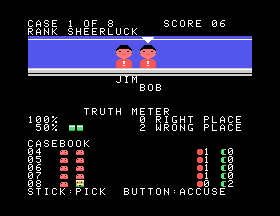 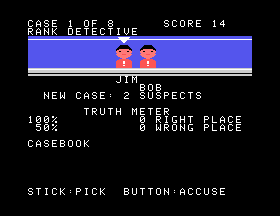 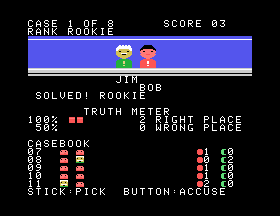 |
|
|
A word game for one to four players taking turns. Each turn rolls 13 letter dice, so a letter can come up twice, and the player makes as many words as possible from them before the timer of 1, 3, 5 or 7 minutes runs out. A word uses each rolled letter at most once, must be at least two letters long, and must be in the built-in word list; a word not in the list is refused and costs 3 seconds, and a repeated word is thrown out. In a WORDS game each word scores 1 point. In a POINTS game longer words score more, up to 9 for six letters or more. After the last player the scores and the winner are shown. A high score is kept for each timer and game type.
Controls: Use either controller. The stick moves the cursor and repeats when held; the left button picks a letter or OK sends the word, and the right button takes back the last letter. On the title, up and down choose a line, left and right change it, and a button starts. ColecoVision version credited in the source to Claude (an AI made by Anthropic) for Amy Studio, in Amy, the language by Amy Bienvenu, 2026: a reimagined adaptation of the published rules. From COMPUTE!'s Gazette, July 1988: original Commodore 64 program (no author named in the issue). This is a modern homebrew adaptation, not a commercial Coleco release. Original Amy Studio release file: 189 - SCRAMBLER (Gazette word game, ColecoVision) - by R. ANDERSON & D. HENSLEY JR - COMPUTE! Gazette - July 1988.rom |
Amy Studio/Amy Purple (Bienvenu) | 30kb | 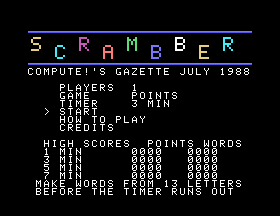  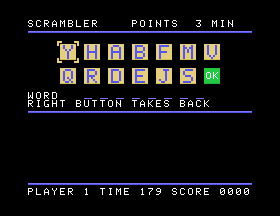 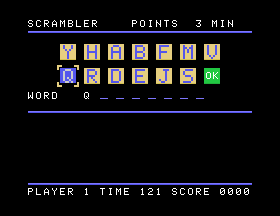 |
|
|
Scorpion solitaire. All 52 cards are dealt with no stock: seven columns of seven, plus three more under the middle three columns, and 18 of the cards lie face down. Pick any face-up card, even one deep in a column. If it is the last card of its column and its suit's home pile wants it, it goes home, followed by the next cards of the same suit in order. Otherwise it moves, with every card below it, the scorpion's tail, onto the column whose last card is the same suit and one rank higher. A king can move to an empty column. A face-down card at the foot of a column turns up. When no move is left the game ends, and it is a win if all 52 cards are home. Deals are numbered and can be replayed.
Controls: Use either controller. The stick jumps the cursor from card to card; the left button picks a card and the right button offers GIVE UP. ColecoVision version credited in the source to Claude (an AI made by Anthropic) for Amy Studio, in Amy, the language by Amy Bienvenu, 2026: a reimagined adaptation of the published rules. From COMPUTE!'s Gazette, October 1988: original Commodore 64 program by Darrell G. Rose. Also on the Best of 1988 disk with its article. This is a modern homebrew adaptation, not a commercial Coleco release. Original Amy Studio release file: 199 - SCORPION II - by Darrell G. Rose - COMPUTE! Gazette - October 1988.rom |
Amy Studio/Amy Purple (Bienvenu) | 13kb |   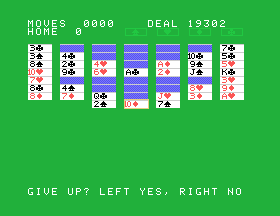 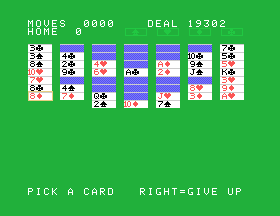 |
|
|
Two karateka face off in a ring, one in a white gi on the left and one in a black gi on the right. Walk in and out. The button with the stick toward the other fighter punches; with toward-and-up it kicks; with toward-and-down it sweeps the feet. The button with any other direction blocks. A move that reaches the other fighter while he is neither attacking nor blocking knocks him down for 100 points. A block stops a punch or a kick but not a foot sweep. Ten knockdowns, 1000 points, win, and a 90-second match clock decides by score at time-out. Let the button go between moves: pressed again too quickly, the fighter freezes. One player can face a computer black belt at EASY or NORMAL.
Controls: Use the joysticks. Player 1, white, uses controller 1 and player 2, black, controller 2; in a one-player game white plays on either controller. On the title, up and down choose and a button starts; on COMPUTER, a button or left and right switch EASY and NORMAL. ColecoVision version credited in the source to Claude (an AI made by Anthropic) for Amy Studio, in Amy, the language by Amy Bienvenu, 2026: a reimagined adaptation of the published rules. From COMPUTE!'s Gazette, October 1986, page 52: original Commodore 64 program by Anthony Bertram. This is a modern homebrew adaptation, not a commercial Coleco release. Original Amy Studio release file: 136 - RINGSIDE KARATE - by Anthony Bertram - COMPUTE! Gazette - October 1986.rom |
Amy Studio/Amy Purple (Bienvenu) | 12kb | 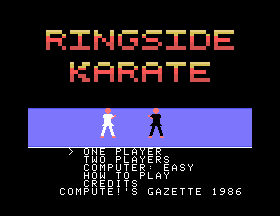 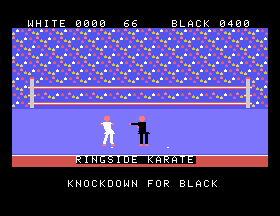   |
|
|
A gunslinger stands at the bar of a saloon. You have 35 bullets and a clock. Shoot the mugs sliding along three shelves for 10 points; a mug that smashes on the floor costs 5. Every ten mugs a mouse runs along the floor, and each hit sends it back faster for more points. Now and then a shadow shows in a balcony window, then a figure appears. A masked bandit is worth 25, and if you miss him he shoots away 10 of your bullets; a friendly old-timer costs 100 if you hit him. Bullets come back only from the cards: shoot them in order from the ace down, and the fifth refills the gun. Shoot the piano keys for a tune. The game ends when the clock or the bullets run out.
Controls: Use either controller. The stick moves the sight and either button fires. On the title, up and down choose PLAY or CREDITS and a button confirms. ColecoVision version credited in the source to Claude (an AI made by Anthropic) for Amy Studio, in Amy, the language by Amy Bienvenu, 2026: a reimagined adaptation of the published rules. From COMPUTE!'s Gazette, July 1986: original Commodore 64 program (no author named in the issue). From the Gazette disk; the program ran on the Commodore 64 and Plus/4. This is a modern homebrew adaptation, not a commercial Coleco release. Original Amy Studio release file: 125 - SALOON SHOOTOUT - by Author not named - COMPUTE! Gazette - July 1986.rom |
Amy Studio/Amy Purple (Bienvenu) | 12kb |   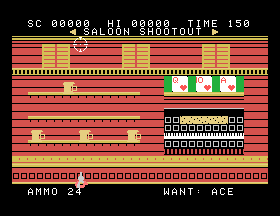 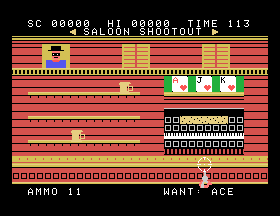 |
|
|
A two-player strategy game. A row of trees, alternately player 1's in yellow and player 2's in green, grows roots down through a triangle of ground toward the water at its point. Players take turns, and each turn grows one root a single step down-left or down-right from a root tip in the current row into a free place below. A row must be finished before the next one starts, and a player with no possible move passes. When the last row, just above the water, is full, the two roots that reached the water compare their whole systems, and the bigger root system wins for its owner. Each player has 3 to 7 trees, and who moves first is a title option. Play a friend or the computer.
Controls: Use either controller. Push left and right to move the ring between your root tips in the current row and press a side button to pick one, then push left or right to grow down-left or down-right; up or a button cancels. On the title, up and down choose a line and left, right or a button change it; a button on START GAME or CREDITS goes there. ColecoVision version credited in the source to Claude (an AI made by Anthropic) for Amy Studio, in Amy, the language by Amy Bienvenu, 2026: a reimagined adaptation of the published rules. From COMPUTE!'s Gazette, December 1987: original Commodore 64 program (no author named in the issue). This is a modern homebrew adaptation, not a commercial Coleco release. Original Amy Studio release file: 169 - ROOT RACE - by Sean D. Wagle - COMPUTE! Gazette - December 1987.rom |
Amy Studio/Amy Purple (Bienvenu) | 11kb | 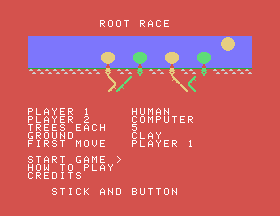 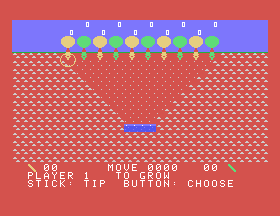 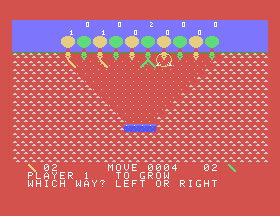 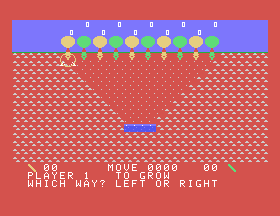 |
|
|
A top-down rally on a walled course. Each player's window scrolls with the car. Leave the start line, drive down to the yellow half-lap line at the bottom of the course, and come back over the checkered start and finish line. Turn left or right and shift up and down through six gears; hitting a wall stops the car dead. Two players race at once on a split screen, a blue car and a white car that never collide, and the first home wins. One player races the clock. The fastest time on each track is kept until power-off. There are four built-in tracks, including Scott Elder's original, and a track editor for building a custom course.
Controls: Use the joysticks. Push left or right to turn, up to shift up and down to shift down; gear 0 brakes. On the title, up and down choose, left and right change the track, and a button starts. In the editor, the stick moves, the left button toggles road or wall, and the right button finishes. ColecoVision version credited in the source to Claude (an AI made by Anthropic) for Amy Studio, in Amy, the language by Amy Bienvenu, 2026: a reimagined adaptation of the published rules. From COMPUTE!'s Gazette, November 1988: original Commodore 64 program by Scott Elder. Also on the Best of 1988 disk with its article. This is a modern homebrew adaptation, not a commercial Coleco release. Original Amy Studio release file: 202 - RALLY RACER (ColecoVision, Amy) - by SCOTT ELDER - COMPUTE! Gazette - November 1988.rom |
Amy Studio/Amy Purple (Bienvenu) | 19kb | 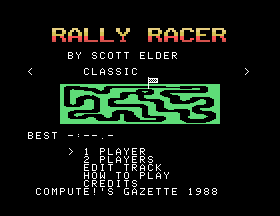 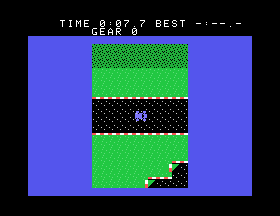 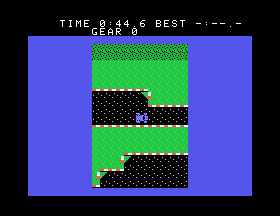 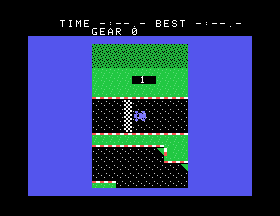 |
|
|
Two boxers, PURPLE and GREEN, face each other in a side view of the ring. Push the stick toward your opponent to step in and any other way to step back. The button with up and toward throws a jab, which scores 5 and takes 5 energy; with down and toward it throws a hook to the body, which scores 10 and takes 10. The button alone raises the guard. A punch lands only on a boxer who is in reach and neither punching nor guarding, and punching into a guard costs extra energy. Energy drains with every punch and slowly comes back. A boxer hit while low on energy goes down for a count, and ten is a knockout. Otherwise the higher score wins after three rounds. One player can face a computer GREEN at two skill levels.
Controls: Controller 1 plays PURPLE, on the left facing right, and controller 2 plays GREEN; in a one-player game controller 1 plays PURPLE. On the title, up and down choose a line, left and right change it, and a button starts. ColecoVision version credited in the source to Claude (an AI made by Anthropic) for Amy Studio, in Amy, the language by Amy Bienvenu, 2026: a reimagined adaptation of the published rules. From COMPUTE!'s Gazette, March 1987: original Commodore 64 program (no author named in the issue). Header cites the Gazette disk for March 1987 rather than a printed listing; it may be a disk-only program. This is a modern homebrew adaptation, not a commercial Coleco release. Original Amy Studio release file: 147 - RINGSIDE BOXING - by Author not named - COMPUTE! Gazette - March 1987.rom |
Amy Studio/Amy Purple (Bienvenu) | 14kb | 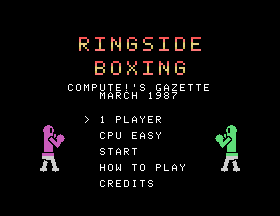 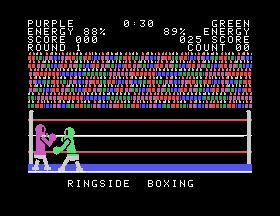   |
|
|
Drive up a winding three-lane road against the clock. Push up to go faster and down to slow; a button brakes and the stick steers. Driving onto the kerb slows you down, and running off it or hitting another car is a crash. The time bar runs down steadily, and every crash costs a piece of it. The road passes through seven stretches: day, desert, day, night, where only the lane lines and other cars' tail lights show, day, ice, where the car slides, and day again. Then comes a checkpoint line. Crossing it pays 100 points for every piece of time left and fills the bar again, but the next lap's clock runs faster. You also score a point every four rows. The game ends when the time bar is empty.
Controls: Use the joystick. Push up to go faster, down to go slower and left or right to steer; either side button brakes. In the menus, up and down choose and a button starts. ColecoVision version credited in the source to Claude (an AI made by Anthropic) for Amy Studio, in Amy, the language by Amy Bienvenu, 2026: a reimagined adaptation of the published rules. From COMPUTE!'s Gazette, May 1990: original Commodore 64 program by Mike Sedore. This is a modern homebrew adaptation, not a commercial Coleco release. Original Amy Studio release file: 237 - RACE ACE - by MIKE SEDORE - COMPUTE! Gazette - May 1990.rom |
Amy Studio/Amy Purple (Bienvenu) | 20kb |   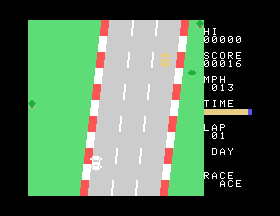 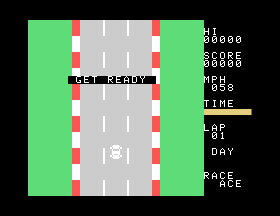 |
|
|
A Cyon ship appears high in the night sky and sinks toward the ground, jumping from side to side to dodge your fire; the higher the skill level, 1 to 6, the wider it jumps. Steer the crosshair over it and press a button to shoot. You have seven shots per ship. A hit sends it fleeing and shows how many shots and seconds it took. From wave 7 two ships come at once, six columns apart and jumping together, and both must be hit. A ship that reaches the ground wrecks one of your three domed bases and the wave starts again. Lose all three bases and the game ends. Survive 11 waves to save the Earth, and the end screen gives your rank, from Private to Mr. President.
Controls: Use either controller. The stick moves the crosshair and either button fires. On the title, up and down choose, left and right set the skill, and a button starts. ColecoVision version credited in the source to Claude (an AI made by Anthropic) for Amy Studio, in Amy, the language by Amy Bienvenu, 2026: a reimagined adaptation of the published rules. From COMPUTE!'s Gazette, June 1984: original Commodore 64 program (no author named in the issue). This is a modern homebrew adaptation, not a commercial Coleco release. Original Amy Studio release file: 048 - REVENGE OF CYON - by Author not named - COMPUTE! Gazette - June 1984.rom |
Amy Studio/Amy Purple (Bienvenu) | 10kb | 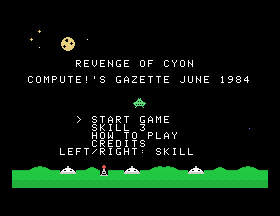 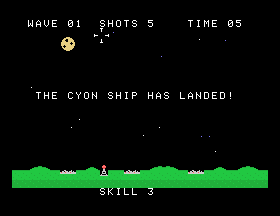 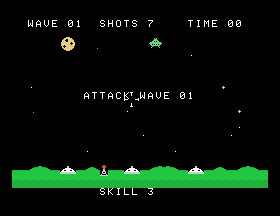 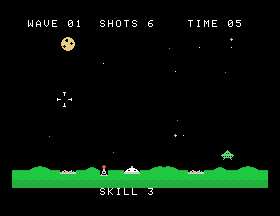 |
|
|
Ionic storms have spun the relay spindles of a deep-space communication network out of line. You are a RADS repair droid. Fly to a spindle, hold the button and push the stick right to wind its gauge up or left to wind it down. Every spindle must end exactly full or exactly empty, with as many full ones as the key at the bottom of the screen shows. Storm cells rise from below: sparks and hunters chase you, scramblers knock a gauge out of line, and ion orbs, when shot, slow the storm for a while. One touch from a spark or hunter knocks the droid down and costs a life. Shoot with the button away from the spindles. Nine layouts repeat, harder each time. Four droids.
Controls: Use controller 1 or 2. The stick flies the droid. On a spindle, hold either button and push right to fill or left to empty; elsewhere the button shoots a bolt the way the droid faces. On the title, up and down choose and a button selects. ColecoVision version credited in the source to Claude (an AI made by Anthropic) for Amy Studio, in Amy, the language by Amy Bienvenu, 2026: a reimagined adaptation of the published rules. From COMPUTE!'s Gazette, February 1988: original Commodore 64 program (no author named in the issue). This is a modern homebrew adaptation, not a commercial Coleco release. Original Amy Studio release file: 176 - RADS - by Bill Chin - COMPUTE! Gazette - February 1988.rom |
Amy Studio/Amy Purple (Bienvenu) | 14kb | 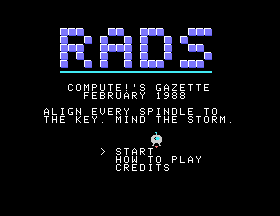 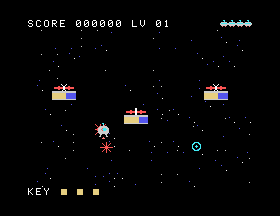 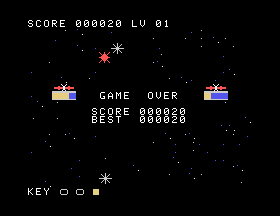 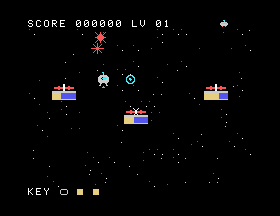 |
|
|
Steer your maynerd round a walled field and grab every treasure. The maynerd leaves a solid trail behind it, and running into a wall, a mine or your own trail costs a maynerd. It moves in eight directions and stops when the stick is centred. Each field is a new random layout, sometimes with inner walls, and each brings more mines and treasures than the last. Treasures are worth 50 points and each step 1, and clearing a field quickly earns a time bonus. A mine hit turns into a blast. After a lost maynerd the same size of field is played again with a new layout. Lose all five maynerds and the game is over.
Controls: Use either controller. The stick moves the maynerd, diagonals too; a button goes on from the score screen. On the title, up and down choose and a button starts. ColecoVision version credited in the source to Claude (an AI made by Anthropic) for Amy Studio, in Amy, the language by Amy Bienvenu, 2026: a reimagined adaptation of the published rules. From COMPUTE!'s Gazette, February 1984: original Commodore 64 program (no author named in the issue). This is a modern homebrew adaptation, not a commercial Coleco release. Original Amy Studio release file: 035 - REACT - by Don Whitaker - COMPUTE! Gazette - February 1984.rom |
Amy Studio/Amy Purple (Bienvenu) | 8kb | 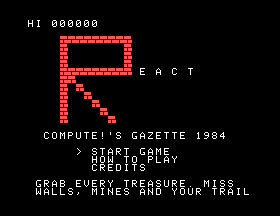  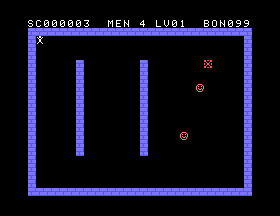 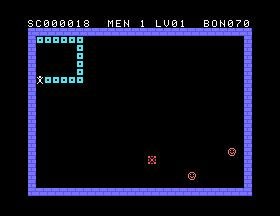 |
|
|
A pod hides behind a wall of coloured cells on the left and rides up and down. Each time it turns it may release an orb. Orbs bounce all over the screen, and when one lines up with your ship across or down, it fires a missile straight at you. Turn your ship through eight headings, thrust, and shoot: each shot knocks one cell out of the wall. The wall's columns keep rolling, even ones up and odd ones down, so the holes move. Touching the wall, the pod, an orb or a missile costs a ship. Shoot the pod through a gap for 2100 points to clear the level. Walls grow wider and orbs more numerous with the levels. Three ships, plus an extra every 10,000 points.
Controls: Use controller 1 or 2. Push left and right to turn the ship, up to thrust and down to brake; either button fires. On the title, up and down choose and a button selects. ColecoVision version credited in the source to Claude (an AI made by Anthropic) for Amy Studio, in Amy, the language by Amy Bienvenu, 2026: a reimagined adaptation of the published rules. From COMPUTE!'s Gazette, November 1988: original Commodore 64 program (no author named in the issue). The listing says the game is based on a 1981 Atari game, used with permission; this version uses none of that game's names, characters or pictures. This is a modern homebrew adaptation, not a commercial Coleco release. Original Amy Studio release file: 201 - QUOLERUS - by James Knesak - COMPUTE! Gazette - November 1988.rom |
Amy Studio/Amy Purple (Bienvenu) | 12kb |  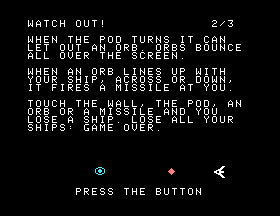 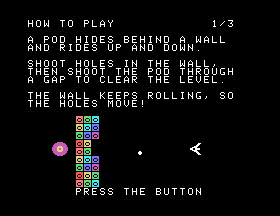 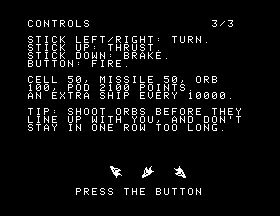 |
|
|
A baby bluebird, too young to fly, hops from cube to cube on a slanted board of 7 x 6 cube tops. Each landing changes a top's colour one step toward the colour shown at the bottom, CHANGE TO, and turning every top to it clears the level. Hop off the edge and you fall. A cat stalks you, toads hop about at random, a hawk sweeps across one row, and a glass marble rolls down the slope. Hold the button as you push the stick for a flapping long jump across two cubes, safe from everything in mid-air. A worm appears now and then as a bonus that freezes the enemies for a while. Later levels need more colour steps or bring faster enemies. Five lives.
Controls: Use controller 1 or 2. The stick hops the bird; hold a side button with the stick for the long jump. On the title, up and down choose the level and a button starts. ColecoVision version credited in the source to Claude (an AI made by Anthropic) for Amy Studio, in Amy, the language by Amy Bienvenu, 2026: a reimagined adaptation of the published rules. From COMPUTE!'s Gazette, December 1986: original Commodore 64 program (no author named in the issue). This is a modern homebrew adaptation, not a commercial Coleco release. Original Amy Studio release file: 142 - Q-BIRD - by Mike Sedore - COMPUTE! Gazette - December 1986.rom |
Amy Studio/Amy Purple (Bienvenu) | 13kb | 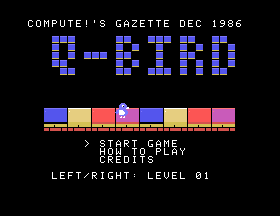 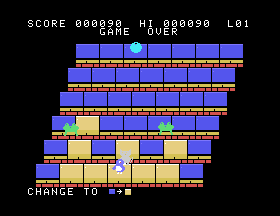 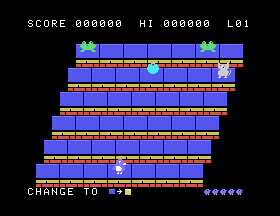 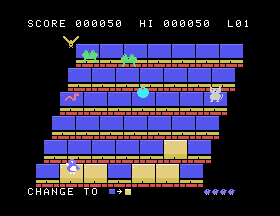 |
|
|
An educational ear-and-eye music drill. Choose BASS, TREBLE or MIXED. Over ten rounds the computer first plays a note, then shows it on the grand staff, and you name it, A to G, on a chalk letter wheel. You may hear the note again before answering. Each note gets one answer: CORRECT, or SORRY, THAT'S INCORRECT, with the right note shown. The same note never comes twice in a row. The score is the percentage of right answers so far, and the end screen recaps all ten notes with your answers. The title keeps a session count of notes named right and the best score.
Controls: Use either controller. On the title, up and down choose a line, left and right change the staff, and a button starts. In play, up and down turn the letter wheel, left plays the note again, and a button answers. ColecoVision version credited in the source to Claude (an AI made by Anthropic) for Amy Studio, in Amy, the language by Amy Bienvenu, 2026: a reimagined adaptation of the published rules. From COMPUTE!'s Gazette, December 1983: original Commodore 64 program (no author named in the issue). This is a modern homebrew adaptation, not a commercial Coleco release. Original Amy Studio release file: 025 - THE NOTE NAME GAME - by Jeff Behrens - COMPUTE! Gazette - December 1983.rom |
Amy Studio/Amy Purple (Bienvenu) | 10kb | 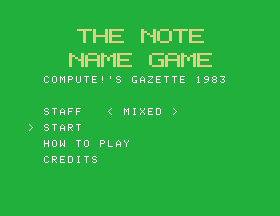 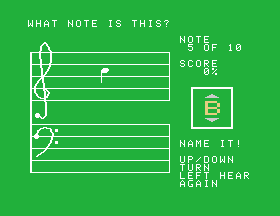 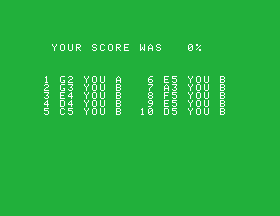 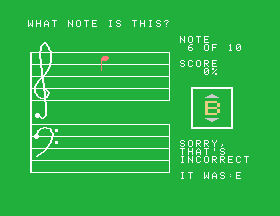 |
|
|
The eight queens puzzle. Place eight queens on a chessboard, one row at a time from top to bottom, so that no two share a column or a diagonal. A queen that would be attacked is refused, and the queen attacking her is shown. You may lift the last queen. A game asks for four different patterns. The 92 solutions fall into 12 patterns once turned and mirrored boards count as the same, so one solution turned round does not count again. Refused queens are your misses, and fewer is better. You can ask the computer to solve from the current board, but its pattern is then marked SHOWN and no longer counts for you. If too few patterns are left to reach four, the game ends.
Controls: Use either controller. Push left and right to move the queen along the row; the left button places her. The right button opens the menu (LIFT QUEEN, SOLVE, END, BACK), where up and down choose and a button picks. ColecoVision version credited in the source to Claude (an AI made by Anthropic) for Amy Studio, in Amy, the language by Amy Bienvenu, 2026: a reimagined adaptation of the published rules. From COMPUTE!'s Gazette, July 1986: original Commodore 64 program (no author named in the issue). This is a modern homebrew adaptation, not a commercial Coleco release. Original Amy Studio release file: 124 - QUEENS' QUARREL - by Author not named - COMPUTE! Gazette - July 1986.rom |
Amy Studio/Amy Purple (Bienvenu) | 9kb | 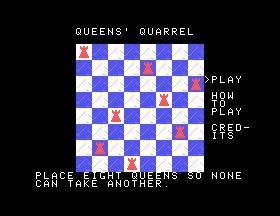 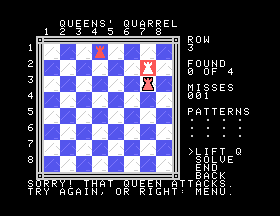 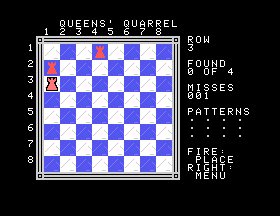 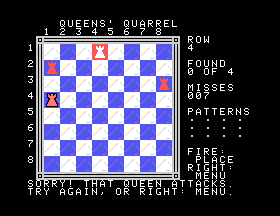 |
|
|
A miner's airship crosses the sky from left to right, over and over, at a new height each pass. Below lies Pudding Mountain: columns of pudding of different heights, each topped with a cream crust, on a bedrock floor, with one green target buried in the bedrock. Press the button to drop a bomb. A bomb falls until it hits pudding and blows away that one cell, so dig a shaft down to the target and drop a bomb through it. A bomb that reaches the bedrock anywhere else is a miss and costs a ship. A game is nine levels with three ships, and the ship speeds up each level. Each target scores more for fewer bombs used.
Controls: Use either controller; the button drops a bomb, one at a time. ColecoVision version credited in the source to Claude (an AI made by Anthropic) for Amy Studio, in Amy, the language by Amy Bienvenu, 2026: a reimagined adaptation of the published rules. From COMPUTE!'s Gazette, April 1985: original Commodore 64 program (no author named in the issue). A 17-line BASIC program from the Horizons column; one listing for the Commodore 64 and VIC-20. This is a modern homebrew adaptation, not a commercial Coleco release. Original Amy Studio release file: 086 - PUDDING MOUNTAIN MINER - by Author not named - COMPUTE! Gazette - April 1985.rom |
Amy Studio/Amy Purple (Bienvenu) | 7kb | 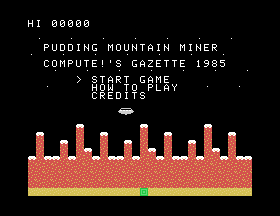 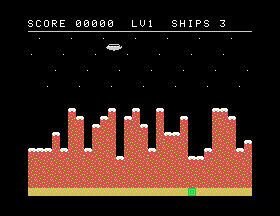 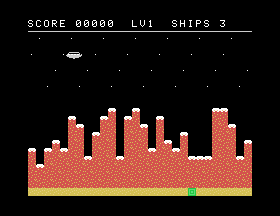 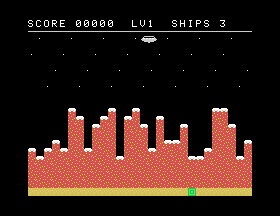 |
|
|
You are a pigeon lost in a sky full of whirling propellers. Your mate waits on a perch in a coop at one edge of the screen. Fly across, past eight propellers that rise and fall in their columns, and land beside your mate; then a new coop opens on the other side. If you are too slow, your mate moves to the other coop. Getting home scores points, and a propeller hit costs points and stuns you for a moment. Higher skills make the propellers faster, and skill 6 brings sudden gusts. Each level has a 99-second daylight clock and asks for 80 points, and passing skill 6 wins. The clock running out ends the game.
Controls: Use either controller. The stick flies the pigeon in eight directions. On the title, up and down choose a line, left and right change the skill, and a button starts. ColecoVision version credited in the source to Claude (an AI made by Anthropic) for Amy Studio, in Amy, the language by Amy Bienvenu, 2026: a reimagined adaptation of the published rules. From COMPUTE!'s Gazette, May 1984: original Commodore 64 program (no author named in the issue). This is a modern homebrew adaptation, not a commercial Coleco release. Original Amy Studio release file: 045 - PROPS - by Author not named - COMPUTE! Gazette - May 1984.rom |
Amy Studio/Amy Purple (Bienvenu) | 9kb |   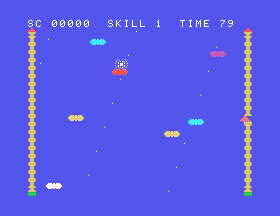 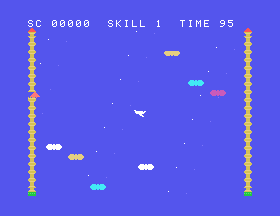 |
|
|
Matching pennies against a machine that learns. Before each move the computer makes its prediction, LEFT or RIGHT, and keeps it hidden. Then you make your move. If the prediction matches, the computer scores; if not, you do. First to 100 wins. The computer remembers your last four moves and keeps a tally for each pattern, so habits and repeated sequences are soon read; repeating one move always loses. Its memory carries over from game to game until the console is switched off. A strip shows the last 14 rounds, red when you scored and blue when the computer guessed you.
Controls: Use either controller. Push the stick left or right and let it return to the middle before the next move. A button starts the game from the title. ColecoVision version credited in the source to Claude (an AI made by Anthropic) for Amy Studio, in Amy, the language by Amy Bienvenu, 2026: a reimagined adaptation of the published rules. From COMPUTE!'s Gazette, June 1986 (Issue 36), page 58: original Commodore 64 program (no author named in the issue). The Gazette listing served the Commodore 64 and VIC-20; the port followed the 64's machine code. This is a modern homebrew adaptation, not a commercial Coleco release. Original Amy Studio release file: 120 - PREDICTOR - by Author not named - COMPUTE! Gazette - June 1986.rom |
Amy Studio/Amy Purple (Bienvenu) | 7kb | 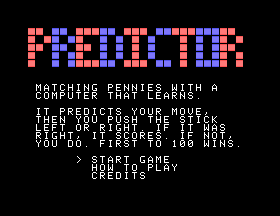 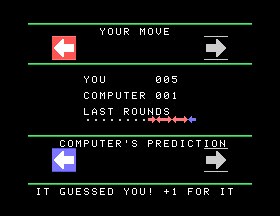 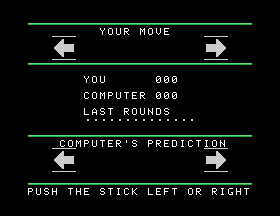 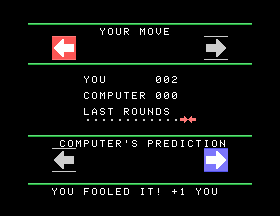 |
|
|
A breakout game with extras. Knock out every grey and green brick on the screen with the ball; steel walls never break. Green bricks break at once, while a hit on a grey or coloured brick changes its colour, often to green. A broken green brick often drops a capsule, and catching it with the paddle gives a power: slow ball, catch, long paddle, three balls, fire shots, next screen, an extra paddle, or the powerball, which ploughs through every brick and steel wall. A new capsule ends the last one. Three drones drift down and roam, and anything that touches one destroys it. Lose every ball and you lose a paddle; you start with four. The ball speeds up over time, and ten screens repeat at higher speed.
Controls: Use controller 1 or 2. The stick moves the paddle left and right, a button serves a held ball and fires shots, and the right button pauses. On the title a button starts. ColecoVision version credited in the source to Claude (an AI made by Anthropic) for Amy Studio, in Amy, the language by Amy Bienvenu, 2026: a reimagined adaptation of the published rules. From COMPUTE!'s Gazette, May 1987: original Commodore 64 program (no author named in the issue). This is a modern homebrew adaptation, not a commercial Coleco release. Original Amy Studio release file: 152 - POWERBALL - by Author not named - COMPUTE! Gazette - May 1987.rom |
Amy Studio/Amy Purple (Bienvenu) | 14kb | 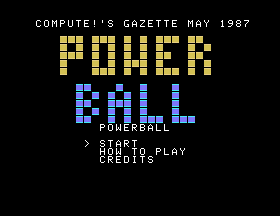 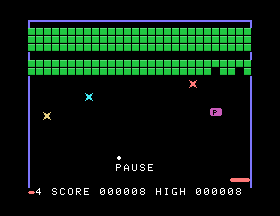 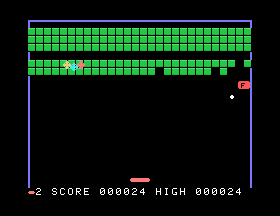 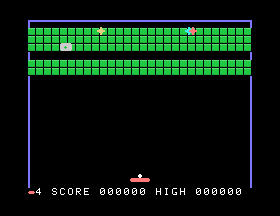 |
|
|
Poker squares for one player. Twenty-five cards are dealt one at a time from a shuffled deck. Lay each one on any empty place of a 5 x 5 grid; once laid, a card stays put. Every row and every column is a poker hand, scored the moment its fifth card goes down: royal flush 400, straight flush 300, four of a kind 160, straight 120, full house 100, three of a kind 60, flush 50, two pair 30, one pair 10. Aces are high, and also low in A-2-3-4-5. There are no diagonals. The ten hands make the game, and each row's and column's points stay beside it. The best score of the session is the high score.
Controls: Use either controller. The stick moves the frame over the grid, the left button lays the card, and the right button shows the point values. ColecoVision version credited in the source to Claude (an AI made by Anthropic) for Amy Studio, in Amy, the language by Amy Bienvenu, 2026: a reimagined adaptation of the published rules. From COMPUTE!'s Gazette, November 1985: original Commodore 64 program by Jud Bleser. This is a modern homebrew adaptation, not a commercial Coleco release. Original Amy Studio release file: 105 - POWER POKER - by JUD BLESER - COMPUTE! Gazette - November 1985.rom |
Amy Studio/Amy Purple (Bienvenu) | 11kb | 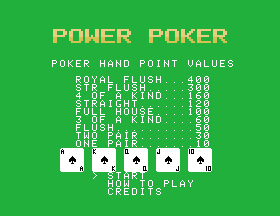 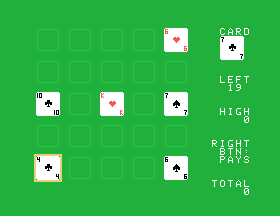 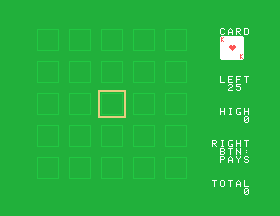 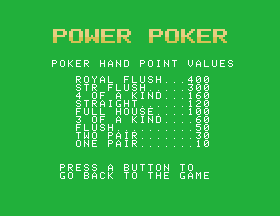 |
|
|
Pocket billiards with a cue ball and six coloured balls racked in a triangle. Move the aiming ring with the stick: the cue ball is sent toward the ring, and the farther the ring, the harder the shot. Press a button to shoot. Balls roll, collide and slow down naturally, bounce off the rails, and drop into the four corner and two side pockets. Sinking the cue ball, or touching no ball at all, is a foul: one of your sunk balls returns to the table and the next shot is taken with the cue ball in hand behind the head string. Alone, sink every ball in as few shots as you can for a rank of PRO, POOL SHARK, AMATEUR or NOVICE. With two players, sinking a ball earns another shot, and whoever sinks more balls wins.
Controls: The stick moves the aiming ring, faster after a moment, and either button shoots. With the cue ball in hand, the stick moves it behind the head string and a button sets it down. Two players share controller 1 or take turns with controllers 1 and 2. ColecoVision version credited in the source to Claude (an AI made by Anthropic) for Amy Studio, in Amy, the language by Amy Bienvenu, 2026: a reimagined adaptation of the published rules. From COMPUTE!'s Gazette, April 1985: original Commodore 64 program (no author named in the issue). The Commodore 64 version is machine language; the same disk has a separate VIC-20 BASIC version. This is a modern homebrew adaptation, not a commercial Coleco release. Original Amy Studio release file: 085 - POOL - by Joseph T. Woyton - COMPUTE! Gazette - April 1985.rom |
Amy Studio/Amy Purple (Bienvenu) | 12kb |  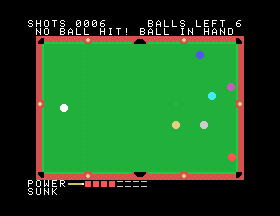   |
|
|
Draw poker against the house. Five cards are dealt from a fresh deck. Mark the ones you want changed, up to three, and draw. The hand is then paid by the table: royal flush $250, straight flush $100, four of a kind $20, full house $10, flush $8, straight $5, three of a kind $4, two pair $3, and a pair of jacks or better $1. Anything less is a lousy hand and costs $1. Aces count high, and also low in A-2-3-4-5. You sit down with $10 and play 50 hands. The game ends after hand 50, or at once if your bank reaches $0. The best bank is kept on the title.
Controls: Use either controller. Push left or right to move the pointer over the five cards and DRAW, or up or down to jump to DRAW; a button marks or unmarks a card, or draws on DRAW. ColecoVision version credited in the source to Claude (an AI made by Anthropic) for Amy Studio, in Amy, the language by Amy Bienvenu, 2026: a reimagined adaptation of the published rules. From COMPUTE!'s Gazette, March 1984: original Commodore 64 program (no author named in the issue). Titled "*** POKER 256 ***" on screen. This is a modern homebrew adaptation, not a commercial Coleco release. Original Amy Studio release file: 038 - POKER - by August J. Kwitowski - COMPUTE! Gazette - March 1984.rom |
Amy Studio/Amy Purple (Bienvenu) | 10kb |   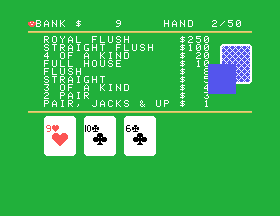 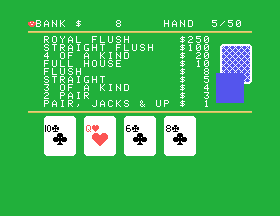 |
|
|
Fly a raider ship down the shaft of an enemy planet. Gravity pulls the ship down; turn it and thrust to steer. Shoot the gun bases on the girders and reach the glowing core at the bottom to complete the level. Touching rock, a girder or a base, or being hit by a base's shot, costs a ship. A shield guards against shots and draws in fuel pods, worth 500 fuel and 100 points each. Thrust and the shield both burn fuel, and a ship out of fuel can only fall. TIME runs down as you fly, and what is left becomes a bonus. After a lost ship the level starts again from the top, with destroyed bases still gone. Shoot all 24 bases in a set of eight levels for two extra ships. Five ships to start.
Controls: Use controller 1. Push left or right to turn, up to thrust, and down to hold the shield, which also pulls in fuel; either button fires. ColecoVision version credited in the source to Claude (an AI made by Anthropic) for Amy Studio, in Amy, the language by Amy Bienvenu, 2026: a reimagined adaptation of the published rules. From COMPUTE!'s Gazette, March 1990: original Commodore 64 program (no author named in the issue). This is a modern homebrew adaptation, not a commercial Coleco release. Original Amy Studio release file: 233 - PLANET RAIDER - by Author not named - COMPUTE! Gazette - March 1990.rom |
Amy Studio/Amy Purple (Bienvenu) | 30kb | 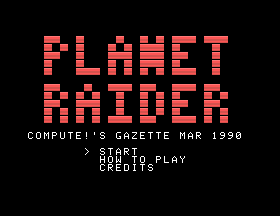 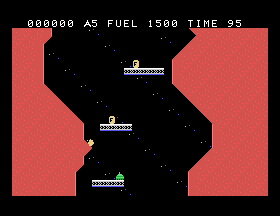 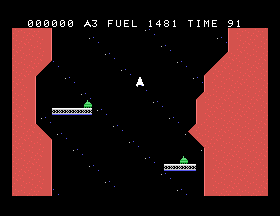 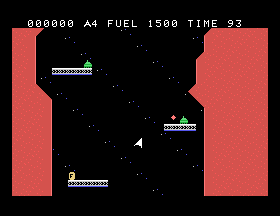 |
|
|
A mini-adventure for children. Your ship sails a sea of 25 places, ten of them land and the rest high seas, shuffled anew each game. You start at PIRATE COVE. On each island you can search two places, which may turn up a key, a cutlass, other treasures or nothing. Read the map to see land and water and the islands you have visited, sail north, south, east or west, and check your inventory. Sail off the edge and a storm turns you back. At the SEA MONSTER'S LAIR you may sail away, with a small chance of escape, or fight, which only a cutlass wins; otherwise you are sent back to Pirate Cove. Reach TREASURE ISLAND with the key and the chest opens to win.
Controls: Use either controller. Push up and down to move the pointer through the menus and press either side button to choose. ColecoVision version credited in the source to Claude (an AI made by Anthropic) for Amy Studio, in Amy, the language by Amy Bienvenu, 2026: a reimagined adaptation of the published rules. From COMPUTE!'s Gazette, August 1986: original Commodore 64 program by Barbara H. Schulak. This is a modern homebrew adaptation, not a commercial Coleco release. Original Amy Studio release file: 127 - PIRATE COVE (pcove) - by Barbara H. Schulak - COMPUTE! Gazette - August 1986.rom |
Amy Studio/Amy Purple (Bienvenu) | 10kb |   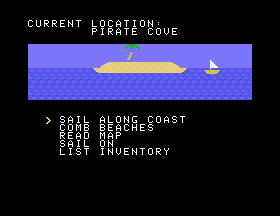  |
|
|
A circus balloon game. Move the trampoline left and right and press the button to launch Pinhead, a little pin-headed acrobat, into the air. Keep him bouncing: where he lands on the trampoline sets how high he flies, with the middle sending him highest, and which way he drifts. Balloons of many colours and sizes float across the tent from either side; pop them with Pinhead. A pop scores more for faster and smaller balloons and turns Pinhead round. Balloons come faster as the score grows. Missing the trampoline drops him to the floor for a dizzy pause and costs a life. Lives start at 4, an extra one comes every 2000 points, and the game ends after the last miss.
Controls: Use controller 1 or 2. The stick moves the trampoline and a button launches Pinhead; holding the button makes the trampoline move faster. On the title, up and down choose and a button selects. ColecoVision version credited in the source to Claude (an AI made by Anthropic) for Amy Studio, in Amy, the language by Amy Bienvenu, 2026: a reimagined adaptation of the published rules. From COMPUTE!'s Gazette, February 1990: original Commodore 64 program (no author named in the issue). This is a modern homebrew adaptation, not a commercial Coleco release. Original Amy Studio release file: 230 - PINHEAD - by Author not named - COMPUTE! Gazette - February 1990.rom |
Amy Studio/Amy Purple (Bienvenu) | 11kb | 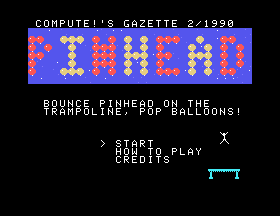 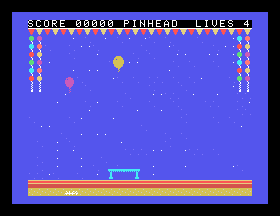 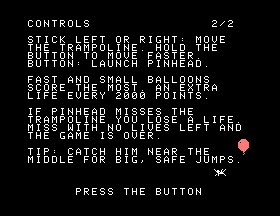 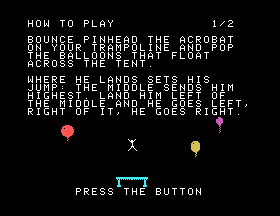 |
|
|
You are a farmer in a fenced pen full of runaway pigs. Walk up to a pig, press a button to pick it up, and carry it out through either gate to market. It sells for $100.00, less one cent for every sixtieth of a second since the level began, but never less than $60.00. Sell every pig to finish the level. The money buys the next level's pigs, $60 each and up to seven, and then spare pants at $25 if you like. Bump into the fence or a boulder and you fall and tear your pants, and a pair from the clothesline replaces them. While you carry a pig, another pig running into you knocks you over too. Fall with an empty line and the game is over. Selling the last pig of level 12 retires you rich.
Controls: Use either controller. The stick walks the farmer in eight directions and either button picks up or puts down a pig. On the title, up and down choose and a button starts. In the store, up and down choose how many pants and a button buys. ColecoVision version credited in the source to Claude (an AI made by Anthropic) for Amy Studio, in Amy, the language by Amy Bienvenu, 2026: a reimagined adaptation of the published rules. From COMPUTE!'s Gazette, October 1986: original Commodore 128 program (no author named in the issue). Written for the Commodore 128 in BASIC 7.0. This is a modern homebrew adaptation, not a commercial Coleco release. Original Amy Studio release file: 135 - PIGS FOR BUCKS - by Bruce Willis and Dave Zeigler - COMPUTE! Gazette - October 1986.rom |
Amy Studio/Amy Purple (Bienvenu) | 12kb | 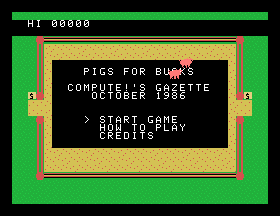 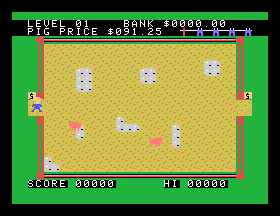 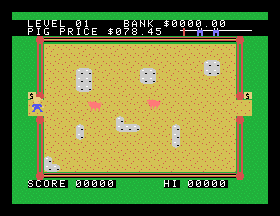 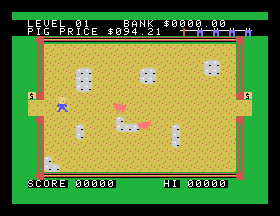 |
|
|
A word puzzle for one to three players taking turns. Spin the score pointer along a strip of value cards, then pick a letter: every copy of it in the hidden puzzle turns over and scores the card's value times your bonus factor. A right letter raises the bonus factor and keeps your turn. A letter not in the puzzle resets the factor and passes play. X loses the turn and ! loses the round score. Once you have a letter right you may solve instead, by picking the hidden letters in order; solving banks your round score, and a wrong answer costs 10 points. Puzzles come in five categories: phrase, place, person, name and object. First to the chosen goal wins. A solo game is eight puzzles with five misses allowed per puzzle.
Controls: Use either controller; players share it or pass it. On the title, up and down choose a line, left and right change it, and a button starts. In play, left and right choose SPIN or SOLVE and a button confirms; the stick moves the box on the alphabet and a button picks. ColecoVision version credited in the source to Claude (an AI made by Anthropic) for Amy Studio, in Amy, the language by Amy Bienvenu, 2026: a reimagined adaptation of the published rules. From COMPUTE!'s Gazette, February 1987: original Commodore 64 program (no author named in the issue). One listing serves the Commodore 64 and 128. This is a modern homebrew adaptation, not a commercial Coleco release. Original Amy Studio release file: 146 - PICK-A-LETTER - by Michael Blackmon - COMPUTE! Gazette - February 1987.rom |
Amy Studio/Amy Purple (Bienvenu) | 15kb | 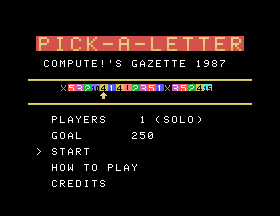 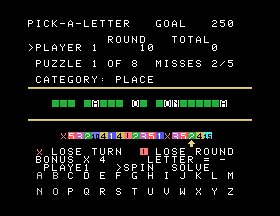 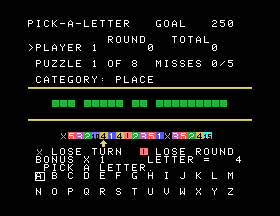 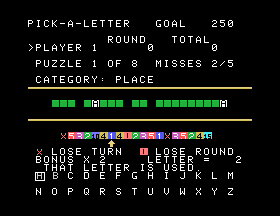 |
|
|
A two-sided strategy game on a diamond of 30 stones. North and South take turns, North first, each moving one token a single diagonal step. The stone a token lands on changes. A neutral red stone turns green when touched. A touched stone landed on again becomes half yours, and a third landing makes it yours for a point. Landing on a half-claimed stone of the other side undoes it back to touched, and landing on your own full stone returns it to neutral and costs the point. Both tokens may share a stone. First to 16 wins, and 15 all is a tie. A game lasts at most 300 moves, after which the higher score wins. In one-player mode you are North against a computer South.
Controls: Use either controller; in play only diagonal pushes of the stick move the token, one push per move. On the title, up and down choose and a side button selects. ColecoVision version credited in the source to Claude (an AI made by Anthropic) for Amy Studio, in Amy, the language by Amy Bienvenu, 2026: a reimagined adaptation of the published rules. From COMPUTE!'s Gazette, October 1986: original Commodore 64 program (no author named in the issue). This is a modern homebrew adaptation, not a commercial Coleco release. Original Amy Studio release file: 134 - PERSUASION (persu) - by Kevin Mykytyn and Mark Tuttle - COMPUTE! Gazette - October 1986.rom |
Amy Studio/Amy Purple (Bienvenu) | 10kb | 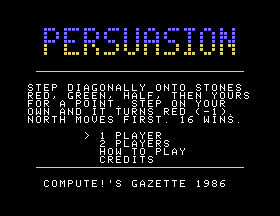 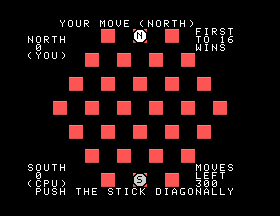 |
|
|
The classic peg solitaire on a triangle of 15 holes, lettered A to O. Every hole holds a gold peg except A at the top. A peg jumps a neighbour along a line of the triangle into an empty hole, and the jumped peg comes off. Each jump scores a point. The game ends when no jump is left, and 13 points, with one peg remaining, wins. Any jump can be taken back, one at a time, all the way to the start, even from the GAME OVER prompt. An illegal move is refused with a buzz. The title keeps the best score.
Controls: Use either controller. The stick moves the cursor from hole to hole; the left button picks a peg and then drops it on the hole to jump to, and the right button takes back a jump. ColecoVision version credited in the source to Claude (an AI made by Anthropic) for Amy Studio, in Amy, the language by Amy Bienvenu, 2026: a reimagined adaptation of the published rules. From COMPUTE!'s Gazette, December 1986 (Issue 42): original Commodore 64 program (no author named in the issue). This is a modern homebrew adaptation, not a commercial Coleco release. Original Amy Studio release file: 141 - PEGS (gpegs) - by Jim and Deborah Chambers - COMPUTE! Gazette - December 1986.rom |
Amy Studio/Amy Purple (Bienvenu) | 11kb | 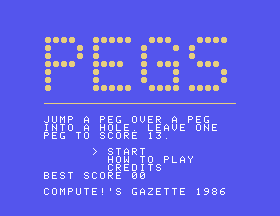 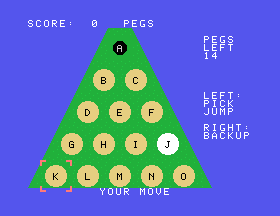 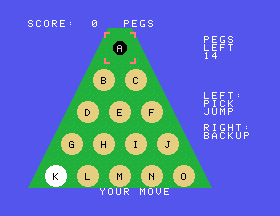 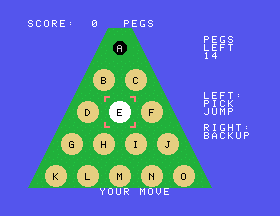 |
|
|
Saboteur drones drift over a night refinery town and drain any oil tank they touch. Three tanks stand in the town, each with a gauge window that shows its level falling. Slide the green launcher along the ground and fire rockets straight up, one at a time, to destroy the drones; each hit scores 999. Destroy the wave's quota to clear it: 10 drones in the first wave and 5 more in each wave after. A cleared wave pumps a little oil back into each tank. The drones speed up from wave to wave. When two tanks are dry the game is over.
Controls: Use controller 1 or 2. The stick moves the launcher and a button fires. On the title, up and down choose and a button selects. ColecoVision version credited in the source to Claude (an AI made by Anthropic) for Amy Studio, in Amy, the language by Amy Bienvenu, 2026: a reimagined adaptation of the published rules. From COMPUTE!'s Gazette, March 1988: original Commodore 64 program (no author named in the issue). This is a modern homebrew adaptation, not a commercial Coleco release. Original Amy Studio release file: 177 - OIL DEFENSE - by Mark H. Thomas - COMPUTE! Gazette - March 1988.rom |
Amy Studio/Amy Purple (Bienvenu) | 10kb | 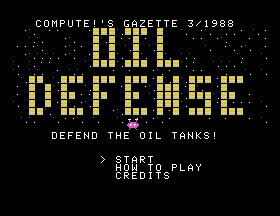 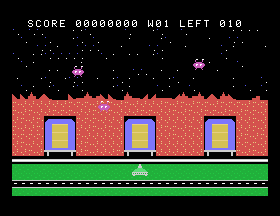 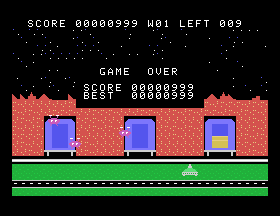 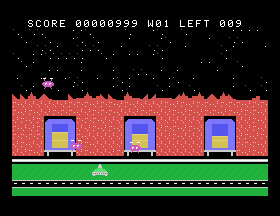 |
|
|
Two players each steer a line that never stops moving. The border is drawn in the players' colours, purple along the top and right and blue along the bottom and left, with a gap at the top of the left side and the bottom of the right side. Each round both lines start on the middle row heading the same random way. Push the stick to turn; holding a diagonal or centring the stick keeps the direction. Running into any line or border, or out through a gap, is a crash, and a crash scores a point for the other player. If both crash, both score. A new round starts by itself, and the first player with at least 5 points and ahead wins. In a one-player game the computer steers purple. Three speeds are offered.
Controls: Controller 1 steers blue and controller 2 steers purple; in a one-player game the computer steers purple. On the title, left and right pick one or two players, up and down set the speed, and a button starts. ColecoVision version credited in the source to Claude (an AI made by Anthropic) for Amy Studio, in Amy, the language by Amy Bienvenu, 2026: a reimagined adaptation of the published rules. From COMPUTE!'s Gazette, November 1986: original Commodore 128 program (no author named in the issue). Written for the Commodore 128 in BASIC 7.0. This is a modern homebrew adaptation, not a commercial Coleco release. Original Amy Studio release file: 139 - OBSTACLE 128 - by Stephen Cheng - COMPUTE! Gazette - November 1986.rom |
Amy Studio/Amy Purple (Bienvenu) | 9kb | 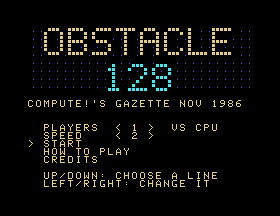 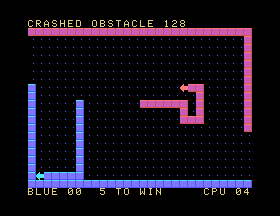 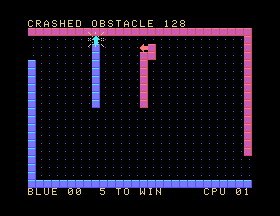 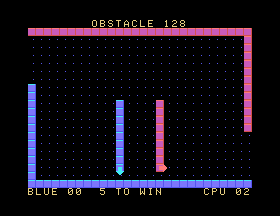 |
|
|
A number-guessing game. The computer thinks of a number from 10 to 99 and you have five turns to guess it. After a wrong guess it says TOO HIGH or TOO LOW. When a guess is off by a factor of two or more, it also says how many TIMES too high or too low. Each wrong guess sends a little man one step down the cliff toward the water, and a log keeps every guess and clue on screen. Guess right and a treasure chest rises from the sea. A fifth wrong guess loses: the man reaches the water and the number is shown. The title counts the quests you have won.
Controls: Use either controller. On the carved tablet, push left or right to go down or up by 1 and up or down to go up or down by 10; held directions repeat, and a button makes the guess. ColecoVision version credited in the source to Claude (an AI made by Anthropic) for Amy Studio, in Amy, the language by Amy Bienvenu, 2026: a reimagined adaptation of the published rules. From COMPUTE!'s Gazette, April 1985: original Commodore 64 program (no author named in the issue). This is a modern homebrew adaptation, not a commercial Coleco release. Original Amy Studio release file: 084 - NUMBER QUEST (nquest) - by Gerald and Betty Schueler - COMPUTE! Gazette - April 1985.rom |
Amy Studio/Amy Purple (Bienvenu) | 10kb | 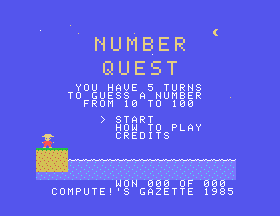 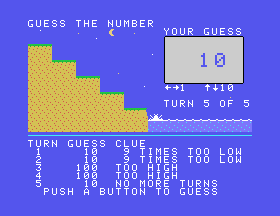 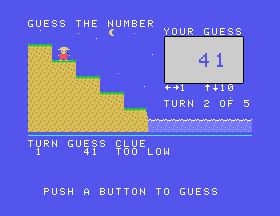 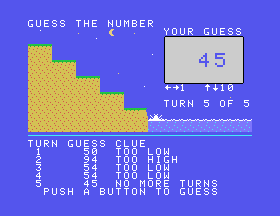 |
|
|
A cross-number puzzle on a 3 x 3 board. Nine digit keys wait in the tray. Put each one in a square so that every row and every column, worked left to right and top to bottom with no precedence, reaches the total shown at its end. The signs between squares are chosen at random from plus, minus, times and divide. HINTS, from 0 to 3, sets how many squares are already given and locked. Any arrangement that makes all six lines right is accepted. A game is five calls. Each call allows three checks, and a right board scores more the fewer hints and checks you used. After a wrong check each line shows a tick or a cross. A third wrong check shows the answer and moves on.
Controls: Use either controller. Move the cursor with the stick; a button picks up or puts down a key, and the CHECK plate checks the board. On the title, up and down choose a line, left and right change the hints, and a button starts. ColecoVision version credited in the source to Claude (an AI made by Anthropic) for Amy Studio, in Amy, the language by Amy Bienvenu, 2026: a reimagined adaptation of the published rules. From COMPUTE!'s Gazette, October 1987: original Commodore 64 program (no author named in the issue). One listing serves the Commodore 64 and 128. This is a modern homebrew adaptation, not a commercial Coleco release. Original Amy Studio release file: 163 - NUMBER PLEASE- - by Fender Tucker - COMPUTE! Gazette - October 1987.rom |
Amy Studio/Amy Purple (Bienvenu) | 14kb | 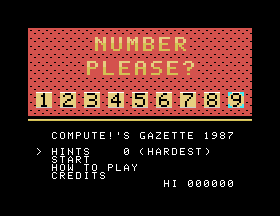 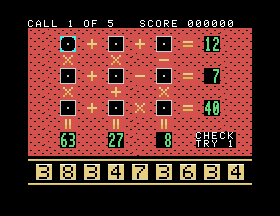 |
|
|
An educational arithmetic game set on a building site. Each turn the site office hands you a PROJECT, a number from 100 to 999, and a few MATERIALS, different digits from 1 to 9. Build the project using the TOOLS plus, minus, times and divide: a chain of up to eight materials joined by tools, using each material as often as you like. Multiplying and dividing come before adding and subtracting, and the running total shows as you build. Press BUILD and the crane raises a building as tall as you came close. Your score depends on how near you got, the level, and the seconds left in the bonus time. BEGINNER, INTERMEDIATE and ADVANCED differ in materials and clock time. One or two players take turns over five rounds.
Controls: Use either controller. Push left or right to move along the chain and up or down to turn a slot through the materials or tools; the button steps right or presses BUILD. On the title, up and down choose a line, left and right change players and level, and the button on START begins. ColecoVision version credited in the source to Claude (an AI made by Anthropic) for Amy Studio, in Amy, the language by Amy Bienvenu, 2026: a reimagined adaptation of the published rules. From COMPUTE!'s Gazette, March 1986: original Commodore 64 program (no author named in the issue). This is a modern homebrew adaptation, not a commercial Coleco release. Original Amy Studio release file: 113 - NUMBER CONSTRUCTION KIT - by Gerald W. Rightmer - COMPUTE! Gazette - March 1986.rom |
Amy Studio/Amy Purple (Bienvenu) | 13kb | 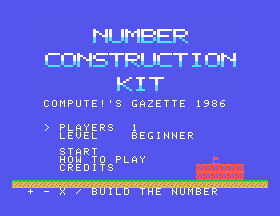 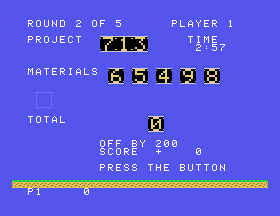 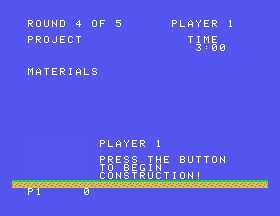 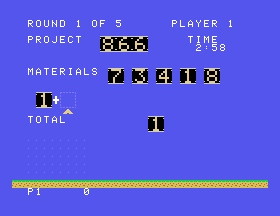 |
|
|
In the Land of Adnerb four power capsules stand beside a tall pole, two on the upper ledge and two on the lower one. Nevets walk in from both ends of both ledges to steal them. Your turret rides up and down the pole and turns left or right, and each shot flies down at 45 degrees. To hit a Nevet you must be at the right height: higher for a far one, lower for a near one. You cannot fire from the bottom of the pole. Shoot the level's quota of Nevets within 60 seconds, for 50 points each plus 10 for every second left. Nevets walk faster with each round of nine levels. Lose all four capsules or run out of time and the game ends. Survive level 40 and the game is won.
Controls: Use either controller. Push up and down to move the turret and left or right to turn it; either side button fires, one press per shot. On the title, up and down choose and a button starts. ColecoVision version credited in the source to Claude (an AI made by Anthropic) for Amy Studio, in Amy, the language by Amy Bienvenu, 2026: a reimagined adaptation of the published rules. From COMPUTE!'s Gazette, April 1984: original Commodore 64 program by Steven R. McCloskey. This is a modern homebrew adaptation, not a commercial Coleco release. Original Amy Studio release file: 042 - NEVETS - by STEVEN R. MCCLOSKEY - COMPUTE! Gazette - April 1984.rom |
Amy Studio/Amy Purple (Bienvenu) | 9kb | 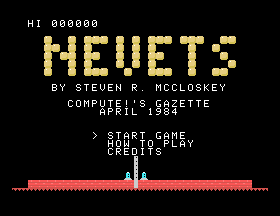 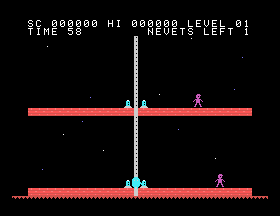 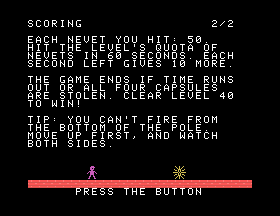 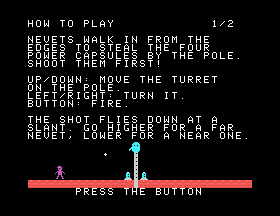 |
|
|
An educational music-reading drill. Pick the treble staff, the bass staff or the whole grand staff. Twenty notes appear on the staff one after another, and each one sounds as it appears. Name each note, A to G, before the counter runs out. The counter starts at 9 and drops about every two thirds of a second, and a right answer scores whatever is left on it, so a quick reader can score up to 180. Each note gets one answer only: a wrong answer is a miss and scores nothing, and the right letter is shown. The same note never comes twice in a row. At the end the game gives your score and how many notes you missed.
Controls: Use either controller. On the title, up and down choose a line, left and right change the staff, and a button starts. In play, left and right pick a letter and a button answers. ColecoVision version credited in the source to Claude (an AI made by Anthropic) for Amy Studio, in Amy, the language by Amy Bienvenu, 2026: a reimagined adaptation of the published rules. From COMPUTE!'s Gazette, February 1985: original Commodore 64 program (no author named in the issue). This is a modern homebrew adaptation, not a commercial Coleco release. Original Amy Studio release file: 078 - NAME THAT NOTE - by Author not named - COMPUTE! Gazette - February 1985.rom |
Amy Studio/Amy Purple (Bienvenu) | 9kb |   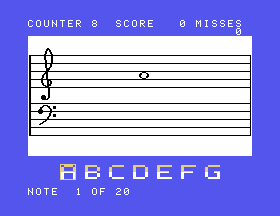 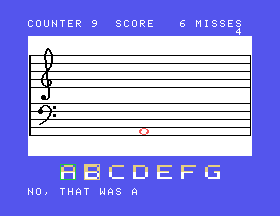 |
|
|
A murder mystery. One of ten guests and staff has been killed somewhere in the fourteen rooms of the manor, and the murderer has fled with the weapon. Walk your detective from room to room through the doorways, search each room, take and drop what you find, and keep notes. You must name the victim, the murderer, who is the one suspect you never find, the weapon, which is the one weapon you never find, and the room where the body lies. The eight room keys all wait in the Pantry, and a skeleton key is hidden in the outer rooms. You can carry only one thing at a time. A NOTES page ticks off every suspect and weapon seen so far. When you accuse, the police arrive with a siren. One wrong accusation and you are off the case.
Controls: Use the joystick and side buttons. In a room, move the cursor over LEAVE, SEARCH, TAKE / DROP, NOTES and ACCUSE and press a button to choose. To leave, push towards a door. When taking, left and right pick the item, the left button takes it and the right button cancels. When accusing, up and down pick the line, left and right pick the name, and a button on ACCUSE! makes the arrest. ColecoVision version credited in the source to Claude (an AI made by Anthropic) for Amy Studio, in Amy, the language by Amy Bienvenu, 2026: a reimagined adaptation of the published rules. From COMPUTE!'s Gazette, September 1984: original Commodore 64 program (no author named in the issue). This is a modern homebrew adaptation, not a commercial Coleco release. Original Amy Studio release file: 059 - MYSTERY AT MARPLE MANOR - by John R. Prager - COMPUTE! Gazette - September 1984.rom |
Amy Studio/Amy Purple (Bienvenu) | 15kb | 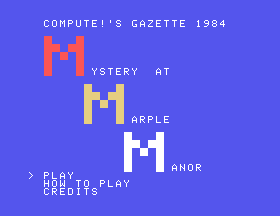 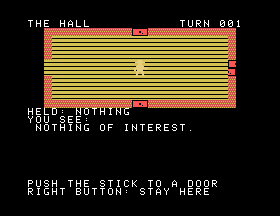 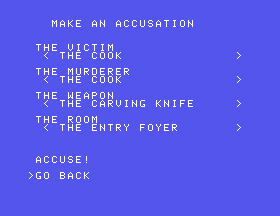 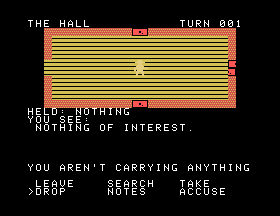 |
|
|
An educational arithmetic game. Choose addition, subtraction, multiplication or division and a level from 1 to 9, and a problem appears in big digits. Dial the answer with the stick and press a button. A right answer moves the Numnom one crumb along the path for 10 points; after every answer, right or wrong, the Minus Cloud behind it drifts one crumb closer. Reach the checkered flag for 100 points and the next board is a level harder. Let the cloud catch up and it zaps the Numnom: 50 points lost and a level easier. Three wrong answers on a board mean a catch. A wrong answer is shown beside the right one. The Numnom has three lives, and clearing the level 9 board wins. A scoreboard shows problems, right, wrong and a grade in per cent.
Controls: Use either controller. Push left or right to pick a digit, up or down to turn it, and press a button to answer. On the title, up and down choose a line, and left or right change the operation and the level. ColecoVision version credited in the source to Claude (an AI made by Anthropic) for Amy Studio, in Amy, the language by Amy Bienvenu, 2026: a reimagined adaptation of the published rules. From COMPUTE!'s Gazette, November 1983: original Commodore 64 program (no author named in the issue). This is a modern homebrew adaptation, not a commercial Coleco release. Original Amy Studio release file: 018 - MUNCHMATH - by Gerald R. Anderson - COMPUTE! Gazette - November 1983.rom |
Amy Studio/Amy Purple (Bienvenu) | 12kb | 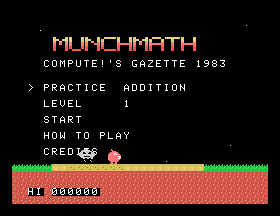 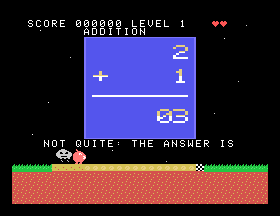 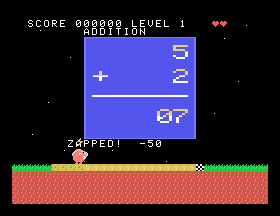 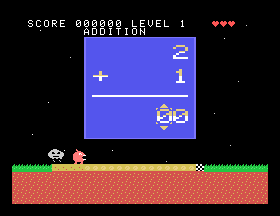 |
|
|
Sixty-four tiles numbered 1 to 64 are in play, and each hand holds ten of them. The goal is to be first to arrange all ten in rising order from left to right. On your turn one tile lies face up in the middle: take it into any of your ten places, and the tile you replace becomes the face-up tile for the next player. Or draw a new tile and either take it or pass. Each tile's colour band climbs with its number, so a hand in order reads as a smooth gradient. When a hand is in order the round ends, and everyone scores 5 points for each tile in the rising run from their first place, 50 for the winner. Seats can be people or the computer. The first to 150 points wins.
Controls: Use either controller. Push left or right to move the arrow under your tiles; the left button takes the face-up tile into the place above the arrow, or presses DRAW or PASS; the right button is DRAW, then PASS. On the title, up and down choose and a button selects, and left or right shows or hides the computer's tiles. ColecoVision version credited in the source to Claude (an AI made by Anthropic) for Amy Studio, in Amy, the language by Amy Bienvenu, 2026: a reimagined adaptation of the published rules. From COMPUTE!'s Gazette, February 1988: original Commodore 64 program by Jay A. Reeve. This is a modern homebrew adaptation, not a commercial Coleco release. Original Amy Studio release file: 175 - MOSAIC - by Jay A. Reeve - COMPUTE! Gazette - February 1988.rom |
Amy Studio/Amy Purple (Bienvenu) | 12kb | 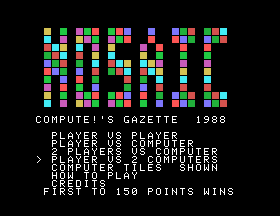 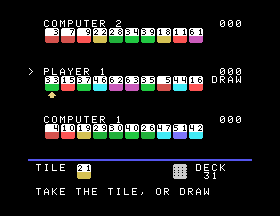 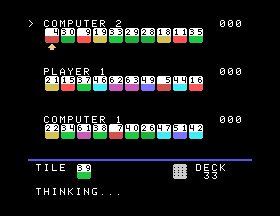 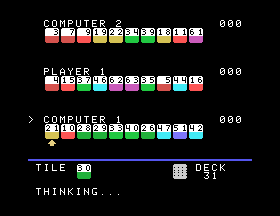 |
|
|
Four astronauts are stranded on the moon, two on the plateaus at the edges and two on landing pads in the valley. Fly your probe down from the mothership past four lanes of drifting rocks, the odd lanes moving right and the even ones left, each at its own speed. Land next to an astronaut to take them aboard, one at a time, and fly back up into the mothership's dock to save them. A probe that hits a rock, leaves the screen, touches the ground away from a landing place or comes up anywhere but the dock is lost along with its passenger. Counters show astronauts saved and lost. When all four of a set are saved or lost, a new set waits below and you earn a bonus probe. You start with three probes.
Controls: Use either joystick. Push up or down to launch the probe and set its drift; any direction steers while held. On the title, push up and down to choose and press a button to start. ColecoVision version credited in the source to Claude (an AI made by Anthropic) for Amy Studio, in Amy, the language by Amy Bienvenu, 2026: a reimagined adaptation of the published rules. From COMPUTE!'s Gazette, December 1986: original Commodore 128 program (no author named in the issue). This is a modern homebrew adaptation, not a commercial Coleco release. Original Amy Studio release file: 140 - MOON RESCUE - by Edward E. Boughton - COMPUTE! Gazette - December 1986.rom |
Amy Studio/Amy Purple (Bienvenu) | 10kb | 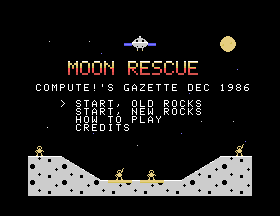 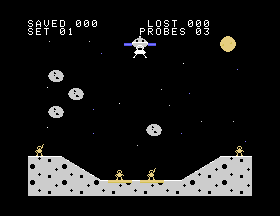 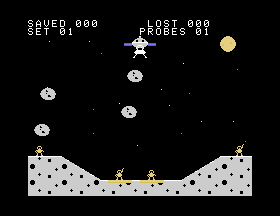 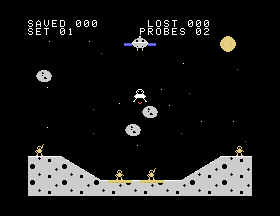 |
|
|
On a stormy night, monsters climb out of the fourteen glowing pits of a brick barbecue, set in three staggered rows of five, four and five. Move the fork sight over a pit and press a button to roast the monster in it for 100 points. A shot at an empty spot is a misfire and costs 50, and a monster that gets back down its pit is a survivor and costs 150. Ten misfires and survivors together end the game. Every 65 seconds lightning strikes and the monsters grow bolder, and after the fifth storm the night is over. The sight wraps around left and right. The total and the high score, which starts at -1500, are shown at the end, with the reason the night ended.
Controls: Use either controller. The stick moves the sight one pit position (hold to keep moving) and either button fires. On the title, push up and down to choose and press a button to start. ColecoVision version credited in the source to Claude (an AI made by Anthropic) for Amy Studio, in Amy, the language by Amy Bienvenu, 2026: a reimagined adaptation of the published rules. From COMPUTE!'s Gazette, July 1989: original Commodore 128 program (no author named in the issue). This is a modern homebrew adaptation, not a commercial Coleco release. Original Amy Studio release file: 219 - MONSTER BAR-B-Q - by Author not named - COMPUTE! Gazette - July 1989.rom |
Amy Studio/Amy Purple (Bienvenu) | 11kb |   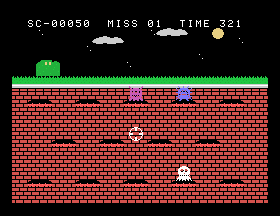 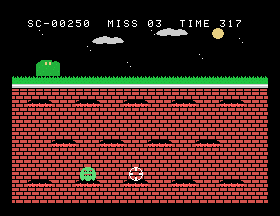 |
|
|
An arcade shooter, not the logic puzzle of the same name. Your minesweeper ship hovers over an industrial landscape that scrolls beneath it; it moves up and down, turns left or right, and fires along its line, one shot at a time. Floating mines come in from both edges: a seeker that drifts towards your height, a fast dart aimed at you and a slow drifter riding a wave. Each mine shot is worth 1 point, and touching a mine or the ground destroys the ship. Survive long enough and the sector's mine layer appears at the right edge, firing bolts that cannot be shot; destroy it for 15 points and NICE BLASTING - SECTOR CLEARED! Clear all five sectors to complete the game. You have nine ships, plus one for every 50 points.
Controls: Use controller 1 or 2. Push up and down to fly, left and right to turn, and press either button to fire. On the title, push up and down to choose and press a button to select. ColecoVision version credited in the source to Claude (an AI made by Anthropic) for Amy Studio, in Amy, the language by Amy Bienvenu, 2026: a reimagined adaptation of the published rules. From COMPUTE!'s Gazette, July 1989: original Commodore 64 program by Ben Campbell. An arcade shooter, not the logic puzzle of the same name. This is a modern homebrew adaptation, not a commercial Coleco release. Original Amy Studio release file: 218 - MINESWEEPER - by B.CAMPBELL - COMPUTE! Gazette - July 1989.rom |
Amy Studio/Amy Purple (Bienvenu) | 14kb | 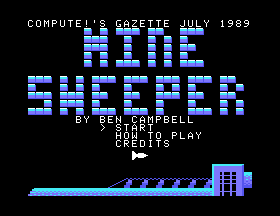 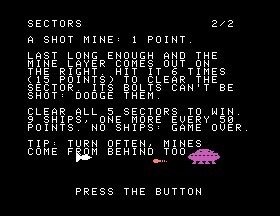 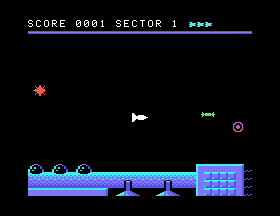 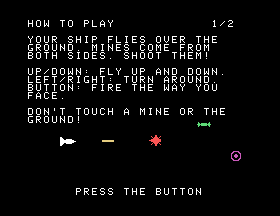 |
|
|
A code-breaking game. The computer chooses four different colours out of six, black, white, red, blue, purple and green, and hides them in a row. Find them, in order, in ten tries. Build each guess by picking colours from a palette; a guess may repeat colours. After each try you get a black ball for each colour in its right place and a white ball for each other right colour in the wrong place. Crack the code for YOU WIN!! and a rating by the number of tries, from LUCKY GUESS! for one try through EXPERT!!!, PRETTY GOOD! and SO SO! to YOU BARELY GOT IT! for nine or ten. After ten misses the hidden colours are shown. The title keeps count of codes broken, games played and the best game.
Controls: Push left and right to move the hand along the palette. The left button drops that colour into the next hole and, with four holes filled, tries the guess; the right button takes the last colour back. ColecoVision version credited in the source to Claude (an AI made by Anthropic) for Amy Studio, in Amy, the language by Amy Bienvenu, 2026: a reimagined adaptation of the published rules. From COMPUTE!'s Gazette, May 1984: original Commodore 64 program (no author named in the issue). This is a modern homebrew adaptation, not a commercial Coleco release. Original Amy Studio release file: 044 - MIND BOGGLE - by Author not named - COMPUTE! Gazette - May 1984.rom |
Amy Studio/Amy Purple (Bienvenu) | 9kb |  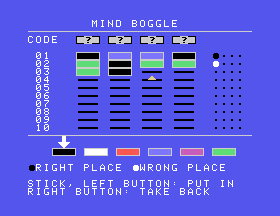 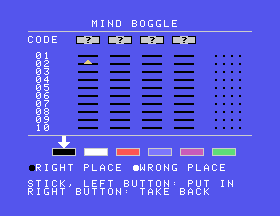 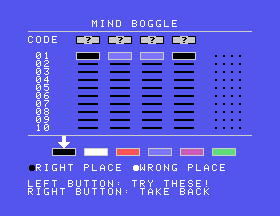 |
|
|
Your rocket is caught in a meteor shower. Steer with the stick and shoot in the direction you last moved, one shot at a time. A big meteor is worth 100 and a small one 200. Six meteors tumble across the field, drifting off one side and returning later, and some are aimed at where the rocket is, so standing still does not pay. A meteor that touches the rocket costs one of five ships. Survive each level until LEVEL COMPLETE: every meteor left bursts and scores, and the next level's meteors fly faster. Finishing level 8 gives an extra ship, and level 9, the last, goes on until the ships run out.
Controls: Use controller 1 or 2. The stick moves the rocket and either side button fires. On the title, push up and down to choose and press a button to select. ColecoVision version credited in the source to Claude (an AI made by Anthropic) for Amy Studio, in Amy, the language by Amy Bienvenu, 2026: a reimagined adaptation of the published rules. From COMPUTE!'s Gazette, July 1986: original Commodore 64 program (no author named in the issue). Machine-language program from the issue's disk. This is a modern homebrew adaptation, not a commercial Coleco release. Original Amy Studio release file: 123 - METEOR STRIKE - by Author not named - COMPUTE! Gazette - July 1986.rom |
Amy Studio/Amy Purple (Bienvenu) | 10kb | 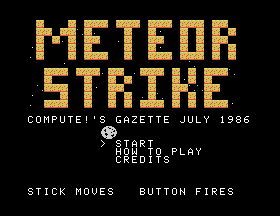 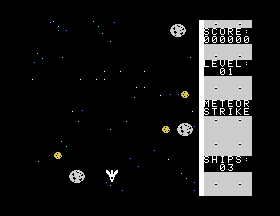 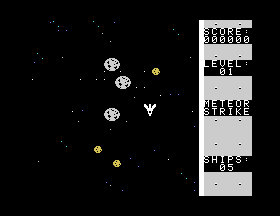 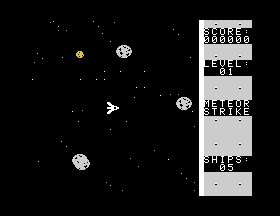 |
|
|
Cross the maze from the left to the exit in the right wall before the time runs out. The maze has three parts: on the left, pillars with one gap each and bouncers running up and down between them; in the middle, bars with one gap each and bouncers running left and right; and on the right, pillars again with bouncers running up and down. Touch a bouncer, let one run into you or run out of time and you lose a man. Clearing a level scores the time left times the level and gives a man back, up to three. There are ten levels, and everything speeds up as they rise. FADE GAME makes the bouncers fade in and out of sight, and NERVOUS GAME makes the walls shudder. Two players take turns.
Controls: Use either controller. The stick moves, diagonals included. On the title, push up and down to choose, left and right to set the number of players, and press a button to start. ColecoVision version credited in the source to Claude (an AI made by Anthropic) for Amy Studio, in Amy, the language by Amy Bienvenu, 2026: a reimagined adaptation of the published rules. From COMPUTE!'s Gazette, September 1985: original Commodore 64 program by Mark Tuttle. This is a modern homebrew adaptation, not a commercial Coleco release. Original Amy Studio release file: 097 - MAZE-MANIA - by MARK TUTTLE - COMPUTE! Gazette - September 1985.rom |
Amy Studio/Amy Purple (Bienvenu) | 10kb | 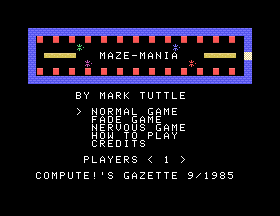 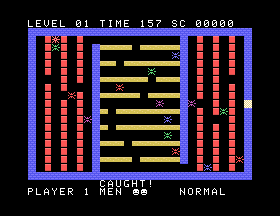 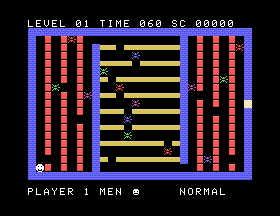 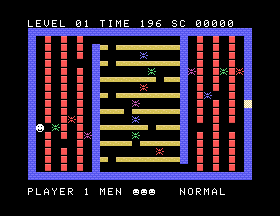 |
|
|
A new random maze is filled with dots, and you, the ball, race the computer, the star, to eat them. The star keeps one hand on the right-hand wall, so a left turn or a dead end costs it a step, while you can go wherever the corridors allow. You both move one cell a step at the same pace, and if you both arrive at a dot together the star gets it. Whoever eats more than half of the dots wins, and the game ends as soon as one side's lead can no longer be caught. The winner is named and a press returns to the title, where a new maze waits. Choose SLOW, NORMAL or FAST on the title.
Controls: Joystick only. The stick moves the ball. On the title, push left and right to choose the speed and press a button to start. ColecoVision version credited in the source to Claude (an AI made by Anthropic) for Amy Studio, in Amy, the language by Amy Bienvenu, 2026: a reimagined adaptation of the published rules. From COMPUTE!'s Gazette, October 1988: original Commodore 64 program (no author named in the issue). Machine-language program from the issue's disk. This is a modern homebrew adaptation, not a commercial Coleco release. Original Amy Studio release file: 198 - MAZE MASTER (mazem) - by Bennie J. Montoya - COMPUTE! Gazette - October 1988.rom |
Amy Studio/Amy Purple (Bienvenu) | 8kb | 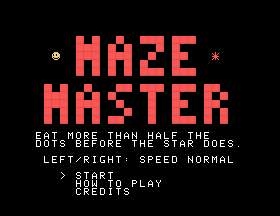 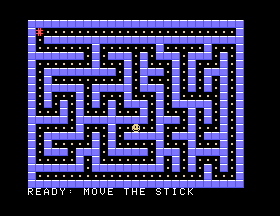 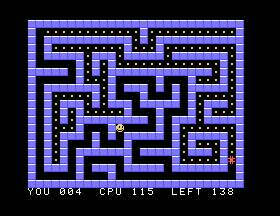 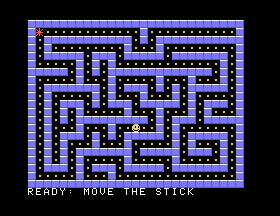 |
|
|
An arithmetic drill with a wizard. Choose addition, subtraction, multiplication or division and a level from 1 to 13. A sum appears on the scroll at the bottom of the screen, and four glowing tablets at the top of the sky hold four answers. Walk the wizard under the right tablet and cast a spark at it for 10 points. A wrong cast takes 10 seconds from the hourglass and blanks that tablet. Five right answers climb a level and refill the hourglass, which holds 55 seconds; when it runs out the game is over, and the last ten seconds tick. Finish level 13 and you graduate with the title of MATH WIZ. The end shows your score and the percentage of right casts.
Controls: Use either controller. On the title, push up and down to choose the operation or CREDITS, left and right to choose the level, and press a button to start. In play, left and right walk and a button casts. ColecoVision version credited in the source to Claude (an AI made by Anthropic) for Amy Studio, in Amy, the language by Amy Bienvenu, 2026: a reimagined adaptation of the published rules. From COMPUTE!'s Gazette, July 1989: original Commodore 128 program (no author named in the issue). This is a modern homebrew adaptation, not a commercial Coleco release. Original Amy Studio release file: 217 - MATH MAGIC - by Author not named - COMPUTE! Gazette - July 1989.rom |
Amy Studio/Amy Purple (Bienvenu) | 11kb | 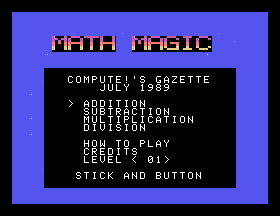  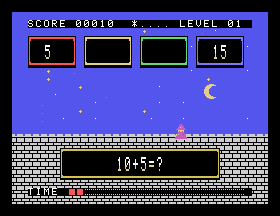 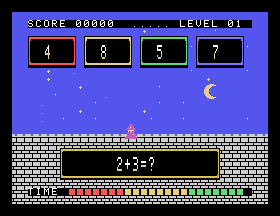 |
|
|
An educational math adventure. In the forest, walk north to the gate, open it, go to the old house and open the milkbox: the note inside holds a math question. Answer it right and the door flies open, and a trap door drops you into the Math Dungeon, a ten-by-ten grid of rooms and hallways. Take the light first. Find the green, blue and red doors and the green and blue keys: the green door hides a map of the dungeon, the blue door hides the red key, and the red door, after one last question, is the way out. Monsters jump out of some rooms and ask a question; answer right and the monster leaves gold, answer wrong and it takes all your gold and transports you elsewhere. Your score is the gold you carry out.
Controls: Use either controller. On the title, push left and right to choose the level and press a button to start. In play the stick walks and a button acts. For questions, up and down change the answer by 1, left and right by 10, and a button answers. ColecoVision version credited in the source to Claude (an AI made by Anthropic) for Amy Studio, in Amy, the language by Amy Bienvenu, 2026: a reimagined adaptation of the published rules. From COMPUTE!'s Gazette, January 1985: original Commodore 64 program (no author named in the issue). One BASIC listing served both the Commodore 64 and the VIC-20; the port follows the Commodore 64 path. This is a modern homebrew adaptation, not a commercial Coleco release. Original Amy Studio release file: 075 - MATH DUNGEON - by Author not named - COMPUTE! Gazette - January 1985.rom |
Amy Studio/Amy Purple (Bienvenu) | 17kb |   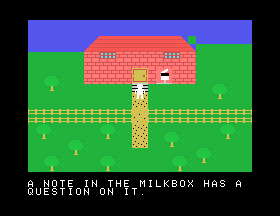 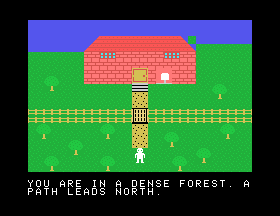 |
|
|
An arithmetic drill played as a city defence. Three bombs fall on a city at night, each carrying a math problem in addition, subtraction or multiplication, chosen on the title along with a starting level. Dial the answer at the bottom of the screen and fire: every falling bomb whose problem has that answer bursts, and a new bomb starts at the top. A wrong answer drops all the bombs closer to the city and speeds them up. Twenty right answers raise the size of the numbers, from one digit up to three-digit by two-digit problems, and the game is won after the hardest level. Three bombs reaching the city lose it. The end shows your right and wrong answers and the bombs that got through.
Controls: Use either controller. On the title, push up and down to choose a line, left and right to change the operation or the level, and press the button to start. In play, left and right choose a slot of the dial, up and down change it (hold to repeat), and a button fires the answer. ColecoVision version credited in the source to Claude (an AI made by Anthropic) for Amy Studio, in Amy, the language by Amy Bienvenu, 2026: a reimagined adaptation of the published rules. From COMPUTE!'s Gazette, October 1986: original Commodore 64 program (no author named in the issue). This is a modern homebrew adaptation, not a commercial Coleco release. Original Amy Studio release file: 133 - MATH ATTACK - by Dan Dickerman - COMPUTE! Gazette - October 1986.rom |
Amy Studio/Amy Purple (Bienvenu) | 12kb | 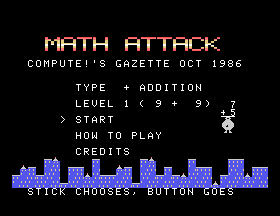 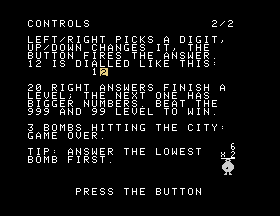 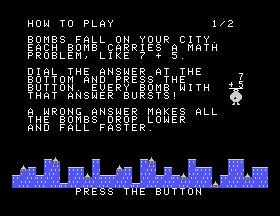 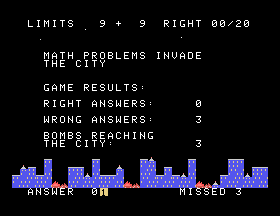 |
|
|
A spot-the-difference game. Four framed boxes, numbered 1 to 4, fill with the same pattern of look-alike symbols, except that in one box a single character on one line has been changed. Find the odd box out and pick it. A wrong guess brings SORRY... TRY AGAIN, adds 45 seconds to your time and marks that box NO. The right one shows CORRECT!, says which line and character are different, marks it in all four boxes and flashes the odd box, then shows your guesses and time. You choose the pattern size first, characters per line and lines per box. A game runs through eleven sets of symbols. One player wins with 75% correct or better; two players are ranked by time or by percentage correct, with a results table at the end.
Controls: Use either joystick. On the title, push up and down to choose a line, left and right to change it, and press a button on START or CREDITS. In the game the stick moves the yellow frame to a box and a button guesses it. ColecoVision version credited in the source to Claude (an AI made by Anthropic) for Amy Studio, in Amy, the language by Amy Bienvenu, 2026: a reimagined adaptation of the published rules. From COMPUTE!'s Gazette, June 1989: original Commodore 64 program (no author named in the issue). This is a modern homebrew adaptation, not a commercial Coleco release. Original Amy Studio release file: 216 - MATCH MANIA - by Donovan E. Anderson, Jr - COMPUTE! Gazette - June 1989.rom |
Amy Studio/Amy Purple (Bienvenu) | 12kb | 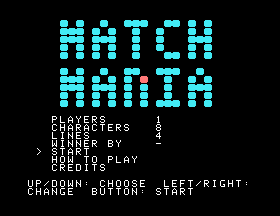 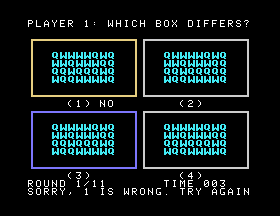 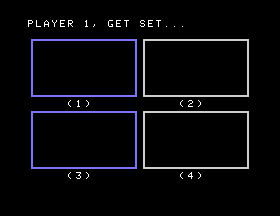 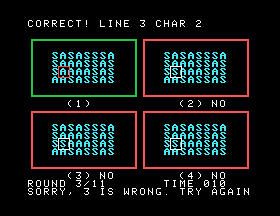 |
|
|
A logic puzzle of nine blocks in a three-by-three square, each orange or light blue, dealt at random. First choose one of five goal patterns: UNI-COLOR, all blue; CROSS, the middle row and column blue with orange corners; NO CENTER, all blue but an orange centre; 4 CORNERS, only the corners blue; or 5 POINTS, corners and centre blue. You may only press an orange block. Pressing it turns it blue and flips its neighbours: a corner flips its two edges and the centre, an edge flips the two corners beside it, and the centre flips the four edges. Every press counts as a move. Reach the goal and you see YOU SOLVED IT IN n MOVES; turn everything blue without reaching it and the game is over.
Controls: Use either joystick. On the title, push up and down, or left and right, to choose a goal and press a button to play. In the game the stick moves the cursor and a button presses the block. ColecoVision version credited in the source to Claude (an AI made by Anthropic) for Amy Studio, in Amy, the language by Amy Bienvenu, 2026: a reimagined adaptation of the published rules. From COMPUTE!'s Gazette, November 1986: original Commodore 64 program (no author named in the issue). This is a modern homebrew adaptation, not a commercial Coleco release. Original Amy Studio release file: 138 - MATCH BLOX - by Mark Tuttle - COMPUTE! Gazette - November 1986.rom |
Amy Studio/Amy Purple (Bienvenu) | 10kb | 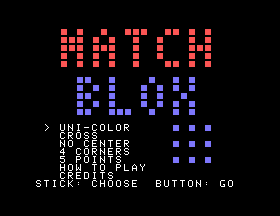 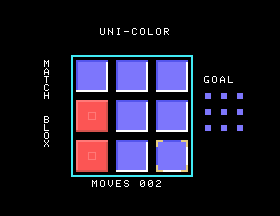 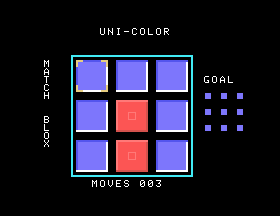 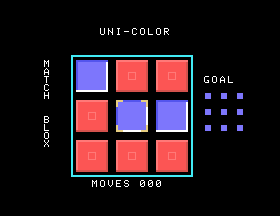 |
|
|
You run on a grid of lanes, always moving, and the stick picks the way you turn at the next crossing. Rival runners chase you, and touching one costs a runner. Pick up the flags for points; each is worth more in later rounds, and a new one appears when one is taken. Survive a round and the next brings more or faster rivals. Every stretch you run takes a hundredth of a mile off the 26 miles to go: reach 0 and you are the greatest runner in history. Once a life, the button makes the rivals drop out for four seconds before they return at the corners. You start with three runners and gain one more every four rounds. Lose your last runner and the marathon is over. A high score is kept.
Controls: Use either controller. The stick steers and either button clears the rivals once a life. On the title, push up and down to choose and press a button to start. ColecoVision version credited in the source to Claude (an AI made by Anthropic) for Amy Studio, in Amy, the language by Amy Bienvenu, 2026: a reimagined adaptation of the published rules. From COMPUTE!'s Gazette, August 1989: original Commodore 128 program (no author named in the issue). This is a modern homebrew adaptation, not a commercial Coleco release. Original Amy Studio release file: 221 - MARATHON - by Leonard Morris - COMPUTE! Gazette - August 1989.rom |
Amy Studio/Amy Purple (Bienvenu) | 9kb | 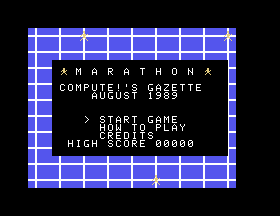 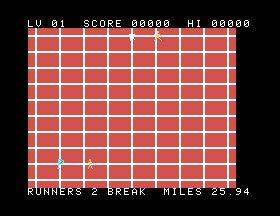 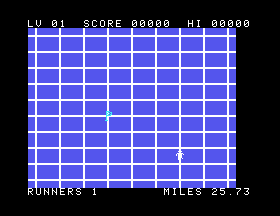 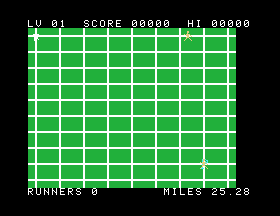 |
|
|
You are a sanitation worker sweeping a park. Walk over every piece of litter to pick it up for 10 points while the litterbugs chase you; one that touches you dirties your uniform and costs a life. Press the button to put down a garbage bag: the first two bugs go for the bag instead of you, and while it lies there every piece of litter is worth ten times as much. A bug that reaches the bag eats it. You have eight bags a life. Now and then a badge appears; pick it up for 1000 points and an extra bag. A clean park ends the level with a bonus for the time left, and the next level brings new litter and a third bug. Choose a speed from 1 to 9 and EASY or NORMAL.
Controls: Joystick only. The stick walks and a side button puts down a bag. On the title, left and right choose the speed from 1 to 9, up and down choose EASY or NORMAL, and a button starts. ColecoVision version credited in the source to Claude (an AI made by Anthropic) for Amy Studio, in Amy, the language by Amy Bienvenu, 2026: a reimagined adaptation of the published rules. From COMPUTE!'s Gazette, November 1987: original Commodore 64 program by Paul Choquette. This is a modern homebrew adaptation, not a commercial Coleco release. Original Amy Studio release file: 165 - LITTERBUG - by PAUL CHOQUETTE - COMPUTE! Gazette - November 1987.rom |
Amy Studio/Amy Purple (Bienvenu) | 10kb | 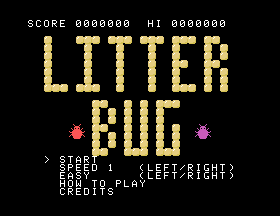 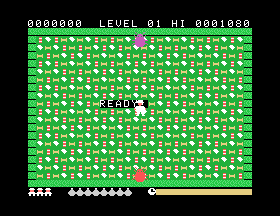   |
|
|
A hooded outlaw in green is lost in an endless forest with archers on his trail. Somewhere lies a sanctuary: the two numbers at the bottom of the screen tell how far it is east to west and north to south, but not in which direction, so you walk and watch them change. Bring both to 0 to reach sanctuary. Arrows fly at you in volleys from the sides, and the closer you get the more arrows come; nine nicks and you are caught. Walking into a tree costs money from your purse of 600, though pushing long enough forces a way through, and an empty purse also ends the game. Only straight moves north, south, east and west are allowed.
Controls: Use controller 1 or 2. The stick walks north, south, west and east. On the title, push up and down to choose and press a button to select. ColecoVision version credited in the source to Claude (an AI made by Anthropic) for Amy Studio, in Amy, the language by Amy Bienvenu, 2026: a reimagined adaptation of the published rules. From COMPUTE!'s Gazette, September 1988: original Commodore 64 program by Robert Bixby. This is a modern homebrew adaptation, not a commercial Coleco release. Original Amy Studio release file: 196 - LINCOLN GREEN - by Robert Bixby - COMPUTE! Gazette - September 1988.rom |
Amy Studio/Amy Purple (Bienvenu) | 10kb |   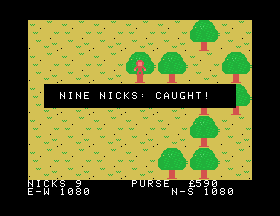 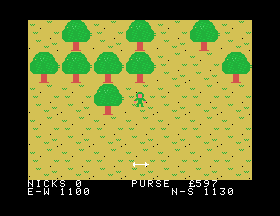 |
|
|
The card game known as 31, Scat or Blitz, played against three computer opponents. Everyone starts with the same number of points, from 5 to 25. Each player holds three cards; on your turn you take the top discard or the top card of the deck, then discard one. A hand counts the cards of its best suit, ace 11, picture cards and tens 10 and the rest their number, up to 31. When you think your hand is good enough you knock: everyone else has one more turn, then the hands are shown. If anyone matches the knocker, the knocker loses two points; otherwise every other player loses one, or two when the knock came in the first round or with 31. A player with no points is out, and the last one left wins.
Controls: Push the joystick left and right to choose the deck or the discard, then the card to throw, and press either button to confirm. When asked whether to knock, choose NO or YES with the stick. ColecoVision version credited in the source to Claude (an AI made by Anthropic) for Amy Studio, in Amy, the language by Amy Bienvenu, 2026: a reimagined adaptation of the published rules. From COMPUTE!'s Gazette, May 1989: original Commodore 64 program (no author named in the issue). This is a modern homebrew adaptation, not a commercial Coleco release. Original Amy Studio release file: 214 - KNOCK 31 - by Robert B. Cook - COMPUTE! Gazette - May 1989.rom |
Amy Studio/Amy Purple (Bienvenu) | 14kb | 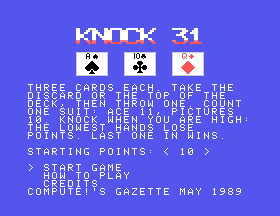 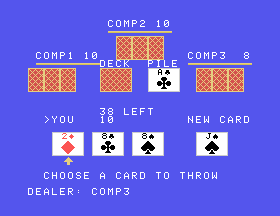 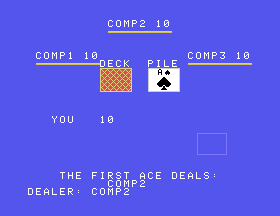 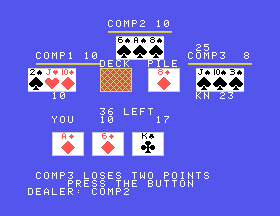 |
|
|
Table soccer, seen from above, with steel rods and round men in red and blue. Each side has three rods of three men. Hold the stick up, centred or down to take your top, middle or bottom rod, and push left and right to slide it. Press the button and that rod's men swing; a ball they touch early in the swing is kicked towards the other goal, while the men of rods that are not swinging let the ball pass through. Blue kicks down and scores in the bottom goal, red kicks up and scores at the top, and a goal lights the net. The first to 9 goals wins. One player can take on the computer at EASY, NORMAL or HARD, and the ball speed is chosen on the title.
Controls: In two-player games controller 1 plays blue and controller 2 red; in one-player games controller 1 plays red. Hold the stick up, centred or down to choose a rod, push left and right to slide it, and press either button to kick. On the title, push up and down to choose a line, left and right to change it, and press a button to start. ColecoVision version credited in the source to Claude (an AI made by Anthropic) for Amy Studio, in Amy, the language by Amy Bienvenu, 2026: a reimagined adaptation of the published rules. From COMPUTE!'s Gazette, February 1986: original Commodore 64 program by John Krause and Mark Tuttle. This is a modern homebrew adaptation, not a commercial Coleco release. Original Amy Studio release file: 110 - KICKER - by J. Krause and Mark Tuttle - COMPUTE! Gazette - February 1986.rom |
Amy Studio/Amy Purple (Bienvenu) | 11kb | 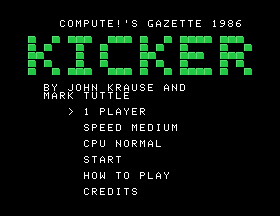 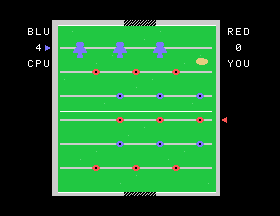 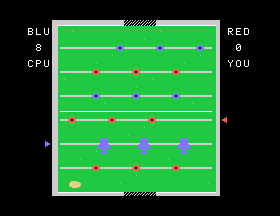 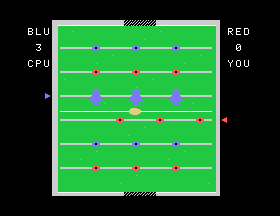 |
|
|
A prankster raccoon on the rooftop walks back and forth along the ledge, dropping firecrackers one at a time. Push your blast bin along the pavement and catch each one before it hits the street; the bin wraps from one edge of the screen to the other. Every catch scores a point, and every ten catches the prankster speeds up. A missed firecracker goes KABLAM!, leaves a scorch mark and costs a spare bin; you have three spares, and a miss with none left ends the game with bursts over the town and GAME OVER. The skill level, from 1 to 15, sets the starting speed.
Controls: Use either controller. The stick moves the bin left and right. On the title, push up and down to choose START GAME or CREDITS, left and right to set the skill, and press a button to start. ColecoVision version credited in the source to Claude (an AI made by Anthropic) for Amy Studio, in Amy, the language by Amy Bienvenu, 2026: a reimagined adaptation of the published rules. From COMPUTE!'s Gazette, January 1985: original Commodore 64 program by Stephen Ressler. This is a modern homebrew adaptation, not a commercial Coleco release. Original Amy Studio release file: 074 - KABLAM! - by STEPHEN RESSLER - COMPUTE! Gazette - January 1985.rom |
Amy Studio/Amy Purple (Bienvenu) | 8kb | 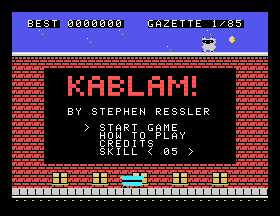 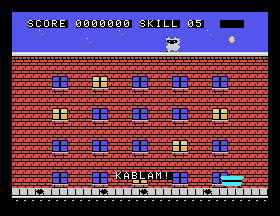 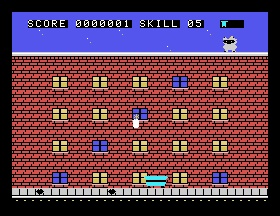 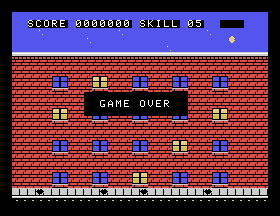 |
|
|
A Ryiad invader patrols the sky over your planet and drops bombs. Your laser base moves along the surface; shoot the Ryiad for 50 points and 45 units of energy, and it reappears somewhere else. Each bomb that lands damages the ground beneath it in stages: first a crack, which is still safe, then a crater, then a pit, and a bomb into a pit costs 25 points. Walking or jumping onto a crater or pit, or being hit by a bomb, costs a base, and you have three. Every step costs 5 energy, every jump 10 and every shot 20; when the energy runs out the game is over with OUT OF ENERGY !! Jump to clear a crater. The invader bombs more often as you score hits. A high score is kept.
Controls: Use either controller. Push left or right to step. Press the right button, or push up, together with left or right to jump. The left button fires. On the title, push up and down to choose, left and right to change the level, and press a button to start. ColecoVision version credited in the source to Claude (an AI made by Anthropic) for Amy Studio, in Amy, the language by Amy Bienvenu, 2026: a reimagined adaptation of the published rules. From COMPUTE!'s Gazette, November 1984: original Commodore 64 program by Fernando Ciccarelli and Marcel Ferreira. This is a modern homebrew adaptation, not a commercial Coleco release. Original Amy Studio release file: 066 - JUMP - by F. Ciccarelli and M. Ferreira - COMPUTE! Gazette - November 1984.rom |
Amy Studio/Amy Purple (Bienvenu) | 9kb | 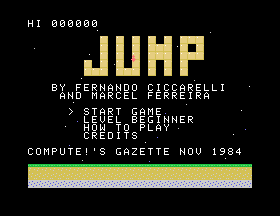 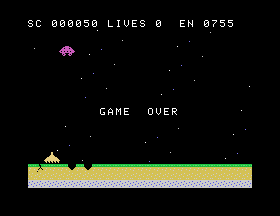 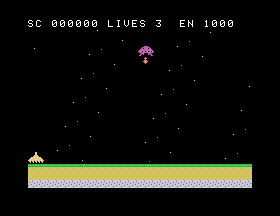 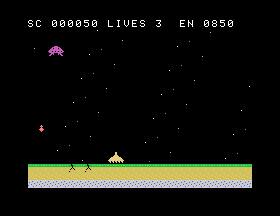 |
|
|
A bidding card game against the computer, the game also known as Goofspiel. You hold the thirteen hearts, the computer holds the thirteen spades, and the thirteen clubs are shuffled face down. Each round one club is turned over and both players bid one card for it at the same time; the computer's bid lies face down until you have chosen. The higher bid takes the club and scores its value, ace 1 up to king 13. A tie takes nothing and the club is lost. Bid cards are spent, so a high card used now is gone for later. The game ends when a player reaches 46, more than half the points, or after the thirteenth club, and the higher score wins. The computer catches on if you keep bidding your lowest heart.
Controls: Push the joystick left and right to choose one of your hearts, and press either button to bid it or to go on. ColecoVision version credited in the source to Claude (an AI made by Anthropic) for Amy Studio, in Amy, the language by Amy Bienvenu, 2026: a reimagined adaptation of the published rules. From COMPUTE!'s Gazette, September 1986: original Commodore 64 program (no author named in the issue). A bidding card game (Goofspiel), not a martial-arts game. This is a modern homebrew adaptation, not a commercial Coleco release. Original Amy Studio release file: 131 - JUJITSU - by Rob Landeros - COMPUTE! Gazette - September 1986.rom |
Amy Studio/Amy Purple (Bienvenu) | 10kb | 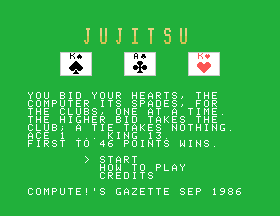 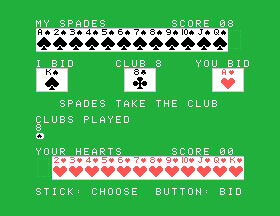 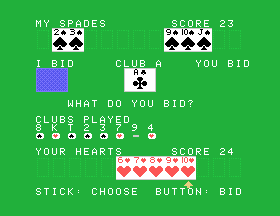 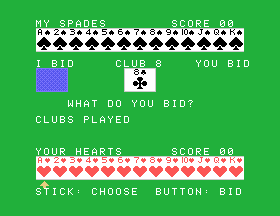 |
|
|
A miner gathers every gem on a cavern screen while round bombs float after him through the rock. Each gem is worth 100. The ledges are stone blocks and the ladders are loose: the miner can pick up as many as four of each and put them down elsewhere to build his own way to gems he could not otherwise reach. He walks, climbs and jumps four rows up. A golden goblet is worth 200 and freezes the bombs for a while. Every so often a bomb stops with its fuse burning and then heads for where the miner now stands. Touching a bomb costs a life and the screen starts again as new. Six screens make a round, each round adds a bomb, and clearing the fourth round wins.
Controls: Use controller 1 or 2. The stick walks left and right and climbs ladders. The button jumps. Stick down plus the button picks up or puts down a block below and ahead; stick up plus the button picks up or puts down a ladder piece. On the title, push up and down to choose, left and right to set the speed, and press a button to select. ColecoVision version credited in the source to Claude (an AI made by Anthropic) for Amy Studio, in Amy, the language by Amy Bienvenu, 2026: a reimagined adaptation of the published rules. From COMPUTE!'s Gazette, January 1989: original Commodore 64 program (no author named in the issue). Machine-language program from the issue's disk. This is a modern homebrew adaptation, not a commercial Coleco release. Original Amy Studio release file: 207 - JEWEL GRAB - by Brian Casey - COMPUTE! Gazette - January 1989.rom |
Amy Studio/Amy Purple (Bienvenu) | 13kb | 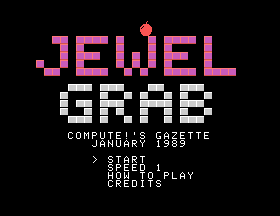 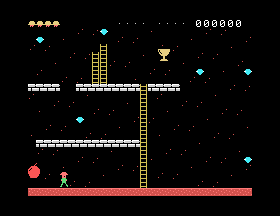 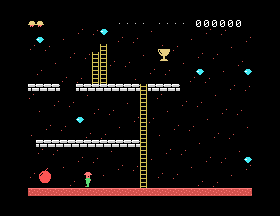 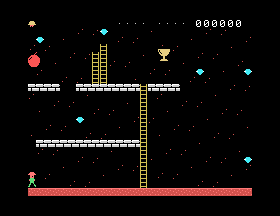 |
|
|
A duel for two players, or one against the computer. The screen is split into two halves, each holding a player's brick wall inside that player's own ring of track, which carries two shields on opposite sides. Turn your ring to keep the balls in your half: every ball that touches a brick of your wall knocks it and shakes a few more loose at random. A ball that slips through a gap in your ring, at the top, the bottom or the middle, flies into your opponent's half and works for them instead. Fallen bricks score steadily for their player. Each new wall takes more hits per brick, and more balls come into play as the levels rise. The first to bring their wall down five times wins.
Controls: Joystick only. Push up or right to turn your ring clockwise, down or left to turn it counter-clockwise. Controller 1 plays the left half and controller 2 the right; with one player, either controller plays the left half. On the title, push up and down to choose and press a button to start. ColecoVision version credited in the source to Claude (an AI made by Anthropic) for Amy Studio, in Amy, the language by Amy Bienvenu, 2026: a reimagined adaptation of the published rules. From COMPUTE!'s Gazette, June 1989: original Commodore 64 program by Robert Bixby. A sequel to Jericho (#114), a different game for two. This is a modern homebrew adaptation, not a commercial Coleco release. Original Amy Studio release file: 215 - JERICHO II - by ROBERT BIXBY - COMPUTE! Gazette - June 1989.rom |
Amy Studio/Amy Purple (Bienvenu) | 10kb |  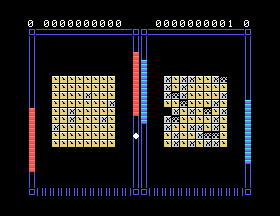 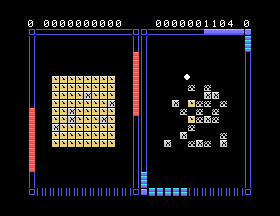 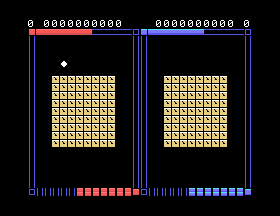 |
|
|
A ball bounces inside a ring that runs around the edge of the screen. Two pieces of the ring, on opposite sides, are solid ramparts and the rest is open. Turn the whole ring so that a rampart is always where the ball arrives; if the ball slips out through an opening it is lost. In the middle stands the wall of Jericho, and every brick the ball touches falls and turns the ball back. Several times a second each fallen brick scores a point, so the wider the breach, the faster the score climbs. Each new ball starts from the middle of the wall, and fallen bricks stay down. There are nine balls, and the game goes on until the last one is lost. The best score is kept.
Controls: Use controller 1 or 2. Push the stick up or right to turn the ring clockwise, down or left to turn it anticlockwise, and press a button to serve the next ball. On the title, push up and down to choose and press a button to select. ColecoVision version credited in the source to Claude (an AI made by Anthropic) for Amy Studio, in Amy, the language by Amy Bienvenu, 2026: a reimagined adaptation of the published rules. From COMPUTE!'s Gazette, June 1988: original Commodore 64 program (no author named in the issue). Machine-language program from the issue's disk. This is a modern homebrew adaptation, not a commercial Coleco release. Original Amy Studio release file: 186 - JERICHO - by Robert Bixby - COMPUTE! Gazette - June 1988.rom |
Amy Studio/Amy Purple (Bienvenu) | 8kb | 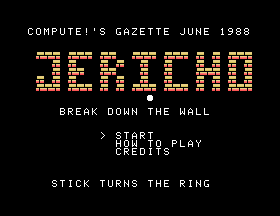 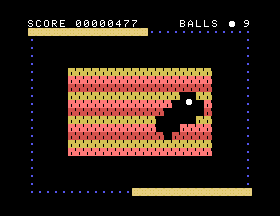 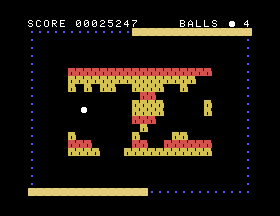  |
|
|
Two rats in a hedge maze, red on the right and blue on the left, each starting at its home pad on the maze's edge. In RACE TO THE OTHER SIDE, the first rat to reach the other's home wins, and arriving together is a tie. In GRAB THE GOLD, every path is strewn with nuggets; a rat picks one up on every square it walks onto and carries them home to bank them at the current value, 500 at the start and 5 less every second for 60 seconds, so the bigger bank wins. Drones wander the maze, and a rat a drone touches goes back home and drops what it carries. Choose up to nine drones and a VISIBLE or INVISIBLE maze, shown at the end. One player can race against a computer rat.
Controls: Joystick only. Red, on the right, uses controller 1; blue, on the left, controller 2. On the title, push up and down to choose a line, left, right or a button to change it, and press a button on START. ColecoVision version credited in the source to Claude (an AI made by Anthropic) for Amy Studio, in Amy, the language by Amy Bienvenu, 2026: a reimagined adaptation of the published rules. From COMPUTE!'s Gazette, March 1988: original Commodore 64 program (no author named in the issue). Machine-language program from the issue's disk. This is a modern homebrew adaptation, not a commercial Coleco release. Original Amy Studio release file: 178 - THE HUMAN RAT RACE - by Roger Hughes - COMPUTE! Gazette - March 1988.rom |
Amy Studio/Amy Purple (Bienvenu) | 11kb |   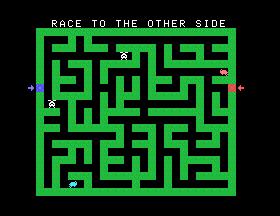 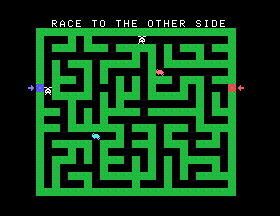 |
|
|
A board game for one to four players on seven by six stone plates. Each player starts on a home plate in a corner: red top left, green bottom right, blue top right and magenta bottom left. On a turn you step to one of the eight plates around your token, if it is still there and nobody is on it, and then knock out any empty plate on the board that is not a home plate; it cracks and falls away. After each turn, a player with no free plate around the token is isolated and leaves the game. The last player left wins and is named. With one player, green is the computer, which pauses to show the plate it will knock out.
Controls: Use either controller and pass it on in turn. Push the stick towards a plate and press a button to step there, then move the cross-hair to a plate and press a button to knock it out. On the title, push up and down to choose and press a button to start. ColecoVision version credited in the source to Claude (an AI made by Anthropic) for Amy Studio, in Amy, the language by Amy Bienvenu, 2026: a reimagined adaptation of the published rules. From COMPUTE!'s Gazette, May 1990: original Commodore 64 program (no author named in the issue). This is a modern homebrew adaptation, not a commercial Coleco release. Original Amy Studio release file: 236 - ISOLATION (COMPUTE!'s Gazette, May 1990) - by Author not named - COMPUTE! Gazette - May 1990.rom |
Amy Studio/Amy Purple (Bienvenu) | 12kb |  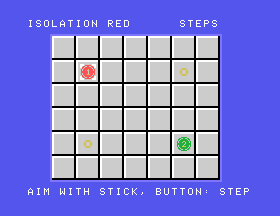 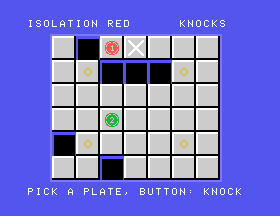 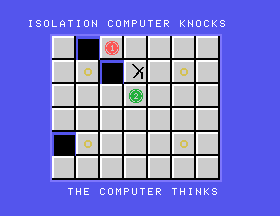 |
|
|
A stock-market trading game. One or two investors start with $1,000 each and trade in eleven mutual funds while the market runs against a time limit. Every tick one fund moves 1 to 5 points up or down, marked with an arrow and described on a ticker line. A fund that reaches 200 splits, doubling your shares and returning the price to 100; a fund that falls to 0 breaks, wiping out your shares in it. Each move pays a dividend to the fund's holders. The market pauses while a player trades, and leaving the trading screen costs some time. When time runs out the market closes and cash plus holdings is your net worth: two players see the winner, one player sees the gain or loss, and a best net worth is kept.
Controls: Use either controller. In the market a button opens that controller's player's trading screen. There, pick a fund with the stick, push right to buy and left to sell (hold to go faster), press the left button to buy as many as the cash allows and the right button to sell the whole holding. On the title, push up and down to choose a line, left and right to change the players or the time, and press a button to start. ColecoVision version credited in the source to Claude (an AI made by Anthropic) for Amy Studio, in Amy, the language by Amy Bienvenu, 2026: a reimagined adaptation of the published rules. From COMPUTE!'s Gazette, August 1988: original Commodore 64 program (no author named in the issue). This is a modern homebrew adaptation, not a commercial Coleco release. Original Amy Studio release file: 192 - INVESTOR - by Troy Tucker - COMPUTE! Gazette - August 1988.rom |
Amy Studio/Amy Purple (Bienvenu) | 15kb | 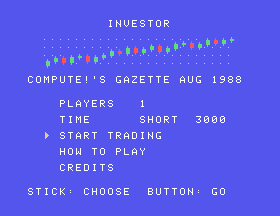 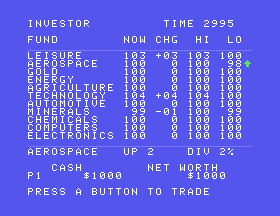   |
|
|
BLACK and WHITE stand in a field around a lava vent. The lava spreads outward a cell at a time, and a player it reaches, or who walks into it, is burnt and loses one of five lives before a new round starts. Press the button to switch building on or off: a building player walks more slowly and leaves a brick behind with every step. Bricks hold back the lava for a while, but lava touching a brick heats it through four colours until it melts into lava itself. Both players burnt at the same moment both lose a life. The last player with lives left wins, and if both go out together it is a draw. One player can take BLACK against a computer WHITE.
Controls: Joystick only. BLACK uses controller 1 and WHITE controller 2; in a one-player game either controller moves BLACK. The stick walks and a button switches building on or off. On the title, push up and down to choose a line, left, right or a button to change it, and press a button on START. ColecoVision version credited in the source to Claude (an AI made by Anthropic) for Amy Studio, in Amy, the language by Amy Bienvenu, 2026: a reimagined adaptation of the published rules. From COMPUTE!'s Gazette, September 1988: original Commodore 64 program (no author named in the issue). A second build of the same program as #122 (identical source). Machine-language program from the issue's disk. This is a modern homebrew adaptation, not a commercial Coleco release. Original Amy Studio release file: 194 - Lava Flow - by Author not named - COMPUTE! Gazette - September 1988.rom |
Amy Studio/Amy Purple (Bienvenu) | 8kb | 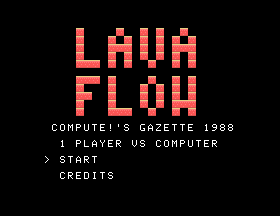 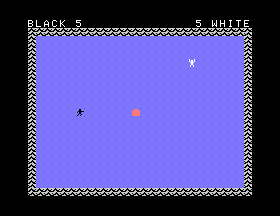 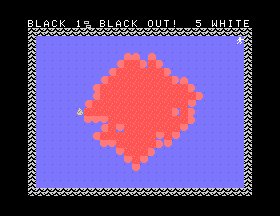 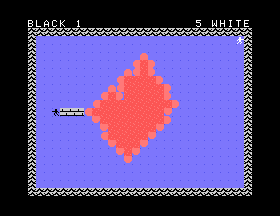 |
|
|
You fly a jet over an enemy base of ten heat-seeking missiles standing on their pads. Strafe the pads to destroy them for 50 points each, but every little while the right-most missile lifts off and chases the heat of your engine. It flies faster than you, but you turn tighter. You cannot shoot it down: dodge it, or lead it into a missile still on its pad, which blows it up for 100 points. Touching a full pad or being caught by the missile costs a ship. You earn 10 points for every stretch you survive, and when every pad is empty the base is cleared for 1000 points and a ship back. The screen wraps from side to side. One or two players take turns, with eight ships each, at NOVICE, INTERMEDIATE or EXPERT.
Controls: Use controller 1 or 2. Left and right, or up and down, turn the jet, and a side button fires; hold it for a stream of shots. On the title, push up and down to choose a line, left and right to change the skill or the number of players, and press a button to start. ColecoVision version credited in the source to Claude (an AI made by Anthropic) for Amy Studio, in Amy, the language by Amy Bienvenu, 2026: a reimagined adaptation of the published rules. From COMPUTE!'s Gazette, March 1985: original Commodore 64 program by Jeff Wolverton. The port follows the machine-language Commodore 64 version; the same issue also had a VIC-20 BASIC version. This is a modern homebrew adaptation, not a commercial Coleco release. Original Amy Studio release file: 082 - HEAT SEEKER - by J.WOLVERTON - COMPUTE! Gazette - March 1985.rom |
Amy Studio/Amy Purple (Bienvenu) | 13kb | 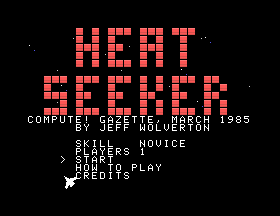 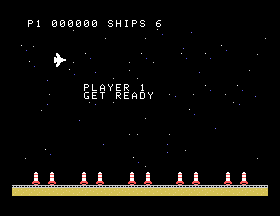   |
|
|
A word search against an energy meter. Ten words hide in a field of 20 by 15 letters. Move the cursor onto a letter of a hidden word and press the button: the letter lights up and your energy rises by one. Light every letter of a word to find it, and find all ten to win, with your time shown. Pressing a letter that belongs to no word costs one energy and brings TRY ANOTHER, and the energy also drains at random moments. Now and then a clue names a word you have not started. Level 1 hides words forwards across or down, level 2 adds backwards and level 3 adds diagonals. When the energy runs out the game is over and the words you missed are shown in red.
Controls: Use either controller. The stick moves the cursor and a side button marks the letter under it. On the title, push up and down to choose and press a button to start. ColecoVision version credited in the source to Claude (an AI made by Anthropic) for Amy Studio, in Amy, the language by Amy Bienvenu, 2026: a reimagined adaptation of the published rules. From COMPUTE!'s Gazette, February 1986: original Commodore 64 program by Ron Wilson. A second build of the same program as #124 (identical source). This is a modern homebrew adaptation, not a commercial Coleco release. Original Amy Studio release file: 111 - Lexitron - by RON WILSON - COMPUTE! Gazette - February 1986.rom |
Amy Studio/Amy Purple (Bienvenu) | 10kb | 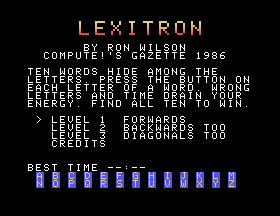 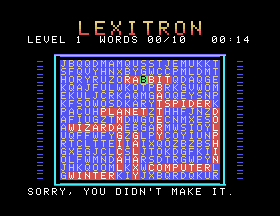 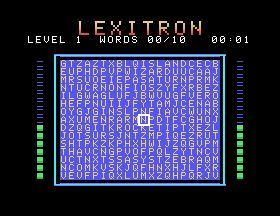 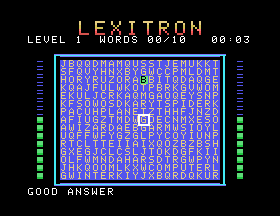 |
|
|
A letter-recognition game. One letter at a time drops down a brick chute; before it falls, a counter runs through the alphabet and stops on it. Turn your dial to the same letter and press the button to shoot it before it reaches the floor. The higher you catch it, the better your time. A wrong shot freezes the dial for a moment, and a third wrong shot loses the letter; a letter that reaches the floor is simply lost. Choose a difficulty level from 1 to 9, which sets the speed of the fall, and how many letters to play, from 10 to 90. At the end you see your score, high score, highest possible score, an efficiency rating and an average time, where 1 is good and 22 is bad.
Controls: Use either controller. The stick turns the dial, left and right one letter and up and down five, and either button shoots. On the title, push up and down to choose and left and right to set the level or the number of letters; a button starts. ColecoVision version credited in the source to Claude (an AI made by Anthropic) for Amy Studio, in Amy, the language by Amy Bienvenu, 2026: a reimagined adaptation of the published rules. From COMPUTE!'s Gazette, December 1984: original Commodore 64 program (no author named in the issue). A second build of the same program as #123 (identical source). This is a modern homebrew adaptation, not a commercial Coleco release. Original Amy Studio release file: 070 - Letter Attack! - by Craig Howarth - COMPUTE! Gazette - December 1984.rom |
Amy Studio/Amy Purple (Bienvenu) | 8kb | 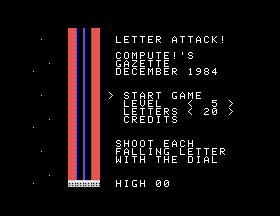 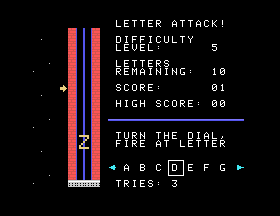 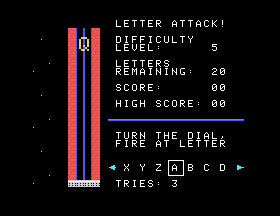 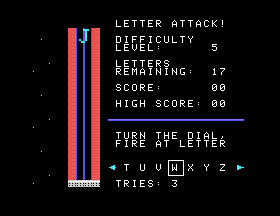 |
|
|
Klondike solitaire played for money. Your bank starts at $500. Before each deal you see the face-up cards and place a bet, which is charged once for every card in the deck; every card that reaches its suit pile pays five times the bet back, and getting all 52 home pays a large bonus on top. Seven columns hold one to seven cards with the last face up. The deck is dealt one card at a time onto the stack, in a single pass. A column's whole face-up run moves at once onto a card one higher of the other colour, and only a king goes to an empty column. Cards are played home automatically when it is safe. A bank at or below $0 means BROKE and the game ends.
Controls: Use either joystick. Left and right move the cursor over the seven columns and onto the right-hand panel, where up and down choose the piles, deck or stack. The left button deals from the deck, or picks up and puts down cards. The right button sends a card to its pile. Hold both buttons to end the deal. ColecoVision version credited in the source to Claude (an AI made by Anthropic) for Amy Studio, in Amy, the language by Amy Bienvenu, 2026: a faithful adaptation of the published rules. From COMPUTE!'s Gazette, May 1986: original Commodore 64 program (no author named in the issue). This is a modern homebrew adaptation, not a commercial Coleco release. Original Amy Studio release file: 118 - KLONDIKE - by James E. Hosek - COMPUTE! Gazette - May 1986.rom |
Amy Studio/Amy Purple (Bienvenu) | 14kb | 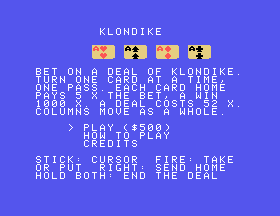 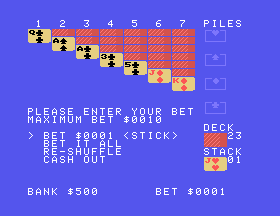 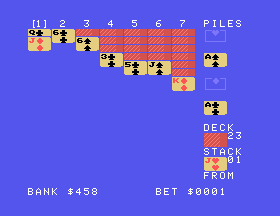 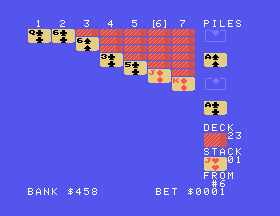 |
|
|
A geography chase across a political map of the world as it stood in 1990, with 149 countries. A criminal hides in one country and you start in another. Travel from country to neighbouring country to reach his hideout; an arrow at the edge of the map points towards him, and you see him once he is on your part of the map. Each turn he may slip away to one of his neighbours, and each of his moves takes $100 off the $10,000 bounty. Catch him, then take him back to the country you started from before the time runs out, six minutes at level 1 down to one minute at level 6, or he escapes and the chase begins again. If the bounty reaches $0 he gets away for good.
Controls: Use either controller. The stick points at a neighbouring country, the right button steps through the choices, including STAY and LOOK, and the left button goes. In LOOK the stick scrolls the map and a button returns. On the title, push up and down to choose a line, left and right to change it, and press a button to start. ColecoVision version credited in the source to Claude (an AI made by Anthropic) for Amy Studio, in Amy, the language by Amy Bienvenu, 2026: a reimagined adaptation of the published rules. From COMPUTE!'s Gazette, March 1990: original Commodore 128 program (no author named in the issue). This is a modern homebrew adaptation, not a commercial Coleco release. Original Amy Studio release file: 232 - International Bounty Hunter - by Author not named - COMPUTE! Gazette - March 1990.rom |
Amy Studio/Amy Purple (Bienvenu) | 23kb | 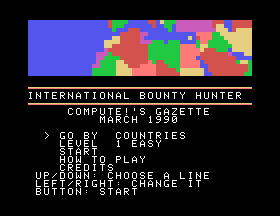 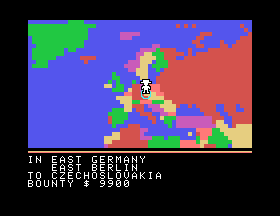   |
|
|
The witch is away on her broom, and inside her house, a maze under a pointed roof, she keeps ten yellow cats. Pick up one cat at a time, turning yellow while you carry it, and bring it to the bottom row of the house; each saved cat sits outside on the grass. Save all ten and a new house appears for another round. A ghost or a bat gives you a fright: it vanishes, you drop your cat somewhere else in the house, lose points and jump a cell in a random direction. Purple spirits float along the hallways, and touching one ends the game, though the bottom row is safe from them. Skill 1 to 6 sets the number of ghosts, bats and spirits and the points a cat is worth. The best score is kept.
Controls: Use either controller. The stick moves; hold it to keep walking. On the title, push up and down to choose, left and right to change the skill level, and press a button to start. ColecoVision version credited in the source to Claude (an AI made by Anthropic) for Amy Studio, in Amy, the language by Amy Bienvenu, 2026: a reimagined adaptation of the published rules. From COMPUTE!'s Gazette, February 1984: original Commodore 64 program by Calvin Overhulser. This is a modern homebrew adaptation, not a commercial Coleco release. Original Amy Studio release file: 034 - Haunted Mansion - by Calvin Overhulser - COMPUTE! Gazette - February 1984.rom |
Amy Studio/Amy Purple (Bienvenu) | 9kb |   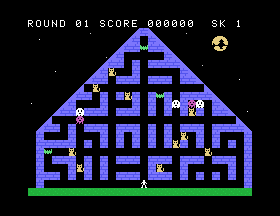 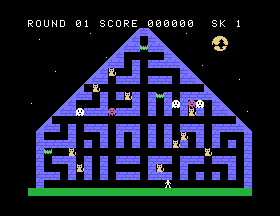 |
|
|
An American history word jumble. Each game asks five words picked from 33, each shown with its letters scrambled, and you rebuild the word from the letter blocks within 30 seconds. Right with no clue scores 10. Wrong or out of time, a clue appears and you try again for 7, then 5 after the second clue and 2 after the third; after that the word is shown for no points. A word is never asked twice in one game. After every word your covered wagon rolls west across the map to the stop your score has reached: under 20 STUCK ON EAST COAST, then ALMOST TO THE MISSISSIPPI, MADE IT TO THE ROCKIES, and at 40 or more CALIFORNIA AND GOLD!
Controls: Push left and right to choose a letter, press the left button to lay it down and the right button to take the last one back. In menus, push up and down and press a button. ColecoVision version credited in the source to Claude (an AI made by Anthropic) for Amy Studio, in Amy, the language by Amy Bienvenu, 2026: a reimagined adaptation of the published rules. From COMPUTE!'s Gazette, March 1984: original Commodore 64 program (no author named in the issue). This is a modern homebrew adaptation, not a commercial Coleco release. Original Amy Studio release file: 037 - Guess America! - by Ellen Barcel - COMPUTE! Gazette - March 1984.rom |
Amy Studio/Amy Purple (Bienvenu) | 15kb | 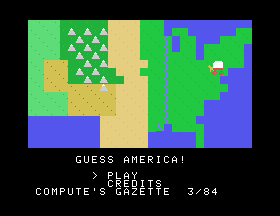 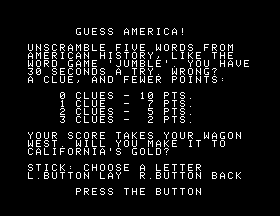 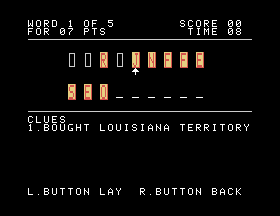 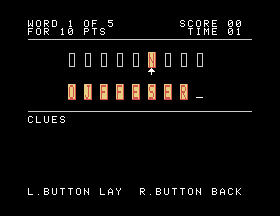 |
|
|
A dice-and-board game on a six-by-six grid with columns 1 to 6 and rows A to F. One to five players and the computer take turns. Each turn the dice throw two different columns and two different rows, marking out a rectangle, and the player claims any square inside it, even one another player owns, which then becomes his. The first to own a square in every column and every row achieves GRIDLOC and wins; only the player who moves can win. The computer weighs each square, favouring columns and rows it lacks and blocking any player close to GRIDLOC. A score list beside the board shows the columns and rows each player covers, and a fanfare greets the winner.
Controls: Use either controller; players share it in turn. The stick moves the cursor and either button claims the square. On the title, push up and down to choose, left and right to change the number of players, and press a button to start. ColecoVision version credited in the source to Claude (an AI made by Anthropic) for Amy Studio, in Amy, the language by Amy Bienvenu, 2026: a reimagined adaptation of the published rules. From COMPUTE!'s Gazette, February 1989: original Commodore 128 program (no author named in the issue). This is a modern homebrew adaptation, not a commercial Coleco release. Original Amy Studio release file: 208 - Gridloc - by Author not named - COMPUTE! Gazette - February 1989.rom |
Amy Studio/Amy Purple (Bienvenu) | 10kb |  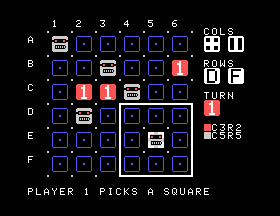 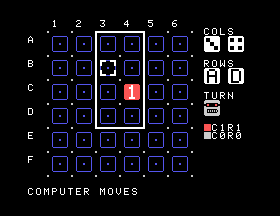 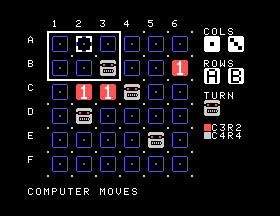 |
|
|
A worker has to cross the four floors of a tower made entirely of open lift shafts. Seven lift cars run up and down their shafts without stopping, each at its own speed. Walk floor 1 from right to left, ride the landing's platform up, walk floor 2 from left to right, and so on; after floor 4 the platform carries you off the roof. The landings are safe, but a car that touches the worker in a shaft knocks him flat and he starts that floor again. Each floor is worth 100 points and the bonus clock, counting down from 1000, is added at the end of a level; if it reaches zero the game ends at once. You have five men, with extras at levels 5, 10 and 15, and the cars speed up every level.
Controls: Use controller 1 or 2. The stick walks the worker left and right. On the title, push up and down to choose and press a button to select. ColecoVision version credited in the source to Claude (an AI made by Anthropic) for Amy Studio, in Amy, the language by Amy Bienvenu, 2026: a reimagined adaptation of the published rules. From COMPUTE!'s Gazette, June 1987: original Commodore 64 program (no author named in the issue). Taken from the issue's disk (machine-language program). This is a modern homebrew adaptation, not a commercial Coleco release. Original Amy Studio release file: 153 - Going Up- - by Author not named - COMPUTE! Gazette - June 1987.rom |
Amy Studio/Amy Purple (Bienvenu) | 9kb |  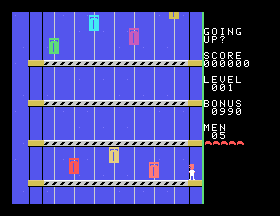 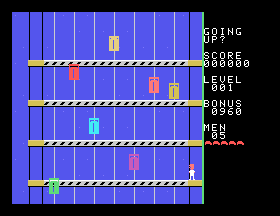 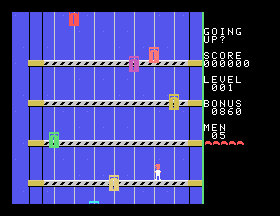 |
|
|
A board game on a jigsaw of 70 regions in 18 shapes. The 70 matching pieces are dealt at random, 35 to each side, and both hands are shown beside the board with a count per shape. On your turn you place one of your pieces on a free region of the same shape, and every neighbouring region your opponent holds turns to your colour. After 70 turns the regions are counted: in TAKE the most regions wins, in GIVE the fewest wins, and equal counts tie. Play against a friend or the computer, which can move first or second and plays either RANDOM or GREEDY. Regions you can play are shown white and the others grey, and captured regions turn over one by one.
Controls: The stick moves the cursor from region to region and a button places a piece. On the title, push up and down to choose, left, right or a button to change an option, and press a button on START GAME to begin. ColecoVision version credited in the source to Claude (an AI made by Anthropic) for Amy Studio, in Amy, the language by Amy Bienvenu, 2026: a reimagined adaptation of the published rules. From COMPUTE!'s Gazette, August 1987: original Commodore 64 program (no author named in the issue). This is a modern homebrew adaptation, not a commercial Coleco release. Original Amy Studio release file: 158 - Give 'N' Take - by Mark Tuttle - COMPUTE! Gazette - August 1987.rom |
Amy Studio/Amy Purple (Bienvenu) | 13kb | 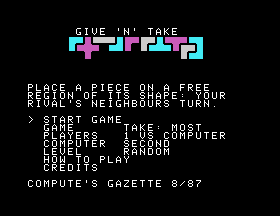 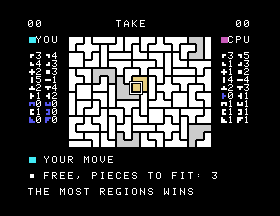 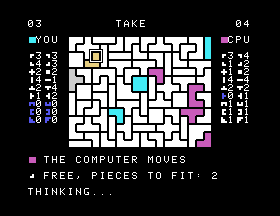 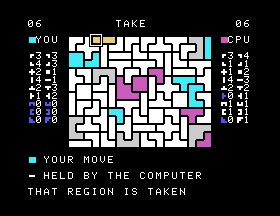 |
|
|
A picture of diagonal colour bands on light blue is cut into a three-by-three set of square pieces and mixed up. Put it back together by rolling rows and columns: each move shifts a whole row one piece left or right, or a whole column one piece up or down, and the piece pushed off one end comes back at the other. Corner, edge and centre pieces are told apart by their fill pattern. The board is always mixed so that it can be solved. A move counter and a clock run while you work, a message appears when the picture is whole, and the best move count is kept. You can give up at any time.
Controls: Use either controller. The stick moves the cursor, which wraps around. Hold the left button and push the stick to roll the row or column. Hold the right button for two seconds to give up. On the title, push up and down to choose and press a button to start. ColecoVision version credited in the source to Claude (an AI made by Anthropic) for Amy Studio, in Amy, the language by Amy Bienvenu, 2026: a reimagined adaptation of the published rules. From COMPUTE!'s Gazette, October 1987: original Commodore 64 program by Rhett Anderson and David Hensley Jr.. Originally a GEOS application with no goal or ending; its source listing came on the November 1987 disk. The scramble, solve check and move counter are added. This is a modern homebrew adaptation, not a commercial Coleco release. Original Amy Studio release file: 162 - Geopuzzle - by R. ANDERSON & D. HENSLEY JR - COMPUTE! Gazette - October 1987.rom |
Amy Studio/Amy Purple (Bienvenu) | 10kb |  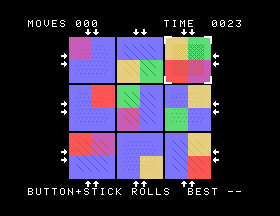 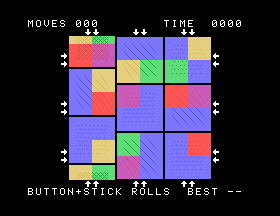 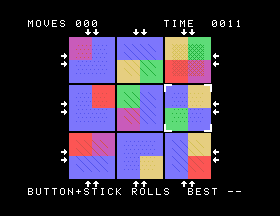 |
|
|
Two platoons of eight soldiers, red and blue, fight over the last forest. Players take turns: pick one of your soldiers, carry it up to its MOVE number of cells in any direction and drop it; pines and your own soldiers block the way. Drop it on an enemy and the two fight it out in an arena with five bunkers, each trooper running and shooting with its own speed, bolt speed, damage and weapon, AUTO reloading fast and SEMI slowly. Every hit takes damage off the target's strength, and at zero the trooper falls. The attacker gets 10 extra strength for the fight, and the winner takes the cell with whatever strength is left. Win by beating all eight enemy soldiers or by holding all three flagged hilltops at once. One player commands red against a computer-led blue platoon.
Controls: In one-player games either controller plays red; in two-player games controller 1 is red and controller 2 is blue. The stick moves the cursor or the trooper; either button picks up, drops or fires (hold to keep firing). Button 2 also puts a carried soldier back. On the title, push up and down to choose and press a button to start. ColecoVision version credited in the source to Claude (an AI made by Anthropic) for Amy Studio, in Amy, the language by Amy Bienvenu, 2026: a reimagined adaptation of the published rules. From COMPUTE!'s Gazette, August 1987: original Commodore 64 program by Georg Zimmer and Paul Zimmer. This is a modern homebrew adaptation, not a commercial Coleco release. Original Amy Studio release file: 157 - Front Line - by Georg and Paul Zimmer - COMPUTE! Gazette - August 1987.rom |
Amy Studio/Amy Purple (Bienvenu) | 15kb |  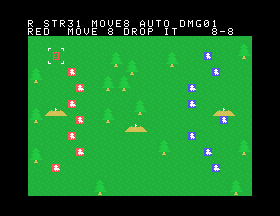 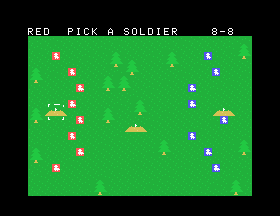 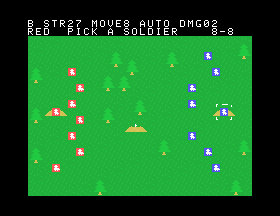 |
|
|
Guide a little alien around a fenced field and pick up all 20 candies. Once they are gone a space phone appears in the top left corner: walk to it and he calls home. A spaceship then lands in the middle of the field; walk onto its ramp and he flies home. Cans of cola give him an allergic reaction: he drinks one, glug-glug, and staggers a step in a random direction, possibly onto more cola, a candy or a flu bug. Touching a flu bug, or running out of the one-minute clock, gives him the flu and he cannot go home. Skill levels 1 to 5 set how many flu bugs and cans there are, and at level N, N of the bugs wander about. The best time is kept for each skill level.
Controls: Use either controller. The stick walks the alien in eight directions; hold it to keep walking. On the title, push up and down to choose, left and right to change the skill level, and press a button to start. ColecoVision version credited in the source to Claude (an AI made by Anthropic) for Amy Studio, in Amy, the language by Amy Bienvenu, 2026: a reimagined adaptation of the published rules. From COMPUTE!'s Gazette, September 1985: original Commodore 64 program (no author named in the issue). This is a modern homebrew adaptation, not a commercial Coleco release. Original Amy Studio release file: 096 - Friendly Alien - by Author not named - COMPUTE! Gazette - September 1985.rom |
Amy Studio/Amy Purple (Bienvenu) | 10kb | 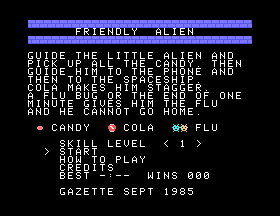 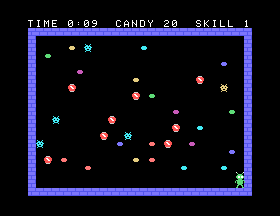 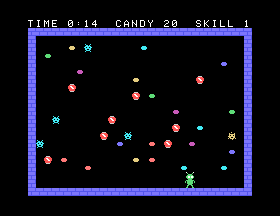 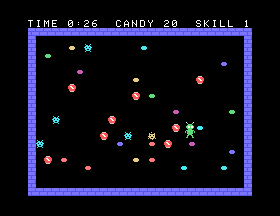 |
|
|
A quiz on 41 flags of the world. LEARN FLAGS pages through the flags with their names. In ONE PLAYER, ten flags are shown one at a time, each with three names, the right one and two others; a timer counts down from 15. A right answer adds the time left times 50, a wrong one takes off the time left times 30, never below zero, and running out of time scores nothing. Flags do not repeat until all 41 have been asked. In TWO PLAYERS, both choose at once with their own joystick and arrow, and the first to press the button answers for that flag; the first past 5000 points wins, and the end names the winner. The flags are drawn with their real emblems.
Controls: Push up and down to choose a name and press a side button to answer. In learn mode, left and right change the flag and a button goes back to the title. ColecoVision version credited in the source to Claude (an AI made by Anthropic) for Amy Studio, in Amy, the language by Amy Bienvenu, 2026: a reimagined adaptation of the published rules. From COMPUTE!'s Gazette, January 1990: original Commodore 64 program (no author named in the issue). This is a modern homebrew adaptation, not a commercial Coleco release. Original Amy Studio release file: 228 - Flags - by Author not named - COMPUTE! Gazette - January 1990.rom |
Amy Studio/Amy Purple (Bienvenu) | 22kb | 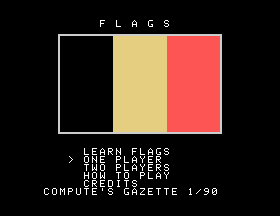 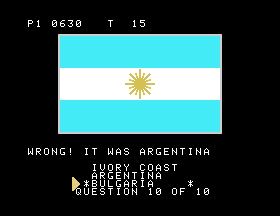   |
|
|
An arithmetic drill for young players. A ten-floor building is on fire with one person waving at a window on every floor. The fire engine arrives, the ladder goes up and the fireman climbs to the top. Each floor asks one problem in addition, subtraction, multiplication or division; a right answer puts out that floor's fire, saves its person, who then stands on the sidewalk, and sends the fireman down a floor. A wrong answer brings NO!!! and the same problem stays while the clock keeps running. Three levels set the clock for the whole building at 90, 68 or 45 seconds, and the last ten seconds tick. Save all ten for a fanfare and YAY!!!, with the seconds to spare shown; if time runs out the building burns down to rubble.
Controls: Use either joystick. In the menus push up and down and press the button to pick. The answer is set on one or two digit wheels beside the floor: up and down turn the wheel, left and right move between wheels, and the button gives the answer. ColecoVision version credited in the source to Claude (an AI made by Anthropic) for Amy Studio, in Amy, the language by Amy Bienvenu, 2026: a reimagined adaptation of the published rules. From COMPUTE!'s Gazette, February 1988: original Commodore 64 program (no author named in the issue). This is a modern homebrew adaptation, not a commercial Coleco release. Original Amy Studio release file: 174 - Fire! - by Andy Van Duyne - COMPUTE! Gazette - February 1988.rom |
Amy Studio/Amy Purple (Bienvenu) | 10kb |   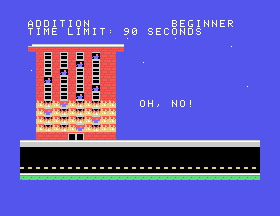 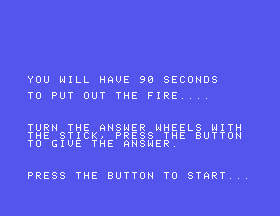 |
|
|
You are the last defender. Take off from the airfield, then fly out over the sea and the fields where hundreds of enemy ships and tanks are advancing. In the battle the jet slides nearer and farther across the scene while you drop torpedoes at sea and bombs over land, one at a time; a ship is worth 10 and a tank 50. Enemy missiles fly up at you, one at a time, and each one that reaches the jet costs one of five lives. After three rounds the message PREPARE TO LAND appears: come down on the airfield and stop on the runway for MISSION COMPLETED and the next of nine levels. Touching the ground anywhere else means SPLASH! or CRASH! and the game is over.
Controls: Use controller 1 or 2. For take-off and landing, push left to speed up, right to slow down, up to climb and down to dive. In battle the stick slides the jet nearer or farther and a button drops a bomb or torpedo. On the title, push up and down to choose the level and press a button to start. ColecoVision version credited in the source to Claude (an AI made by Anthropic) for Amy Studio, in Amy, the language by Amy Bienvenu, 2026: a reimagined adaptation of the published rules. From COMPUTE!'s Gazette, December 1989: original Commodore 64 program (no author named in the issue). Taken from the issue's disk (machine-language program with a BASIC loader). This is a modern homebrew adaptation, not a commercial Coleco release. Original Amy Studio release file: 227 - Final Defense - by Author not named - COMPUTE! Gazette - December 1989.rom |
Amy Studio/Amy Purple (Bienvenu) | 13kb |   |
|
|
Air hockey, seen from above. Each side has a mallet confined to its own half of the rink; the puck slides, rebounds off the boards and gradually slows until a mallet strikes it again, and where the mallet meets the puck decides the angle it flies off at. Drive the puck into the goal in the middle of the far board. Nine goals are played and the side with more wins. One player handles the blue mallet on the right against the computer's red goalie on the left, which only moves up and down to guard its goal; two players can also share the rink, red against blue. After each goal the puck is faced off on the side that let it in. Puck speed and the computer's skill are chosen on the title, and the end names the winner.
Controls: The stick moves the mallet in eight directions. In two-player games controller 1 plays blue and controller 2 plays red. On the title, push up and down to choose a line, left and right to change it, and press a button on START. ColecoVision version credited in the source to Claude (an AI made by Anthropic) for Amy Studio, in Amy, the language by Amy Bienvenu, 2026: a reimagined adaptation of the published rules. From COMPUTE!'s Gazette, January 1986: original Commodore 64 program by Kevin Mykytyn and Mark Tuttle. This is a modern homebrew adaptation, not a commercial Coleco release. Original Amy Studio release file: 108 - Face-Off - by Kevin Mykytyn and Mark Tuttle - COMPUTE! Gazette - January 1986.rom |
Amy Studio/Amy Purple (Bienvenu) | 10kb | 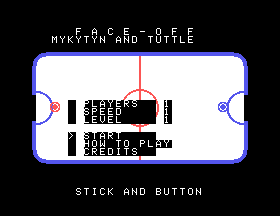 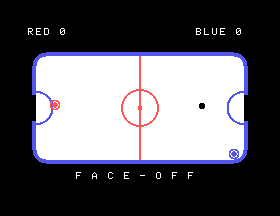 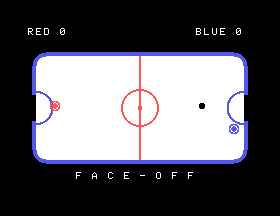 |
|
|
A tug of war between eight eagles in the sky and eight gators in the swamp, one of each in each of eight columns, split by a moving border. Free creatures fly or swim up and down, turning at the border and the far edge. Each player picks one creature at a time and has one button. Press it as a free creature touches the border and it clamps on, knocking loose the other side's clamped creature in that column. Press it for a free creature away from the border and it turns back; press it for a clamped one and it lets go. The border creeps toward the side with fewer clamped creatures, and a side pushed to its edge loses. Clamped creatures tire after 15 seconds. Play a friend or the computer.
Controls: Push the stick left or right to pick a creature and press either button to act. With one player, either controller plays the eagles; with two, controller 1 is the eagles. ColecoVision version credited in the source to Claude (an AI made by Anthropic) for Amy Studio, in Amy, the language by Amy Bienvenu, 2026: a reimagined adaptation of the published rules. From COMPUTE!'s Gazette, September 1986: original Commodore 64 program (no author named in the issue). This is a modern homebrew adaptation, not a commercial Coleco release. Original Amy Studio release file: 130 - Eagles and Gators - by Philip I. Nelson - COMPUTE! Gazette - September 1986.rom |
Amy Studio/Amy Purple (Bienvenu) | 12kb | 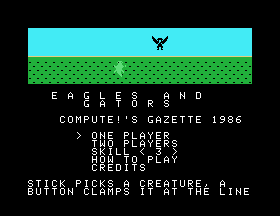 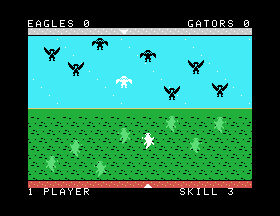 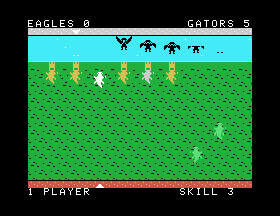 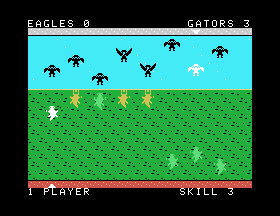 |
|
|
Twenty-five balls drop one at a time onto the top of three slanted boards and roll left or right. One stick moves three open wire crates at once, one on each board: up and down slide them back and forth along the slant, and left and right move them along. A crate that touches the ball while it moves sends the ball off in the crate's direction. A ball over a board's hole drops to the board below. A ball that rolls off any edge is a miss, except off the right-hand end of the bottom board, which scores 3, 2, 1, 2 or 3 points by how far back it leaves, shown by coloured spots. After every score the top and bottom crates may swap their controls at random, and signs show which.
Controls: Use controller 1 or 2. The stick moves all three crates at once. On the title, up and down choose and a button selects. ColecoVision version credited in the source to Claude (an AI made by Anthropic) for Amy Studio, in Amy, the language by Amy Bienvenu, 2026: a reimagined adaptation of the published rules. From COMPUTE!'s Gazette, April 1986: original Commodore 64 program (no author named in the issue). This is a modern homebrew adaptation, not a commercial Coleco release. Original Amy Studio release file: 116 - Dunk - by Author not named - COMPUTE! Gazette - April 1986.rom |
Amy Studio/Amy Purple (Bienvenu) | 9kb | 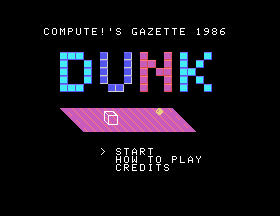 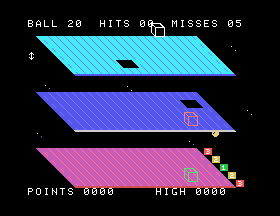 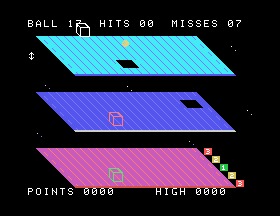 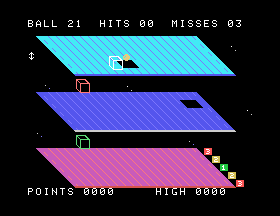 |
|
|
You are lost in a dragon's den, a grid of chambers seen in first person. Each chamber shows its openings to the left, ahead and right, and you can always go back. Clues such as smoke, soot, dripping water, blood or bats hint at what lies below. Some chambers have a trap door: search it and you may find nothing, water, a one-shot magic sword, gold once you hold the sword, or the rattle of scales. Then a dragon is under you: RUN through an opening at once or meet it. With the sword you slay it; without it you are eaten. Search deep enough and a trap door may be an exit: escape with your gold, or hunt on. Every step makes you thirstier, and bread marks chambers.
Controls: Push the stick left, up (ahead), right or down (back) to move; press the left button to search a trap door and the right button for a menu of CHART, MARK and CANCEL. ColecoVision version credited in the source to Claude (an AI made by Anthropic) for Amy Studio, in Amy, the language by Amy Bienvenu, 2026: a reimagined adaptation of the published rules. From COMPUTE!'s Gazette, December 1985: original Commodore 64 program (no author named in the issue). This is a modern homebrew adaptation, not a commercial Coleco release. Original Amy Studio release file: 106 - Dragon's Den - by Author not named - COMPUTE! Gazette - December 1985.rom |
Amy Studio/Amy Purple (Bienvenu) | 12kb | 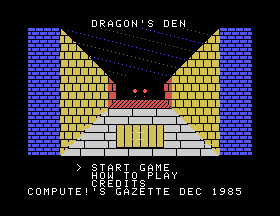 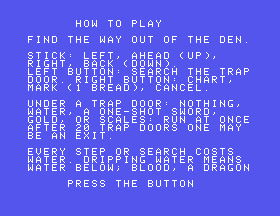  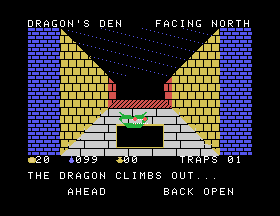 |
|
|
Two delta-wing fighters, red and blue, duel in a framed starfield arena until the clock runs out. Turn with the stick, push up to thrust, press the button to fire, with up to three fireballs in flight, and pull down to jump through hyperspace. A fighter hit by a fireball, its own included, by the other fighter, or by the star or black hole in the centre blows up, and the other pilot scores one; two fighters that collide both blow up and nobody scores. Then a new round starts. Before the game, choose bouncing or open edges, an empty centre, a black hole or a star pulling at the ships, fireball range, one to nine minutes, and hyperspace on or off. The highest score wins. Play a friend or the computer.
Controls: Controller 1 flies the red ship and controller 2 the blue ship, or the computer does. Push left or right to turn, up to thrust and down to jump through hyperspace; either button fires. On the title, up and down choose a line, left and right or the button change it, and the button on START plays. ColecoVision version credited in the source to Claude (an AI made by Anthropic) for Amy Studio, in Amy, the language by Amy Bienvenu, 2026: a reimagined adaptation of the published rules. From COMPUTE!'s Gazette, January 1988: original Commodore 64 program (no author named in the issue). This is a modern homebrew adaptation, not a commercial Coleco release. Original Amy Studio release file: 173 - Delta War - by Brian Pike - COMPUTE! Gazette - January 1988.rom |
Amy Studio/Amy Purple (Bienvenu) | 15kb | 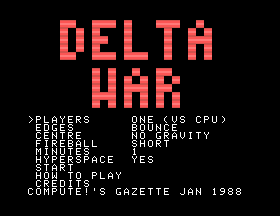    |
|
|
One or two players run the tube-like corridors of a maze at the same time, shooting creatures and picking up whirling spars. A spar is worth 500 points and a shield, and a shield stops one hit; a hit without one costs a life. When the players together hold five spars, the next maze comes. Red spars give quicker, more numerous shots and blue spars double your speed, but both are lost with a life. Sixteen kinds of creature appear as the levels go on: shooters, rammers, rubberheads that bounce back shots from behind, a spar-eating white creature, a Green Vacuum, a friendly Brown Dog that hunts the others, and a mutant that joins its partner to form a supercreature. Some turn invisible, and every 30 seconds they get faster.
Controls: Controller 1 is player 1 and controller 2 is player 2; in a one-player game either works. The stick runs and either button shoots; hold it for a stream. On the title, up and down choose a line, left and right change it, and a button starts. ColecoVision version credited in the source to Claude (an AI made by Anthropic) for Amy Studio, in Amy, the language by Amy Bienvenu, 2026: a reimagined adaptation of the published rules. From COMPUTE!'s Gazette, December 1988: original Commodore 64 program by Steve Harter. Sequel to Crossroads (#077); also on the Gazette's Best of 1988 disk. This is a modern homebrew adaptation, not a commercial Coleco release. Original Amy Studio release file: 203 - Crossroads II- Pandemonium - by S.HARTER - COMPUTE! Gazette - December 1988.rom |
Amy Studio/Amy Purple (Bienvenu) | 28kb |  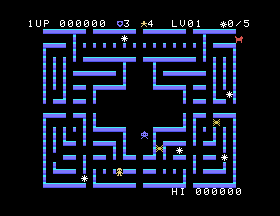  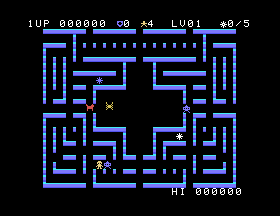 |
|
|
Two-hand cribbage against the computer, played to 121. The low cut deals first, then the deal alternates. Each player gets six cards and lays two in the dealer's crib, and the starter is turned; a jack gives the dealer two for his heels. In the play, cards are laid in turn with the count kept to 31: pairs, runs, fifteen and thirty-one all peg points, a player who cannot play says go, and the last card pegs one. Then the hands are counted, non-dealer first, then the dealer and the crib, for fifteens, pairs, runs, flushes and his nobs, each count showing what it is made of. Pegs hop along a cribbage board. First past 120 wins, and a loser under 91 is skunked. A hint shows the best discard, and a match table is kept until power off.
Controls: Push the stick left or right to choose a card and press the left button to lay it; the right button asks for a hint while discarding. Any button goes on after a count. ColecoVision version credited in the source to Claude (an AI made by Anthropic) for Amy Studio, in Amy, the language by Amy Bienvenu, 2026: a reimagined adaptation of the published rules. From COMPUTE!'s Gazette, August 1988: original Commodore 128 program (no author named in the issue). A Commodore 128 program. This is a modern homebrew adaptation, not a commercial Coleco release. Original Amy Studio release file: 191 - Cribbage 128 - by Bruce Boyles - COMPUTE! Gazette - August 1988.rom |
Amy Studio/Amy Purple (Bienvenu) | 20kb | 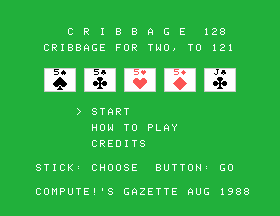 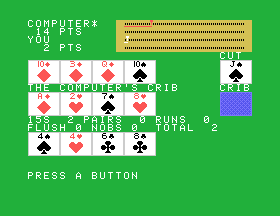 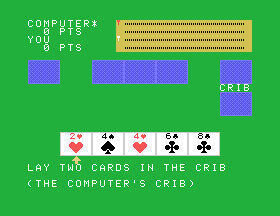 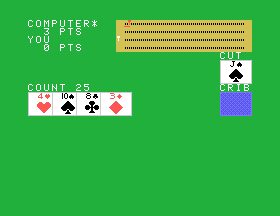 |
|
|
A game of dots and boxes on a peg board. Two players take turns joining two neighbouring pegs, across or down, with a rail in their own colour: choose a peg, then the peg next to it. Whoever puts the fourth side on a box claims it, and the box shows an emblem in that player's colour; claiming a box means you must play again. When every box is claimed, the player with more boxes wins, and an equal count is a tie. Play on the regular board of 77 boxes or the mini board of 42. Either player may be the computer, or both, and the computer never gives away a third side while it can help it. A scoreboard and a clock of the game's time are shown.
Controls: Use either controller. The stick moves the cursor from peg to peg, holding to keep moving; a side button chooses the peg under it, and a button on a neighbouring peg across or down lays the rail. On the title, up and down choose a line, left, right or a button change it, and a button on START GAME or CREDITS goes there. ColecoVision version credited in the source to Claude (an AI made by Anthropic) for Amy Studio, in Amy, the language by Amy Bienvenu, 2026: a reimagined adaptation of the published rules. From COMPUTE!'s Gazette, January 1987: original Commodore 64 program (no author named in the issue). Printed for the Commodore 64 and 128. This is a modern homebrew adaptation, not a commercial Coleco release. Original Amy Studio release file: 143 - Connect'em - by Francis Chambers - COMPUTE! Gazette - January 1987.rom |
Amy Studio/Amy Purple (Bienvenu) | 9kb | 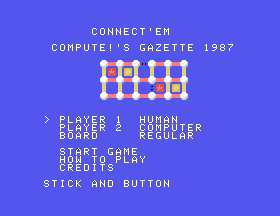 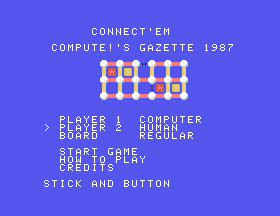 |
|
|
A game of tag on a board of 13 by 10 squares, each with an arrow. Every few moments all the arrows turn a quarter turn counter-clockwise together. Each player has just one button: press it and your marker steps one square the way the arrow under it points, unless that would leave the board. One player is IT and chases; the other runs and scores a point for every step. When the two markers meet on one square the runner is tagged, the roles swap and both markers jump to new squares. A timer bar fills slowly, and faster with every press; when it is full the round is over. Round 2 starts from the corners on the same board, and then the higher score wins. Play a friend or the computer.
Controls: Player 1 presses controller 1's button and player 2 controller 2's button to step. On the title, the stick chooses (up and down an item, left and right a value) and a button starts. ColecoVision version credited in the source to Claude (an AI made by Anthropic) for Amy Studio, in Amy, the language by Amy Bienvenu, 2026: a reimagined adaptation of the published rules. From COMPUTE!'s Gazette, October 1988: original Commodore 64 program (no author named in the issue). This is a modern homebrew adaptation, not a commercial Coleco release. Original Amy Studio release file: 197 - Computag - by Mark Tuttle - COMPUTE! Gazette - October 1988.rom |
Amy Studio/Amy Purple (Bienvenu) | 11kb | 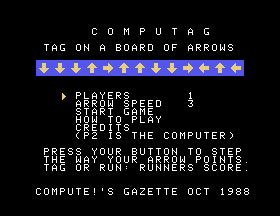 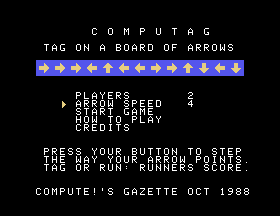 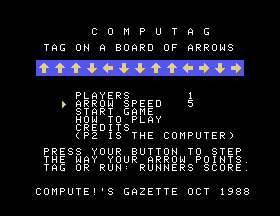 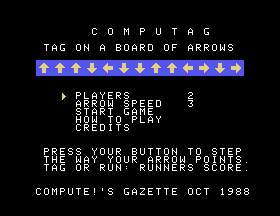 |
|
|
A strategy game on two boards at once. Two 5 by 5 boards hold the numbers 1 to 25, each shuffled its own way. You move a cursor on the first board, and claiming a cell also claims the cell with the same number on the second board, which a second cursor marks. A claimed cell that sits between two of the opponent's cells, left and right or above and below, captures both of them, separately on each board. Five in a row of your colour, across, down or diagonally, on either board wins. When all 25 numbers are claimed with no line, the game is a draw. Player 1 is light blue and opens; player 2 is yellow. Two people can play, or one against the computer.
Controls: Move the cursor with the stick and press a button to claim a cell. On the title, up and down choose, left and right or a button change PLAYERS, and a button starts. ColecoVision version credited in the source to Claude (an AI made by Anthropic) for Amy Studio, in Amy, the language by Amy Bienvenu, 2026: a reimagined adaptation of the published rules. From COMPUTE!'s Gazette, December 1988: original Commodore 64 program (no author named in the issue). This is a modern homebrew adaptation, not a commercial Coleco release. Original Amy Studio release file: 204 - Double Take - by Author not named - COMPUTE! Gazette - December 1988.rom |
Amy Studio/Amy Purple (Bienvenu) | 12kb | 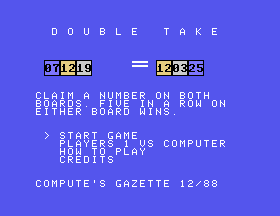 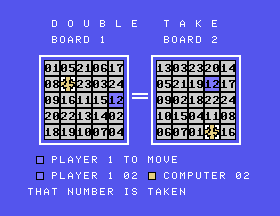 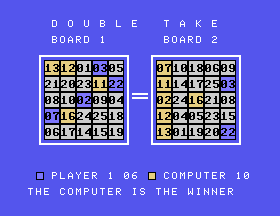 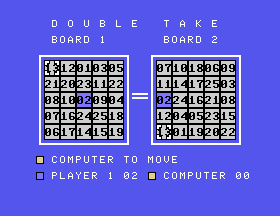 |
|
|
You dig tunnels through the earth under a hill, keeping on in the last direction you pushed, while three trolls dig after you. Boulders lie in the earth. Dig away the earth under one and, after a moment of rumbling, it drops until it lands on earth again or on the bottom. A falling boulder squashes any troll it meets for 10 points. Squash all three trolls to clear the screen for 100 points and start the next, where the trolls are a little faster. A troll that touches you, or a boulder that drops on you, ends the game. So does the last boulder reaching the bottom while trolls are left, since nothing can squash them any more. You can stop the digger, and pause. The high score is kept.
Controls: Use either controller. Push the stick up, down, left or right to set the digging direction; diagonals are ignored. The left button stops the digger and the right button pauses. A button starts from the title. ColecoVision version credited in the source to Claude (an AI made by Anthropic) for Amy Studio, in Amy, the language by Amy Bienvenu, 2026: a reimagined adaptation of the published rules. From COMPUTE!'s Gazette, March 1985: original Commodore 64 program (no author named in the issue). Printed in machine language for both the Commodore 64 and VIC-20. This is a modern homebrew adaptation, not a commercial Coleco release. Original Amy Studio release file: 081 - Digger - by Author not named - COMPUTE! Gazette - March 1985.rom |
Amy Studio/Amy Purple (Bienvenu) | 12kb | 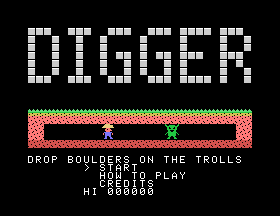 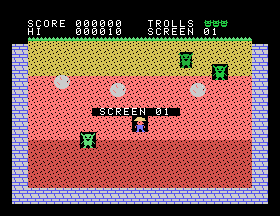 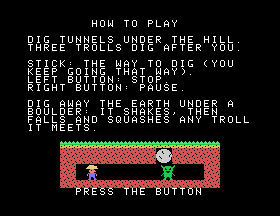  |
|
|
Your ship sits on the left edge of the field and moves only up and down. Six spinning discs bounce round the field diagonally, all at the same speed, right up to your edge. Shoot them all, 10 points each, to clear the wave; you fire one shot at a time, and holding the button keeps firing. A disc that touches the ship destroys it, and then the whole wave comes back in its formation. Four formations make a level: a diagonal, a column on the right, a column on the left and a row near the bottom. Each of the five levels sets the discs off in different directions, and at level 5 they go at random; then level 5 repeats for ever. You have three spare ships. The high score is kept.
Controls: Use either controller. Push the stick up or down to move the ship and press either button to fire, holding it to keep firing. On the title, up and down choose and a button starts. ColecoVision version credited in the source to Claude (an AI made by Anthropic) for Amy Studio, in Amy, the language by Amy Bienvenu, 2026: a reimagined adaptation of the published rules. From COMPUTE!'s Gazette, January 1989: original Commodore 64 program (no author named in the issue). This is a modern homebrew adaptation, not a commercial Coleco release. Original Amy Studio release file: 206 - Disc Blitz - by Peter Marino - COMPUTE! Gazette - January 1989.rom |
Amy Studio/Amy Purple (Bienvenu) | 8kb |   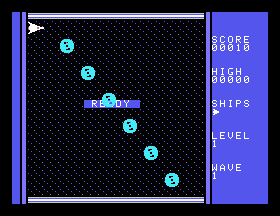 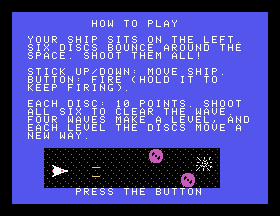 |
|
|
Your lander cruises across the top of the screen from left to right, starting again at the left if you wait. Press the button to release it. It falls through four rows of drifting asteroids, two drifting left and two right, and a barrier with gaps, down into a crater with four landing pads. Hold the button to fire the retro-rockets and hover, and steer with the stick. Touch a rock, the barrier, the ground or a lander already parked, and the lander is lost. A safe landing scores 100 and parks the lander on its pad. Fill all four pads for a bonus of 100 times the level and a BONUS LEVEL with new, denser asteroid rows. You have three landers, and the game goes on until they are gone. The high score is kept.
Controls: Use either controller. Press the button to release the lander, then hold it to hover; push the stick left or right to steer while falling. On the title, up and down choose and a button starts. ColecoVision version credited in the source to Claude (an AI made by Anthropic) for Amy Studio, in Amy, the language by Amy Bienvenu, 2026: a reimagined adaptation of the published rules. From COMPUTE!'s Gazette, November 1984: original Commodore 64 program (no author named in the issue). Printed for both the Commodore 64 and VIC-20; this follows the 64 listing. This is a modern homebrew adaptation, not a commercial Coleco release. Original Amy Studio release file: 065 - Descent to Kaylon - by Steve Stiglich - COMPUTE! Gazette - November 1984.rom |
Amy Studio/Amy Purple (Bienvenu) | 9kb | 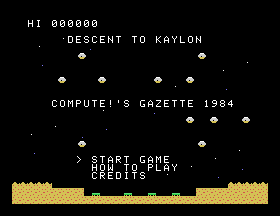 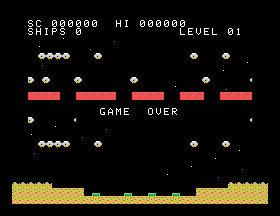 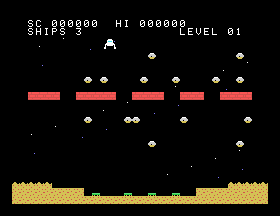 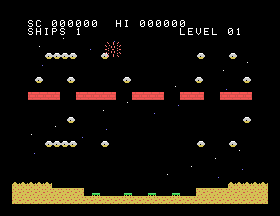 |
|
|
A crawler of ten amber beads with a violet head enters at the top left and runs across a field of crystals. When a crystal or the side blocks it, it steps down a row and turns back; once at the bottom it stays in your gun zone for good. A red, poisoned crystal makes the head dive straight down. Your gun moves in the bottom four rows and fires one shot at a time. Any bead hit takes one bead off the end of the crawler for 50 points; ten hits clear the wave. Crystals break for 25. One pest at a time joins in: the zigzagging HOPPER, the DROPPER that plants crystals above you, and the CREEPER that poisons them. A head, hopper or dropper touching your gun costs one of three guns.
Controls: Use either controller. The stick moves the gun and either button fires; hold it to keep firing. ColecoVision version credited in the source to Claude (an AI made by Anthropic) for Amy Studio, in Amy, the language by Amy Bienvenu, 2026: a reimagined adaptation of the published rules. From COMPUTE!'s Gazette, January 1987: original Commodore 64 program (no author named in the issue). This is a modern homebrew adaptation, not a commercial Coleco release. Original Amy Studio release file: 144 - Decipede - by James Knesek - COMPUTE! Gazette - January 1987.rom |
Amy Studio/Amy Purple (Bienvenu) | 10kb | 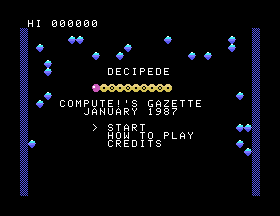 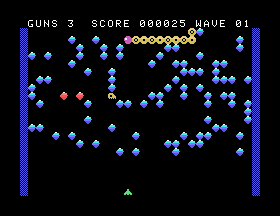 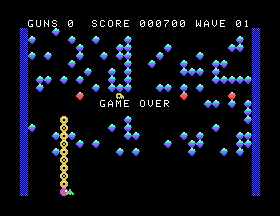 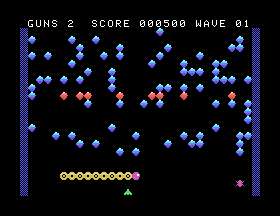 |
|
|
A code-breaking puzzle. The computer hides a code of six pegs, each one of eight colours, and a colour may appear more than once. You have twelve turns to guess it. After each guess the key pegs say how close you are: a black key for each peg of the right colour in the right place, and a white key for each other peg of a right colour in the wrong place. The keys don't say which pegs they belong to. Each new row starts as a copy of your last guess, so you change only what you want, and each colour plays its own note. You can give up and see the code. Break it to see YOU WON with the number of moves, or run out of turns and YOU LOSE. Your best game is kept.
Controls: Use either controller. Push left or right to pick a hole and up or down to change its colour; press the left button to enter the guess, and the right button twice to give up. On the title, up and down choose and a button starts. ColecoVision version credited in the source to Claude (an AI made by Anthropic) for Amy Studio, in Amy, the language by Amy Bienvenu, 2026: a reimagined adaptation of the published rules. From COMPUTE!'s Gazette, February 1985: original Commodore 64 program (no author named in the issue). Printed for both the Commodore 64 and VIC-20. This is a modern homebrew adaptation, not a commercial Coleco release. Original Amy Studio release file: 077 - Cypher - by Author not named - COMPUTE! Gazette - February 1985.rom |
Amy Studio/Amy Purple (Bienvenu) | 8kb |     |
|
|
Two players each steer a line that never stops growing. Blue starts moving right and red moving left, facing each other across the arena. Turn with the stick in any of the four directions, but turning straight back runs into your own trail. Run into a wall, any trail, your own included, or the other head and you crash: the other player scores the round's step count and you lose one of your ten lives. A head-on crash, with both lines moving straight at each other, scores for both and costs both a life. The game ends when a player has no lives left, and the higher score is named the winner. Pick a skill from 0 to 9 before the game. Two people can play, or one against the computer's red line.
Controls: Controller 1 steers blue and controller 2 steers red; in a one-player game the computer steers red. Either button pauses. On the title, left and right pick 1 or 2 players, up and down the skill, and a button starts. ColecoVision version credited in the source to Claude (an AI made by Anthropic) for Amy Studio, in Amy, the language by Amy Bienvenu, 2026: a reimagined adaptation of the published rules. From COMPUTE!'s Gazette, March 1984: original Commodore 64 program (no author named in the issue). Printed for both the Commodore 64 and VIC-20 in machine language; the two agree on every rule. This is a modern homebrew adaptation, not a commercial Coleco release. Original Amy Studio release file: 036 - Cut-Off! - by Tom R. Halfhill - COMPUTE! Gazette - March 1984.rom |
Amy Studio/Amy Purple (Bienvenu) | 9kb |    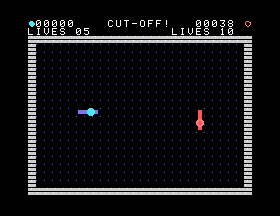 |
|
|
One or two players roam a maze crowded with nine kinds of creatures, and the creatures fight each other as readily as they fight you. Each kind has a colour; the same colour, or a friendly pair such as cyan and green, means friends, and everything else is a foe. Shoot creatures for points, from 50 for a blob up to 1500 for a knight; shells and knights shrug off bullets unless hit in the face. Pick up the spinning spars, each worth a shield point and 500 at the end of the level; five spars taken end the level. Creatures eat spars too and drop them when they die. An attack or a bullet costs a shield point, and with none left you lose a life. You start with four lives. The maze's edges wrap round.
Controls: Controller 1 is player 1 and controller 2 is player 2. The stick walks (pushing a new way first turns) and a button fires. On the title, up and down choose and a button selects. ColecoVision version credited in the source to Claude (an AI made by Anthropic) for Amy Studio, in Amy, the language by Amy Bienvenu, 2026: a reimagined adaptation of the published rules. From COMPUTE!'s Gazette, December 1987: original Commodore 64 program by Steve Harter. The first of two Crossroads games in the set; Crossroads II: Pandemonium (#088) is the sequel. This is a modern homebrew adaptation, not a commercial Coleco release. Original Amy Studio release file: 168 - Crossroads - by Steve Harter - COMPUTE! Gazette - December 1987.rom |
Amy Studio/Amy Purple (Bienvenu) | 18kb |    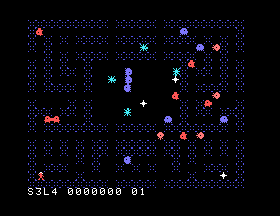 |
|
|
The Zirconians dive on the Earth in waves. Their raiders have no guns: they fall, drifting from side to side, and blow up where they reach the ground. Slide your cruiser along the ground and shoot them with the laser, holding the button to keep firing. Each raider shot scores 50, and each one that lands takes 10 off. Two raiders that touch both explode, for no points. A raider that blows up next to your cruiser, or rams it, destroys it. Every raider gone counts one off the attack; when an attack is over the raiders fly off and the next, longer and faster, begins. You have three cruisers. The current attack and the raiders left are always shown, and the high score is kept.
Controls: Use controller 1 or 2. Push the stick left or right to move the cruiser and press either button to fire, holding it to keep firing. A button starts the game on the title. ColecoVision version credited in the source to Claude (an AI made by Anthropic) for Amy Studio, in Amy, the language by Amy Bienvenu, 2026: a reimagined adaptation of the published rules. From COMPUTE!'s Gazette, December 1984: original Commodore 64 program by Tommy Graham. The 64 version was machine language; a VIC-20 BASIC version was also printed. This is a modern homebrew adaptation, not a commercial Coleco release. Original Amy Studio release file: 069 - Cosmic Combat - by Tommy Graham - COMPUTE! Gazette - December 1984.rom |
Amy Studio/Amy Purple (Bienvenu) | 10kb | 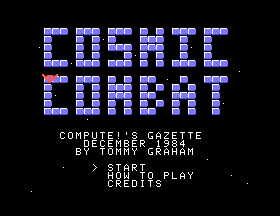 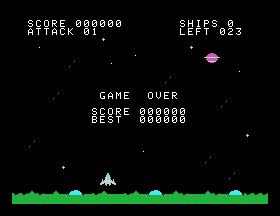 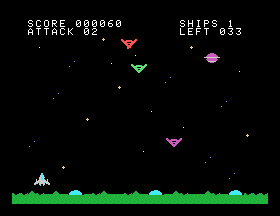 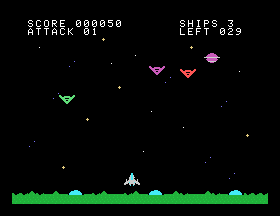 |
|
|
Your yellow car drives clockwise round four nested lanes, while the computer's red car drives the other way and tries to hit you head on. Drive over every dot to clear the level. In the middle of each side the lane walls open, and a car passing a crossover moves to the lane chosen on the LANE meter: push left for a lane further in, right for one further out. The catch is that the red car takes your chosen lane too. Hold a button to brake the red car to half speed, while the BRK bar lasts. A collision costs a car, though eaten dots stay eaten. You have three cars, with a bonus car on reaching levels 3 and 6. From level 4 each dot must be driven over twice, and each level is faster.
Controls: Use either controller. Push the stick left or right to choose the lane, holding to repeat, and hold either button to brake the computer's car. Any button starts. ColecoVision version credited in the source to Claude (an AI made by Anthropic) for Amy Studio, in Amy, the language by Amy Bienvenu, 2026: a reimagined adaptation of the published rules. From COMPUTE!'s Gazette, February 1987: original Commodore 64 program (no author named in the issue). This is a modern homebrew adaptation, not a commercial Coleco release. Original Amy Studio release file: 145 - Collision Course - by Mark Tuttle - COMPUTE! Gazette - February 1987.rom |
Amy Studio/Amy Purple (Bienvenu) | 10kb | 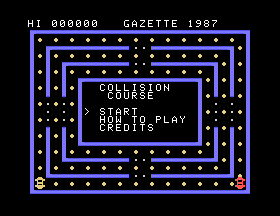 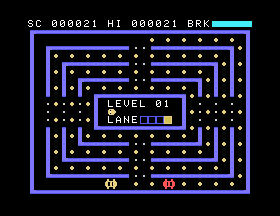  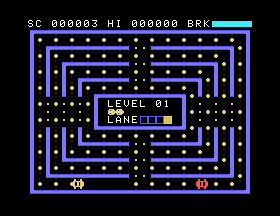 |
|
|
A security computer has gone haywire, and pulses of electricity run along the wires of its circuit board. You cannot steer the pulses, but you can throw the board's switches: one direction throws the bridges, two others throw the left-hand and right-hand shunts, and the last cycles the colours of the transporter pads. Route the pulses into the pyramid power points; three hits destroy a pyramid, and a board shuts down when all its pyramids are gone. Hidden chips turn or reverse pulses unseen. A pulse that runs into a burnt-out hole or crosses a bridge set the other way crashes the circuit and costs a life, unless a safety is on. You have three lives a game and three safeties a board. Clear all five boards and they return with one more pulse.
Controls: Use either controller. Push up to throw the bridges, left for the left-hand shunts, down for the right-hand shunts and right to cycle the pads' colours; a side button starts a safety. On the title, up and down choose, left and right change the number of pulses, and a button starts. ColecoVision version credited in the source to Claude (an AI made by Anthropic) for Amy Studio, in Amy, the language by Amy Bienvenu, 2026: a reimagined adaptation of the published rules. From COMPUTE!'s Gazette, December 1989: original Commodore 64 program by Eric Haines. This is a modern homebrew adaptation, not a commercial Coleco release. Original Amy Studio release file: 226 - Circuits - by ERIC HAINES - COMPUTE! Gazette - December 1989.rom |
Amy Studio/Amy Purple (Bienvenu) | 12kb |    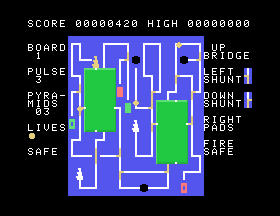 |
|
|
Fly a helicopter low over rolling country that streams past from the left. The button is your throttle: hold it to speed up, let go to slow down. Pull the stick back to climb and push it forward to dive. Every stretch you pass scores by how low you fly, up to 5 points. Flags, radio masts, trees and birds stand on the flat stretches; touch down gently on a flag to take it for 100 points. Hitting a mast, a tree or the birds, or scraping the ground, is an ERROR, and at 20 errors the sky turns yellow. A level ends when you have flown its miles, its clock runs out or you reach 25 errors; you go on only if your score has reached the level's bonus mark. There are five levels.
Controls: Use either controller. Pull the stick back to climb and push it forward to dive (PILOT), or push up to climb and down to dive (ARCADE); a button is the throttle. On the title, up and down choose, left and right change, and a button starts. ColecoVision version credited in the source to Claude (an AI made by Anthropic) for Amy Studio, in Amy, the language by Amy Bienvenu, 2026: a reimagined adaptation of the published rules. From COMPUTE!'s Gazette, October 1987: original Commodore 64 program by Chris Boss. The header cites the Gazette disk for October 1987. This is a modern homebrew adaptation, not a commercial Coleco release. Original Amy Studio release file: 161 - Chopper Pilot - by Christopher R. Boss - COMPUTE! Gazette - October 1987.rom |
Amy Studio/Amy Purple (Bienvenu) | 19kb |  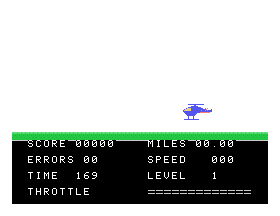  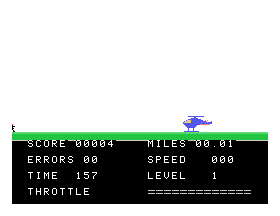 |
|
|
Gems and jinxes lie scattered over an open field that wraps round at all four edges. Steer the chomper in eight directions to eat gems for 150 points each and keep clear of the sour-faced jinxes, which cost 450, though the score never drops below zero. Robot droids walk straight at you, eating whatever they cross; a droid that reaches you ends the game, and so does the clock running out. Press the button to scatter 70 more gems and jinxes over the field, at a cost of three seconds. Every 3000 points the clock gains extra time, though less each time. Reach 54768 points and you are one of the few to win at CHOMPER. Choose one to seven droids and EASY or HARD speed. The high score is kept.
Controls: Use controller 1 or 2. The stick moves the chomper, diagonals too, and either button scatters more gems and jinxes. On the title, up and down choose a line, left and right change it, and a button starts. ColecoVision version credited in the source to Claude (an AI made by Anthropic) for Amy Studio, in Amy, the language by Amy Bienvenu, 2026: a reimagined adaptation of the published rules. From COMPUTE!'s Gazette, January 1985: original Commodore 64 program (no author named in the issue). The 64 version was machine language; a VIC-20 version in BASIC was on the same disk. This is a modern homebrew adaptation, not a commercial Coleco release. Original Amy Studio release file: 073 - Chomper - by Author not named - COMPUTE! Gazette - January 1985.rom |
Amy Studio/Amy Purple (Bienvenu) | 9kb | 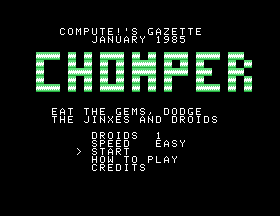 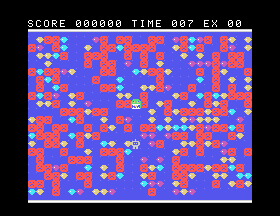 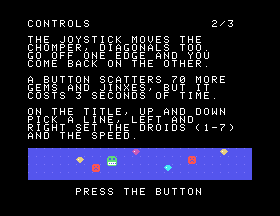 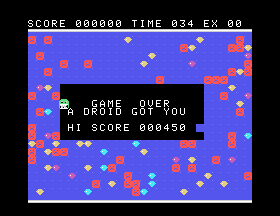 |
|
|
Checkers against the computer. You play yellow, starting on the near rows and moving up the board; the computer plays magenta, moving down, and it moves first. Men move one square diagonally forward, or jump an enemy piece diagonally forward onto the empty square behind it, taking it; after a jump the same piece may jump again, and you may stop a chain of jumps when you like. A man reaching the far row is crowned king and moves and jumps both ways. Jumps are never forced. The computer writes out each of its moves by row and column, and the squares you may move to are marked. Take every enemy piece or leave it no move to win; the computer wins the same way. A long run without a capture is called a draw.
Controls: Use either controller. The stick moves the cursor square by square; the left button picks one of your pieces, then a marked square to move to; the right button puts the piece back or ends a chain of jumps. On the title, up and down choose and a button starts. ColecoVision version credited in the source to Claude (an AI made by Anthropic) for Amy Studio, in Amy, the language by Amy Bienvenu, 2026: a reimagined adaptation of the published rules. From COMPUTE!'s Gazette, February 1984: original Commodore 64 program (no author named in the issue). One BASIC listing served both the Commodore 64 and the VIC-20. This is a modern homebrew adaptation, not a commercial Coleco release. Original Amy Studio release file: 033 - Checkers - by Fred Hambrecht - COMPUTE! Gazette - February 1984.rom |
Amy Studio/Amy Purple (Bienvenu) | 12kb | 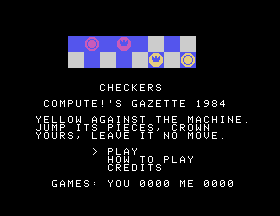 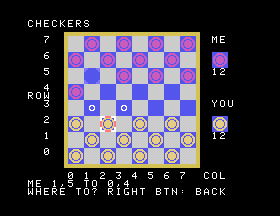 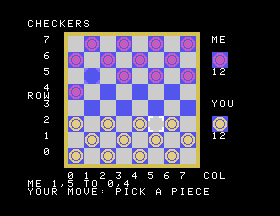 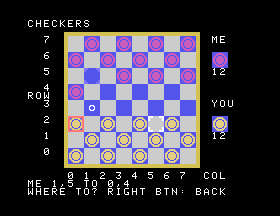 |
|
|
A word game for one to six players, taking turns. Each turn the player picks DICE, and nine letter dice are rolled, or WORDS, and a long word from the computer's vocabulary is dealt. Make as many words as you can from those letters before the time bar runs out, each letter used once per word; a Q without a U turns another die into a U. Then the other players may challenge any word, and the players decide together whether the challenge is right; a word that loses is struck. Longer words score far more: from 1 point for one letter up to 61 for twelve. The scores are shown after every turn, and after the chosen number of rounds the winner is named. A single player keeps a best total.
Controls: Use either controller, passed round. On the dice, push left or right to pick a die and down to reach the DEL, ENTER and DONE line; the left button takes a letter or does the command and the right button deletes the last letter. In menus, use the stick and a button. On the title, up and down choose, left and right change the players or rounds, and a button starts. ColecoVision version credited in the source to Claude (an AI made by Anthropic) for Amy Studio, in Amy, the language by Amy Bienvenu, 2026: a reimagined adaptation of the published rules. From COMPUTE!'s Gazette, May 1985: original Commodore 64 program (no author named in the issue). Printed for the Commodore 64 and the VIC-20 with 8K expansion; this follows the 64 listing. The program's full title is "Charlemagne's Sword ... or Word Search". This is a modern homebrew adaptation, not a commercial Coleco release. Original Amy Studio release file: 088 - Charlemagne's Sword - by Author not named - COMPUTE! Gazette - May 1985.rom |
Amy Studio/Amy Purple (Bienvenu) | 11kb |  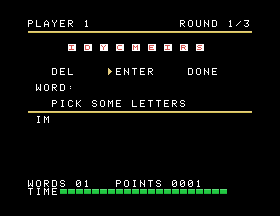  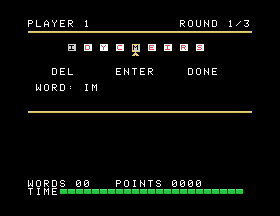 |
|
|
A field of hexagonal cells lies between a start bar at the bottom and a goal bar at the top. Run up from the start bar to the goal, moving only onto cells that are there. About every second the field changes to a new random pattern, and cells about to vanish crumble just before. If the cell you stand on is gone, you fall to the next cell below, or back to the start bar. Each level gives you 30 seconds; reach the goal and the seconds left plus 10 are added to your score. There are 40 levels, each changing a little faster. Holding the stick up for 20 tries in a row sends you back to the start, so let go now and then. The best score is kept.
Controls: Use either controller. Push the stick up, down, left or right to move one cell. On the title, up and down choose and a button selects. ColecoVision version credited in the source to Claude (an AI made by Anthropic) for Amy Studio, in Amy, the language by Amy Bienvenu, 2026: a reimagined adaptation of the published rules. From COMPUTE!'s Gazette, September 1986: original Commodore 64 program by John Krutch. The header cites the Gazette disk for September 1986. This is a modern homebrew adaptation, not a commercial Coleco release. Original Amy Studio release file: 129 - Cell Runner - by John Krutch - COMPUTE! Gazette - September 1986.rom |
Amy Studio/Amy Purple (Bienvenu) | 9kb | 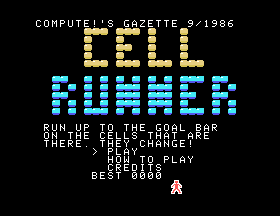 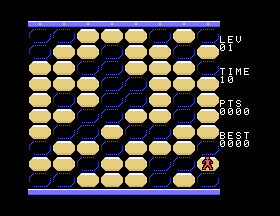 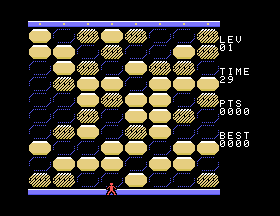  |
|
|
A yard holds seven rows of seven doghouses. The cats and the dogs take turns dropping a pet into one of the seven columns, and it falls to the lowest free doghouse. Four pets of one kind in a line, across, up and down, or diagonally, win the game. With the DOG CATCHER switched on, after every turn he hides in a random empty doghouse; a pet that falls into his house is caught and carried off, and the turn is lost. He goes home once four or more columns are full. A full yard is a tie. A match ends when one side has won three games, and the loser of each game starts the next. Play a friend, or play the cats against the computer's dogs.
Controls: Use either controller. Push left or right to move the pet above the yard, holding to repeat, and press a button to drop it. On the title, up and down choose, left and right or a button change a setting, and a button on PLAY starts. ColecoVision version credited in the source to Claude (an AI made by Anthropic) for Amy Studio, in Amy, the language by Amy Bienvenu, 2026: a reimagined adaptation of the published rules. From COMPUTE!'s Gazette, January 1988: original Commodore 64 program (no author named in the issue). This is a modern homebrew adaptation, not a commercial Coleco release. Original Amy Studio release file: 172 - Cats 'n Dogs - by Fred Karg - COMPUTE! Gazette - January 1988.rom |
Amy Studio/Amy Purple (Bienvenu) | 9kb |    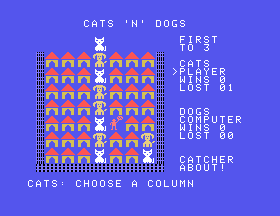 |
|
|
An evil wizard has hidden three bombs in the castle's dark dungeon, and you have three minutes to find them all and save the castle. You carry a lantern that lights only the cells around you, though places you have seen stay dimly drawn. Walls stop you. A pit swallows you unless you cast a levitation spell first; the spell carries you over any number of pits and ends on the first plain floor. A beast, a lion, eats you unless you have found the sword, which slays every beast you meet afterwards. A door opens only once you have found a key. A new dungeon is made every game and is always winnable. The last ten seconds tick away, and at the end the whole dungeon is shown.
Controls: Use either controller. Hold the stick to walk, and press a side button to cast the levitation spell. On the title, up and down choose and a button starts. ColecoVision version credited in the source to Claude (an AI made by Anthropic) for Amy Studio, in Amy, the language by Amy Bienvenu, 2026: a reimagined adaptation of the published rules. From COMPUTE!'s Gazette, June 1984 (Issue 12), page 52: original Commodore 64 program (no author named in the issue). Printed for both the Commodore 64 and VIC-20; this follows the 64 listing. This is a modern homebrew adaptation, not a commercial Coleco release. Original Amy Studio release file: 047 - Castle Dungeon - by Dave and Casey Gardner - COMPUTE! Gazette - June 1984.rom |
Amy Studio/Amy Purple (Bienvenu) | 9kb | 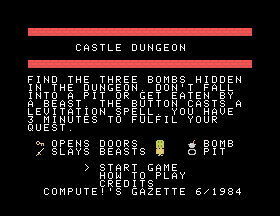    |
|
|
A strategy game of a presidential election. Two campaign managers, CYAN and RED, each pick a candidate from five, rated for charisma, stamina, intelligence, experience and appeal, with positions on economy, social issues, farms, schools and defense. The race runs nine weeks. Each week you plan seven days: campaign in a state of your region, run TV ads across the region, fundraise, rest, poll the region, or travel to another region. Then the week plays out day by day. Every state has undecided voters, and stops and ads win them over, but too many days in one state backfires and tired candidates lose effect. A map shows who leads where. After week nine the last undecided voters split, each state's electoral votes go to the leader there, and 270 of 538 wins. Play a friend or the computer.
Controls: Use either controller. Push the stick left or right to choose a command, state, region or candidate; press the left button for OK and the right button to go back. On the title, up and down choose a line and left and right change it. ColecoVision version credited in the source to Claude (an AI made by Anthropic) for Amy Studio, in Amy, the language by Amy Bienvenu, 2026: a reimagined adaptation of the published rules. From COMPUTE!'s Gazette, August 1984: original Commodore 64 program by Todd Heimarck. A machine-language program typed in with MLX. This is a modern homebrew adaptation, not a commercial Coleco release. Original Amy Studio release file: 057 - Campaign Manager - by Todd Heimarck - COMPUTE! Gazette - August 1984.rom |
Amy Studio/Amy Purple (Bienvenu) | 21kb |     |
|
|
You drive a cab through a new random city each game. The dispatcher sends you to a kind of building (CABBY, GO TO THE BANK), and those buildings light up yellow. Push against one to pick up the fare, who asks for another place (TAKE ME TO THE ZOO); drop the fare there to earn money by the distance, plus a tip. Cash is safe only once banked at the yellow depot; bank more than $200 and the cab is yours. Five trolley cars charge at a cab on their tracks, and a trolley hit ends the game with only banked money counted. Traffic lights let you in only on green, every move burns gas; red pumps refill it. People on the pavements may hail an empty cab. EASY accepts any building of the wanted kind; HARD only one.
Controls: Use either controller. Hold the stick to drive, and push into a building, the gas pump or the depot to use it. On the title, up and down choose and a button starts. ColecoVision version credited in the source to Claude (an AI made by Anthropic) for Amy Studio, in Amy, the language by Amy Bienvenu, 2026: a reimagined adaptation of the published rules. From COMPUTE!'s Gazette, October 1984: original Commodore 64 program (no author named in the issue). Printed for both the Commodore 64 and VIC-20; this follows the 64 listing. This is a modern homebrew adaptation, not a commercial Coleco release. Original Amy Studio release file: 061 - Cabby - by Author not named - COMPUTE! Gazette - October 1984.rom |
Amy Studio/Amy Purple (Bienvenu) | 13kb | 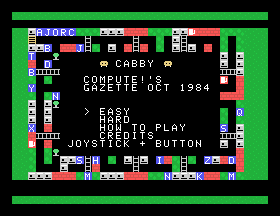 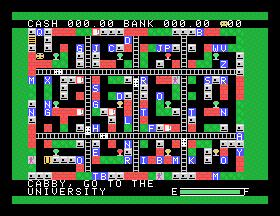 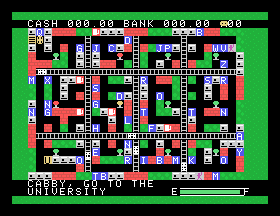 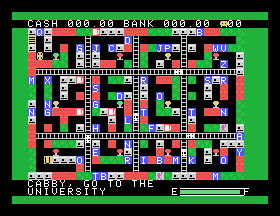 |
|
|
Two bumper cars, PURPLE and YELLOW, share a rink with one ball. Drive over the free ball to take it, then press the button to shoot it: it leaves with your car's speed and direction, and your car stops dead. The ball never slows down; it bounces off the padded rails until someone takes it, and the shooter cannot take it back until it has bounced once. Bump the other car to swap speeds with it, and if either of you holds the ball, it changes hands. Your car speeds up while you push the stick and slows when you let go. Shoot the ball into the far net (PURPLE scores on the right, YELLOW on the left). The first to 15 goals wins. Two people can play, or one against a computer YELLOW.
Controls: Controller 1 drives PURPLE and controller 2 drives YELLOW; in a one-player game either controller drives PURPLE. The stick accelerates and a button shoots. On the title, up and down choose and a button selects. ColecoVision version credited in the source to Claude (an AI made by Anthropic) for Amy Studio, in Amy, the language by Amy Bienvenu, 2026: a reimagined adaptation of the published rules. From COMPUTE!'s Gazette, November 1986: original Commodore 64 program (no author named in the issue). The header cites the Gazette disk for November 1986. This is a modern homebrew adaptation, not a commercial Coleco release. Original Amy Studio release file: 137 - Bump 'n Run - by Tim J. Midkiff - COMPUTE! Gazette - November 1986.rom |
Amy Studio/Amy Purple (Bienvenu) | 11kb | 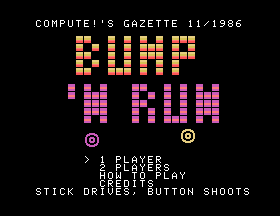 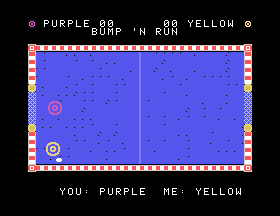 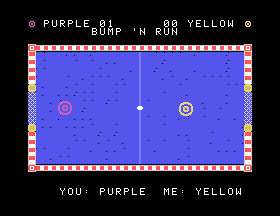 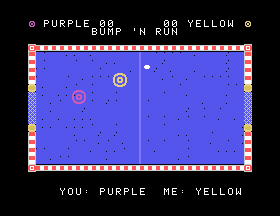 |
|
|
A paint brush runs along the lines of a grid of 9 by 10 boxes, painting every line it passes. It keeps going until it reaches an edge and turns only at a crossing, though you can reverse it at any time. A box whose four sides are painted fills with colour and scores 10 points times the level. Fill all 90 boxes to reach the next level, where the colours change. Blobs chase the brush, and touching one costs a brush. You have three brushes, with one more every fourth level. Once per brush, the button throws a splash: the blobs vanish for three seconds and come back in the corners. On the fastest levels a paint can wanders from crossing to crossing, and picking it up sends the blobs away too. The high score is kept.
Controls: Use either controller. The stick steers the brush and a side button throws the splash. On the title, up and down choose and a button starts. ColecoVision version credited in the source to Claude (an AI made by Anthropic) for Amy Studio, in Amy, the language by Amy Bienvenu, 2026: a reimagined adaptation of the published rules. From COMPUTE!'s Gazette, April 1989: original Commodore 128 program by Leonard Morris. A Commodore 128 program. This is a modern homebrew adaptation, not a commercial Coleco release. Original Amy Studio release file: 212 - Brusher - by LEONARD MORRIS - COMPUTE! Gazette - April 1989.rom |
Amy Studio/Amy Purple (Bienvenu) | 12kb | 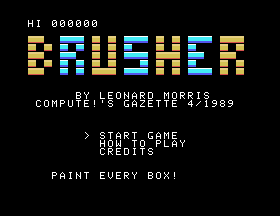 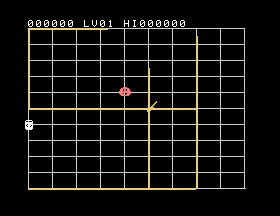 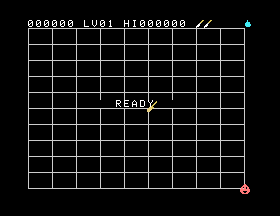 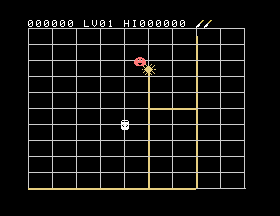 |
|
|
An educational geography chase across a map of the 48 contiguous United States. A crook hides in one state and you start in another, your home. Ride from state to neighbouring state to reach the crook's state. The crook flees every few seconds, and each of its moves takes $100 off the $10,000 bounty. Catch it (GOT HIM!) and it escapes at once and comes after you: now ride home before it catches you (GOT YOU!) and the bounty is lost. Get home and the bounty is yours; if the bounty reaches $0, the crook gets away. In COUNT DOWN there is no crook: visit as many different states as you can in one to five minutes. Either game can name the states or their capitals, and the map can be shown or hidden. There are three difficulty levels.
Controls: Use either controller. Point the stick at a neighbouring state, press the right button to step through the neighbours, and press the left button to ride there. On the title, up and down choose a line, left and right change it, and a button starts. ColecoVision version credited in the source to Claude (an AI made by Anthropic) for Amy Studio, in Amy, the language by Amy Bienvenu, 2026: a reimagined adaptation of the published rules. From COMPUTE!'s Gazette, August 1987: original Commodore 64 program (no author named in the issue). This is a modern homebrew adaptation, not a commercial Coleco release. Original Amy Studio release file: 156 - Bounty Hunter - by Dan Aven - COMPUTE! Gazette - August 1987.rom |
Amy Studio/Amy Purple (Bienvenu) | 13kb | 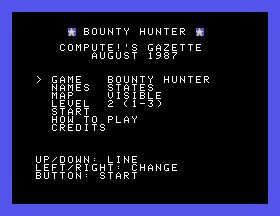 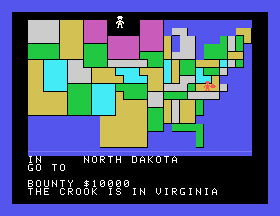 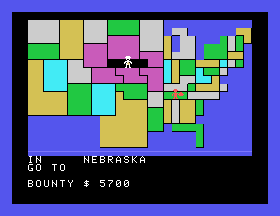 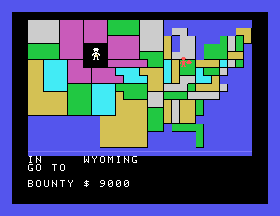 |
|
|
Blue and Red stand at the two ends of a walled field broken up by a random maze, each with one boomerang. Press the button to throw it the way you last moved. It flies straight, twice as fast as you walk, until it hits a wall, where it drops and lies. While it is in the air and not too far away, press again to send it off the way you now face, steering it round the maze. Walk onto your own boomerang, flying or lying, to catch it. The other player's boomerang, in the air or on the ground, knocks you out. Each hit costs a life; the counter starts at 9 and a hit at 0 ends your game. Either player may ask for a new maze. Play a friend or a computer Red.
Controls: Controller 1 plays Blue and controller 2 plays Red. The stick walks and faces, and either button throws, or sends your flying boomerang the way you face. On the title, up and down choose a line, left and right or a button change it, and a button on START begins. At the maze check, the stick toggles YES or NO and a button answers. ColecoVision version credited in the source to Claude (an AI made by Anthropic) for Amy Studio, in Amy, the language by Amy Bienvenu, 2026: a reimagined adaptation of the published rules. From COMPUTE!'s Gazette, August 1989: original Commodore 64 program (no author named in the issue). The header cites the Gazette disk for August 1989; it may be a disk-only program. This is a modern homebrew adaptation, not a commercial Coleco release. Original Amy Studio release file: 220 - Boomerang - by Kevin Dixon - COMPUTE! Gazette - August 1989.rom |
Amy Studio/Amy Purple (Bienvenu) | 15kb | 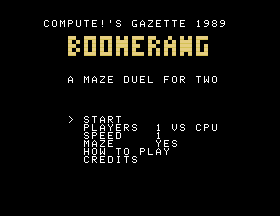 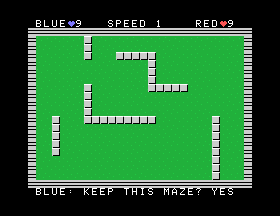 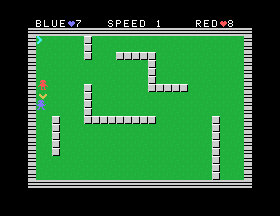 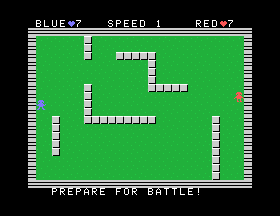 |
|
|
A shooting-gallery word puzzle. A phrase, a thing or an occupation is hidden as a row of cards, while letters ride ten rails across a fairground booth. Your cannon fires one pellet a turn. Hit a letter that is in the puzzle and every copy turns over for $10 each, and you shoot again. Hit a letter that is not there, hit a bomb (BUST), miss, or run out of time and the turn is lost. Any time you are aiming you may solve: get it right and your round money plus $500 is banked; get it wrong and the turn passes. When only one kind of letter is left hidden, you must solve. Two players take turns, or one plays for a shrinking bonus. After eight puzzles the bigger bank is the BOOM AND BUST CHAMPION.
Controls: Use either controller. Push the stick left or right to move the cannon, press the left button to fire and the right button to solve. While solving, up and down change the letter, left and right choose the card, and a button guesses. On the title, up and down choose and a button starts. ColecoVision version credited in the source to Claude (an AI made by Anthropic) for Amy Studio, in Amy, the language by Amy Bienvenu, 2026: a reimagined adaptation of the published rules. From COMPUTE!'s Gazette, September 1988: original Commodore 64 program (no author named in the issue). This is a modern homebrew adaptation, not a commercial Coleco release. Original Amy Studio release file: 193 - Boom and Bust - by Author not named - COMPUTE! Gazette - September 1988.rom |
Amy Studio/Amy Purple (Bienvenu) | 15kb | 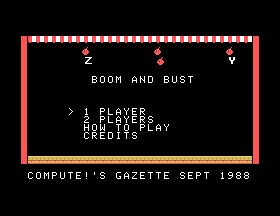 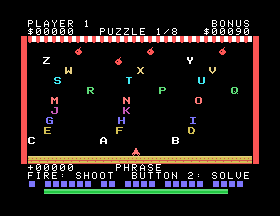 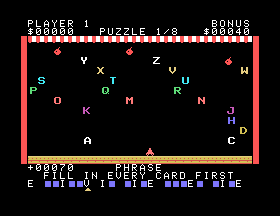 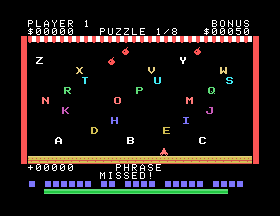 |
|
|
A warehouse has ten plank floors full of random holes. Barrels come in at the top, roll along the floors, each always the same way, and drop through the holes. Your worker starts at the bottom and must climb to the top: jump up through a hole above him, or blast the plank above him to make one. Each jump up scores 2 and each blast costs 5, so the score can go below zero. Touching a barrel costs 8 points and a worker, and the warehouse is rebuilt with new holes. Reach the top and you start again at the bottom; after three climbs a new warehouse is built, and the barrels get faster. With a score over 35 the number of barrels changes at each climb. Lose three workers and the game is over.
Controls: Use either controller. Push the stick left or right to walk and up to jump through a hole above, and press a button to blast the plank above (it costs 5 points). On the title, up and down choose and a button starts. ColecoVision version credited in the source to Claude (an AI made by Anthropic) for Amy Studio, in Amy, the language by Amy Bienvenu, 2026: a reimagined adaptation of the published rules. From COMPUTE!'s Gazette, July 1984: original Commodore 64 program (no author named in the issue). Printed for both the Commodore 64 and VIC-20; this follows the 64 listing. This is a modern homebrew adaptation, not a commercial Coleco release. Original Amy Studio release file: 053 - Bonking Barrels - by Bruce S. Gordon - COMPUTE! Gazette - July 1984.rom |
Amy Studio/Amy Purple (Bienvenu) | 10kb | 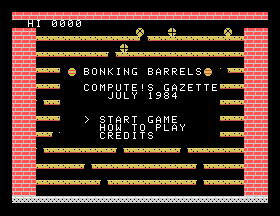 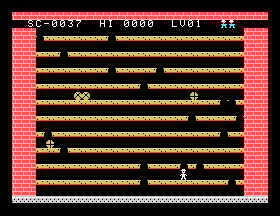 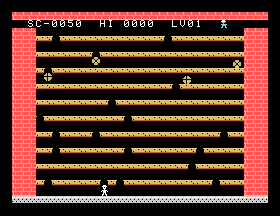 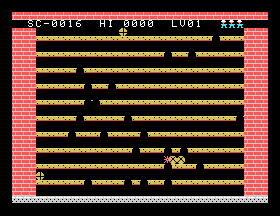 |
|
|
BLACK and WHITE face each other in a walled arena with four inner walls. Each throws bombs the way he faces, and the bombs never stop: they bounce off the walls, knock each other into new directions and slowly fill the arena. Push the stick toward a new direction to turn, and push again to walk; a wall or the other player blocks you. A bomb thrown on the move flies at walking speed, one thrown standing still at half speed. A bomb that reaches a player, or a player who walks into a bomb, costs a life, and the next round starts in a clean arena. Each player has five lives, and the last one standing wins. Two people can play, or one against a computer WHITE at EASY or HARD.
Controls: Controller 1 plays BLACK and controller 2 WHITE, unless the computer plays WHITE. The stick turns and walks, and either button throws a bomb. On the title, up and down choose and a button selects; on LEVEL it switches between EASY and HARD. ColecoVision version credited in the source to Claude (an AI made by Anthropic) for Amy Studio, in Amy, the language by Amy Bienvenu, 2026: a reimagined adaptation of the published rules. From COMPUTE!'s Gazette, January 1989: original Commodore 64 program (no author named in the issue). This is a modern homebrew adaptation, not a commercial Coleco release. Original Amy Studio release file: 205 - Bombardment - by Forrest Bentley - COMPUTE! Gazette - January 1989.rom |
Amy Studio/Amy Purple (Bienvenu) | 11kb | 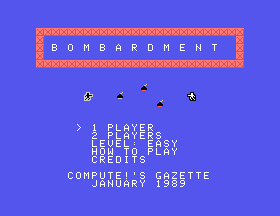 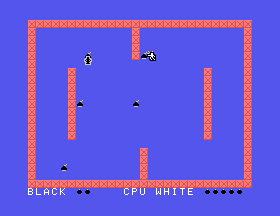 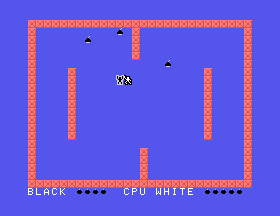 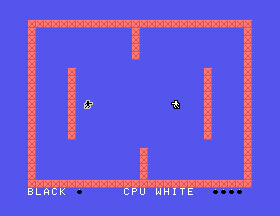 |
|
|
Backgammon against the computer. You play white and move from point 24 at the top right round to point 1 at the bottom right, bearing off into the tray; the computer plays black the other way. Each turn the side to play rolls two dice, and doubles give four moves. A point holding two or more of the other side's checkers is closed; a single checker, a blot, can be hit and sent to the bar, and it must come back in before anything else moves. Once all your checkers are on points 1 to 6 you can bear them off. A turn passes by itself when you have no legal move. First to bear off all fifteen wins. Pip counts and games won are shown on the wooden board.
Controls: Use either controller. The stick moves the cursor between checkers that can move; the left button picks one, the stick chooses where it goes and the left button moves it, and the right button puts it back. On the title, up and down choose and a button starts. ColecoVision version credited in the source to Claude (an AI made by Anthropic) for Amy Studio, in Amy, the language by Amy Bienvenu, 2026: a reimagined adaptation of the published rules. From COMPUTE!'s Gazette, November 1985: original Commodore 64 program (no author named in the issue). Printed for both the Commodore 64 and VIC-20; the two listings are the same. This is a modern homebrew adaptation, not a commercial Coleco release. Original Amy Studio release file: 103 - Backgammon - by Author not named - COMPUTE! Gazette - November 1985.rom |
Amy Studio/Amy Purple (Bienvenu) | 15kb | 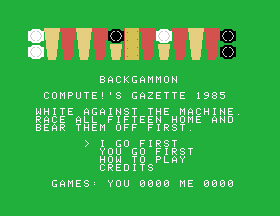 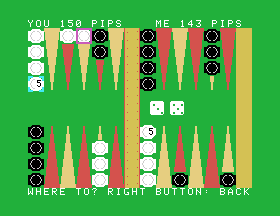 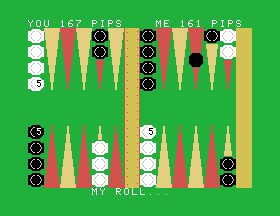 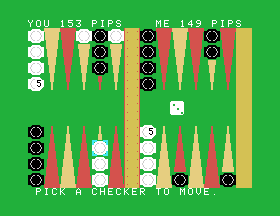 |
|
|
Two players take turns dropping blocks onto a board of 13 columns, each up to eight blocks high. Each player has a tray of four blocks, each in one of four shapes (a window at the top, at the bottom, both, or one tall window) and one of five colours. On your turn pick a block from your tray, carry it along the columns and drop it; it lands on top of that column's stack, and a full column refuses it. The block scores for each neighbour to its right, left and below: 15 for the same colour and 25 for the same shape, both counting if both match. A new random block fills your tray. When all 13 columns are full the game ends and the higher score wins. Play a friend or the computer.
Controls: Player 1 uses controller 1 and player 2 controller 2; in a one-player game either controller plays against the computer. Push left or right to move, holding to run, and press a side button to pick or drop a block. ColecoVision version credited in the source to Claude (an AI made by Anthropic) for Amy Studio, in Amy, the language by Amy Bienvenu, 2026: a reimagined adaptation of the published rules. From COMPUTE!'s Gazette, November 1988: original Commodore 128 program (no author named in the issue). A Commodore 128 program; unrelated to the commercial 3-D falling-block game of the same name. This is a modern homebrew adaptation, not a commercial Coleco release. Original Amy Studio release file: 200 - Block Out - by Jason Wellington - COMPUTE! Gazette - November 1988.rom |
Amy Studio/Amy Purple (Bienvenu) | 11kb | 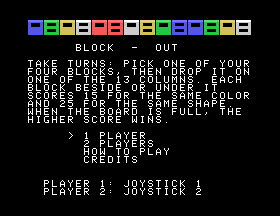 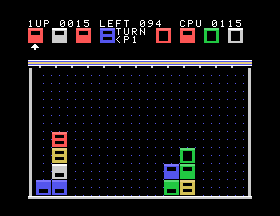  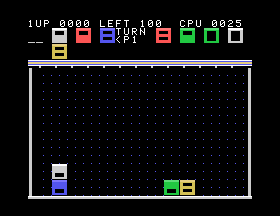 |
|
|
A strategy board game of blocks crossing a pit. Green's home is the left column and yellow's the right, and each side starts with six blocks. The six middle columns are pits crossed by red column strips and blue row strips, and a block in the middle must stand on a strip. Each turn has two parts. First, push one of your blocks one cell onto an empty cell with a strip, or into the enemy's home, where landing on an enemy block captures it. Then slide one row's blue strips or one column's red strips a cell round; any block left with nothing under it falls into the pit. The game ends when one side fills the enemy's home, loses all its blocks, or is outnumbered there. Play the computer or a friend.
Controls: Move the cursor with the stick. Press a button to pick a block or a strip's cell, then push the stick for the direction; press a button again to cancel. On the title, up and down and a button choose. ColecoVision version credited in the source to Claude (an AI made by Anthropic) for Amy Studio, in Amy, the language by Amy Bienvenu, 2026: a reimagined adaptation of the published rules. From COMPUTE!'s Gazette, September 1989: original Commodore 64 program (no author named in the issue). This is a modern homebrew adaptation, not a commercial Coleco release. Original Amy Studio release file: 222 - Block Battle! - by Jon Dearden - COMPUTE! Gazette - September 1989.rom |
Amy Studio/Amy Purple (Bienvenu) | 12kb | 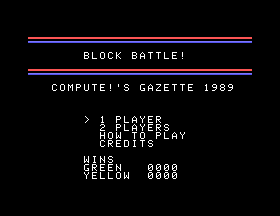 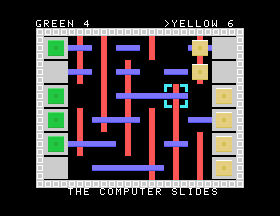 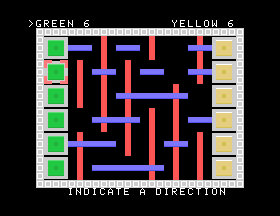 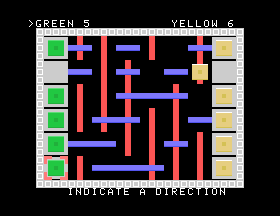 |
|
|
A bingo game for up to four cards. Each card has columns B I N G O holding five numbers from that letter's fifteen, with a free box in the centre. To call a ball, a letter ball is tossed up a chute; if it fails to clear the pass line it drops back and another is tossed. When one clears, an uncalled number of that letter appears on the big white ball. A chime rings for each card holding it, a gong if none does. Covering can be automatic, or done by hand: move a cursor to the number within eight seconds or the card misses it. Five covered boxes in a row, column or diagonal win, and the winning line lights up. Choose automatic or manual ball feed and cover, and how many cards people play.
Controls: Use either controller, passed between players. The stick moves through the menu and moves the cursor on a card; either button chooses, feeds the next ball in manual feed, and covers a number. ColecoVision version credited in the source to Claude (an AI made by Anthropic) for Amy Studio, in Amy, the language by Amy Bienvenu, 2026: a reimagined adaptation of the published rules. From COMPUTE!'s Gazette, April 1984: original Commodore 64 program by Richard L. Witkover. This is a modern homebrew adaptation, not a commercial Coleco release. Original Amy Studio release file: 041 - Bingo 64 - by R. WITKOVER - COMPUTE! Gazette - April 1984.rom |
Amy Studio/Amy Purple (Bienvenu) | 13kb | 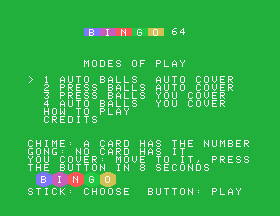 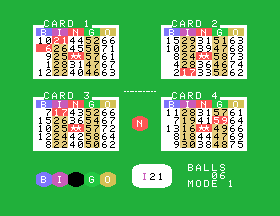 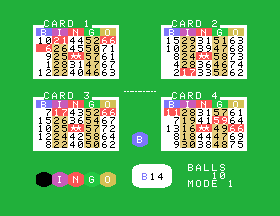 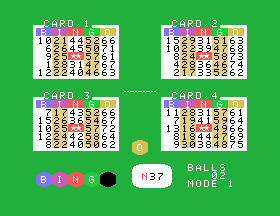 |
|
|
An educational game that teaches binary numbers by building a castle. A number from 0 to 15 appears as a row of four stones, with a lit stone for a 1 and an empty one for a 0. Work out which number it is and give your answer. Get it right and the row flies up and joins the castle, one row higher each time, and the sum is shown beneath, such as 8+2+1 = 11. The place values 8, 4, 2 and 1 are written under the castle as a guide. Stack twenty rows and the castle is finished: YOU DID IT!!! One wrong answer and the castle crumbles row by row, the correct answer is shown, and the game ends. Your best height is kept.
Controls: Use either controller. Push the stick up and down to pick the number, holding it to run through them, and press a side button to answer. ColecoVision version credited in the source to Claude (an AI made by Anthropic) for Amy Studio, in Amy, the language by Amy Bienvenu, 2026: a reimagined adaptation of the published rules. From COMPUTE!'s Gazette, November 1983: original Commodore 64 program (no author named in the issue). An 18-line BASIC program; the disk's VIC-20 file was a copy of the 64 one. This is a modern homebrew adaptation, not a commercial Coleco release. Original Amy Studio release file: 015 - Binary Castle - by Author not named - COMPUTE! Gazette - November 1983.rom |
Amy Studio/Amy Purple (Bienvenu) | 8kb | 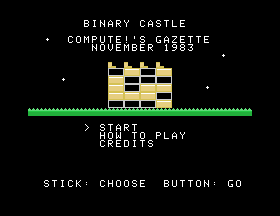 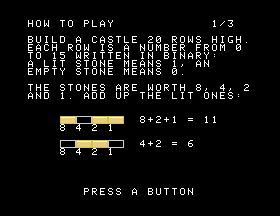 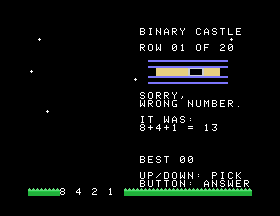 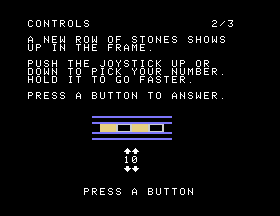 |
|
|
A little honey bear steps from chamber to chamber across a honeycomb, one whole chamber per push of the stick. Every full chamber it steps into is emptied for 10 points. Three guard bees wander the comb, and every so often the queen dives down a column and fills every chamber she passes again. Touching a bee or the queen costs a life, and the bear and bees return to their corners with the comb left as it was. Empty the whole comb for 75 points and a fresh, full comb appears; each new comb brings faster bees and quicker dives. Now and then a flower opens in the middle of the comb for a few seconds: reach it for an extra life and 50 points. You start with four lives, and the high score is kept.
Controls: Use controller 1 or 2. The stick moves the bear one chamber at a time. On the title, up and down choose and a button selects. ColecoVision version credited in the source to Claude (an AI made by Anthropic) for Amy Studio, in Amy, the language by Amy Bienvenu, 2026: a reimagined adaptation of the published rules. From COMPUTE!'s Gazette, September 1987: original Commodore 64 program (no author named in the issue). This is a modern homebrew adaptation, not a commercial Coleco release. Original Amy Studio release file: 159 - Beezone - by Kevin Black and Michael Wiens - COMPUTE! Gazette - September 1987.rom |
Amy Studio/Amy Purple (Bienvenu) | 9kb | 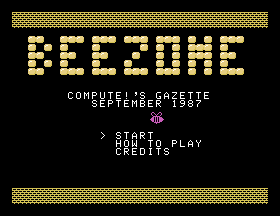 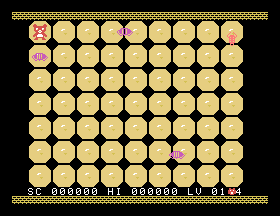 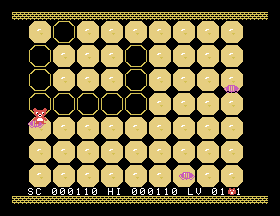 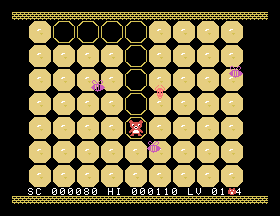 |
|
|
Your plane flies over a meadow of clovers above a hive wall, and under the wall sits the swarm. The plane never stops: it moves one step the way it faces, in eight directions, and you turn it left or right. A clover or the edge of the meadow halts it until you turn away. Your laser reaches up to seven steps and burns the first thing it meets: a clover or a piece of wall scores 50, a bee 100 and the chaser 200. Bore through the wall and shoot enough bees to clear the swarm, and a new one arrives with a fresh meadow and eight ships again. A chasing bee, or sometimes a crab that leaves clovers behind, homes in on you; touching it costs a ship. Lose all eight and the game ends.
Controls: Use either controller. Push the stick left or right to turn the plane and press either button to fire the laser. On the title, up and down choose and a button starts. ColecoVision version credited in the source to Claude (an AI made by Anthropic) for Amy Studio, in Amy, the language by Amy Bienvenu, 2026: a reimagined adaptation of the published rules. From COMPUTE!'s Gazette, July 1984: original Commodore 64 program (no author named in the issue). The issue printed both Commodore 64 and VIC-20 versions; this follows the 64 listing. This is a modern homebrew adaptation, not a commercial Coleco release. Original Amy Studio release file: 052 - Beekeeper - by Daniel Gray - COMPUTE! Gazette - July 1984.rom |
Amy Studio/Amy Purple (Bienvenu) | 10kb | 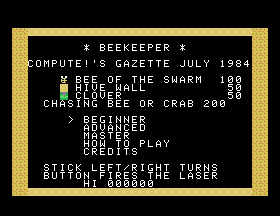 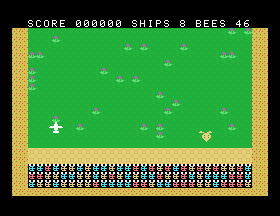 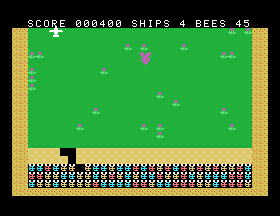 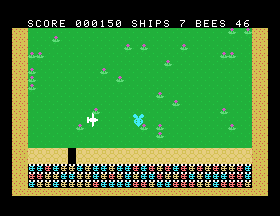 |
|
|
Patrol the fields in a hot air balloon and bomb the enemy tank that drives along the ground below. You have twenty bombs, with one in the air at a time, and each falls for about seven tenths of a second, so you have to lead the tank. After every bomb the tank changes speed, and sometimes direction, and patrols a new stretch of the field, and the wind changes and drifts your balloon. A destroyed tank is replaced by a new one somewhere else. The level, from 1 to 6, sets how fast the tank can go. When the twenty bombs are gone your hits give your rank, from PRIVATE up through CORPORAL, SERGEANT, CAPTAIN and MAJOR to GENERAL. The best hits of the session are kept.
Controls: Use either controller. Push left and right to steer, up and down to set the balloon's speed, and press a button to drop a bomb. On the title, up and down choose, left and right set the level, and a button starts. ColecoVision version credited in the source to Claude (an AI made by Anthropic) for Amy Studio, in Amy, the language by Amy Bienvenu, 2026: a reimagined adaptation of the published rules. From COMPUTE!'s Gazette, August 1984: original Commodore 64 program by Michael T. Bohn. This is a modern homebrew adaptation, not a commercial Coleco release. Original Amy Studio release file: 056 - Balloon Blitz - by MICHAEL T. BOHN - COMPUTE! Gazette - August 1984.rom |
Amy Studio/Amy Purple (Bienvenu) | 9kb | 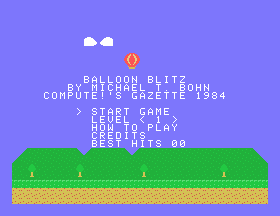 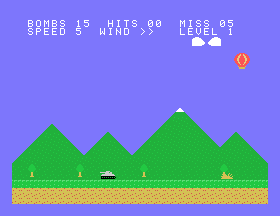 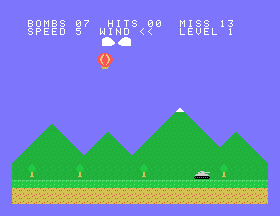 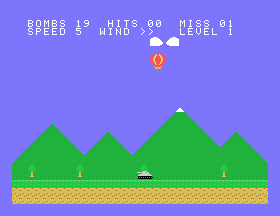 |
|
|
You bag the groceries at the end of four checkout belts. Shoppers come in from the far end along the aisles behind the belts and walk toward you. Throw a bag down a belt: a bag that meets a shopper serves them for 5 points. A shopper who reaches your end unserved, or a bag that slides off the far end of a belt, costs a life. A shopper well into the store may leave a tip on the floor, which rolls toward you twice as fast; be in that aisle when it arrives for 20 points, or it is lost and so is a life. Levels bring 10, 30 and 50 shoppers, then start again a step faster, with 100 points for each level and an extra life at level 5. You have four lives.
Controls: Use controller 1 or 2. Up and down change aisle, wrapping around, and a button throws a bag. On the title, up and down choose and a button chooses. ColecoVision version credited in the source to Claude (an AI made by Anthropic) for Amy Studio, in Amy, the language by Amy Bienvenu, 2026: a reimagined adaptation of the published rules. From COMPUTE!'s Gazette, July 1988 (Issue 61), page 36: original Commodore 64 program (no author named in the issue). This is a modern homebrew adaptation, not a commercial Coleco release. Original Amy Studio release file: 188 - Bagger - by Kevin Black - COMPUTE! Gazette - July 1988.rom |
Amy Studio/Amy Purple (Bienvenu) | 10kb | 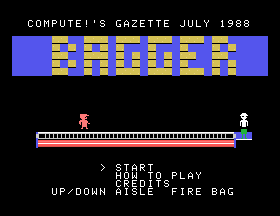  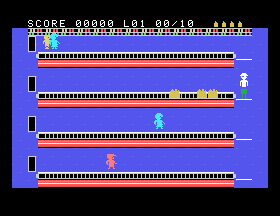  |
|
|
A light blue puck sits in the middle of the field, and each player has a BB gun at the centre of a goal line, one on the left and one on the right. Aim your gun and hold the button for rapid fire: every BB that hits the puck pushes it a little. Knock the puck over your opponent's goal line to score. BBs bounce off the top and bottom and off the deflectors scattered across the field, while the puck slides over them and slowly loses speed. After a minute without a goal the border turns red for destruct mode, and the BBs eat the deflectors away. After each goal the puck returns to the middle and the deflectors are restored. Five goals win. Play a friend, or the computer at EASY or HARD.
Controls: Controller 1 works the left gun and controller 2 the right; in a one-player game either controller plays against the computer's right gun. Push the stick up and down to aim, hold the left button to fire, and press the right button to pause. On the title, up and down choose and a button selects the field and the computer's level. ColecoVision version credited in the source to Claude (an AI made by Anthropic) for Amy Studio, in Amy, the language by Amy Bienvenu, 2026: a reimagined adaptation of the published rules. From COMPUTE!'s Gazette, August 1988: original Commodore 64 program by William Chin. This is a modern homebrew adaptation, not a commercial Coleco release. Original Amy Studio release file: 190 - BB Barrage - by Bill Chin - COMPUTE! Gazette - August 1988.rom |
Amy Studio/Amy Purple (Bienvenu) | 15kb | 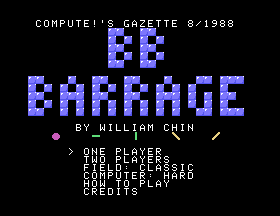 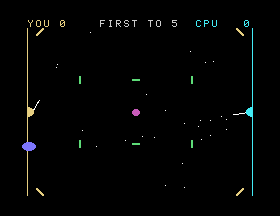 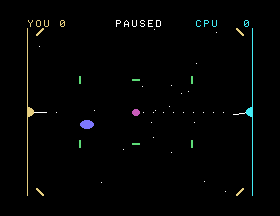 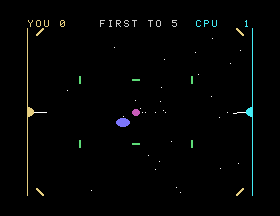 |
|
|
You are the good genie on a magic rug, and bad genies on rugs fly over the city. Touch one from above and it is knocked off its rug into a bottle; touch one from below and you are the one knocked off. Collect every bottle before its genie gets free again, first smoking and then flying out, to clear the wave. Points come only for bottles, 250 each. The button lifts you and letting go drops you, the stick pushes you left and right, and the rug keeps its speed in the air. Each wave brings more genies, up to seven, faster and keener to chase you. You have three genies, with one more every 5000 points.
Controls: Use controller 1 or 2. Press either button to fly up and let go to fall; the stick steers left and right. On the title, up and down choose and a button starts. ColecoVision version credited in the source to Claude (an AI made by Anthropic) for Amy Studio, in Amy, the language by Amy Bienvenu, 2026: a reimagined adaptation of the published rules. From COMPUTE!'s Gazette, November 1984: original Commodore 64 program by Kevin Martin and Bryan Files. This is a modern homebrew adaptation, not a commercial Coleco release. Original Amy Studio release file: 064 - Bagdad - by K. Martin and Bryan Files - COMPUTE! Gazette - November 1984.rom |
Amy Studio/Amy Purple (Bienvenu) | 13kb | 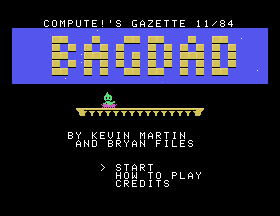 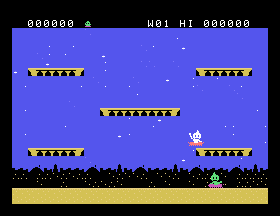 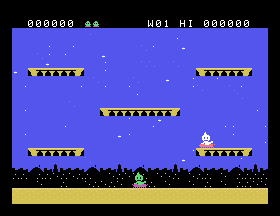 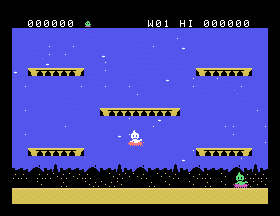 |
|
|
You are a white blood cell circling inside a big cell. Bacteria are born at its centre and wander, and one that reaches the membrane infects the cell and costs a unit of health. Shoot them, the shot flying through the centre to the far wall, or ram them for more points. A virus creeps slowly round your orbit; touching it costs health and sends you back to the bottom and the virus to the top. The clock bar fills, and when it is full the round ends and the next has one more bacterium, from one up to five. After round five comes the next level, with one bacterium again, everything faster and health restored. After 24 infections or stings you have failed the mission.
Controls: Use either controller. Left and right move round the orbit and a button fires. On the title, up and down choose and a button starts. ColecoVision version credited in the source to Claude (an AI made by Anthropic) for Amy Studio, in Amy, the language by Amy Bienvenu, 2026: a reimagined adaptation of the published rules. From COMPUTE!'s Gazette, March 1989: original Commodore 128 program (no author named in the issue). From the March 1989 Gazette disk; a Commodore 128 program. This is a modern homebrew adaptation, not a commercial Coleco release. Original Amy Studio release file: 210 - Bacteria - by Author not named - COMPUTE! Gazette - March 1989.rom |
Amy Studio/Amy Purple (Bienvenu) | 15kb | 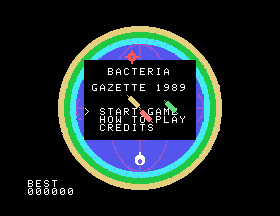 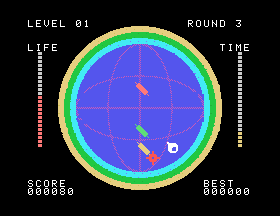 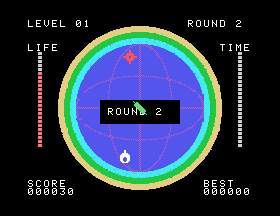 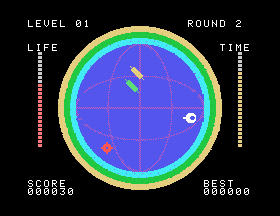 |
|
|
A deduction puzzle. Twenty-five mirrors, the quarks, hide in a 15 by 10 box, each slanted one way or the other. You have 25 turns, and each is a SHOT or a GUESS. A shot sends a beam in from one of the 50 ports around the box; it bounces off every mirror it meets and comes out at a port, and the turn's letter is written at both ends. A guess names a cell and a slant: right, the mirror shows and you score 54 less twice the turn number; wrong, you lose half that. Early turns are worth more, so shooting costs points too. Finding all 25 earns a bonus. After the last turn the box opens and shows the mirrors you missed, and the best score is kept.
Controls: Use either controller. The stick moves the cursor and repeats when held. On a port, either button shoots; on a cell, the left button guesses one slant and the right button the other. On the title, up and down choose and a button starts. ColecoVision version credited in the source to Claude (an AI made by Anthropic) for Amy Studio, in Amy, the language by Amy Bienvenu, 2026: a reimagined adaptation of the published rules. From COMPUTE!'s Gazette, October 1985: original Commodore 64 program (no author named in the issue). The Commodore 64 'Atom Shoot' is a different game from the VIC-20 one on the same disk (#041); '64' was added to the title to tell them apart. This is a modern homebrew adaptation, not a commercial Coleco release. Original Amy Studio release file: 100 - Atom Shoot 64 - by Author not named - COMPUTE! Gazette - October 1985.rom |
Amy Studio/Amy Purple (Bienvenu) | 9kb | 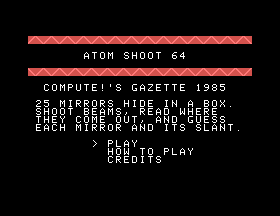 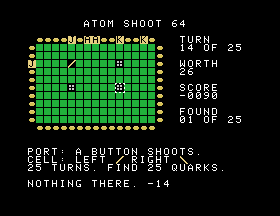 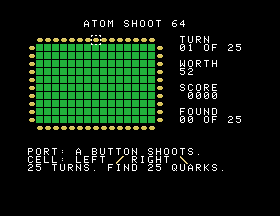 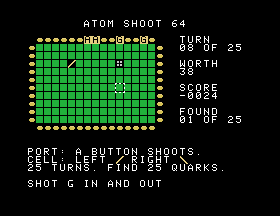 |
|
|
A deduction puzzle. Five atoms hide in an eight by eight box, and you find them by shooting beams in from the 32 ports around its edge and watching what comes out. H means the beam hit an atom head on and was absorbed; R means it was turned back out of the port it went in by; and a matching letter at another port shows where a bent beam came out. A beam passing an atom diagonally ahead of it turns away from it, and two atoms on either side send it back. Each port can be fired only once. Mark the five cells you think hold the atoms; on the fifth mark the box opens, and all five right wins. Fewer beams is better, and the lowest winning count is kept as BEST.
Controls: Use either controller. The stick moves the cursor, and either button fires a beam from a port or marks and unmarks a cell inside the box. On the title, up and down choose and a button starts. ColecoVision version credited in the source to Claude (an AI made by Anthropic) for Amy Studio, in Amy, the language by Amy Bienvenu, 2026: a reimagined adaptation of the published rules. From COMPUTE!'s Gazette, October 1985: original VIC-20 program (no author named in the issue). The same disk has a different Commodore 64 game under the same name, catalogued separately as Atom Shoot 64 (#042). This is a modern homebrew adaptation, not a commercial Coleco release. Original Amy Studio release file: 099 - Atom Shoot - by Author not named - COMPUTE! Gazette - October 1985.rom |
Amy Studio/Amy Purple (Bienvenu) | 10kb | 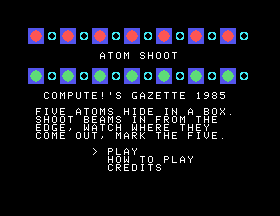 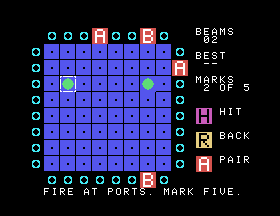 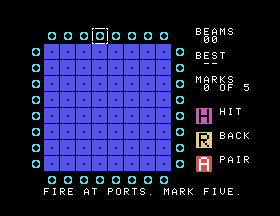 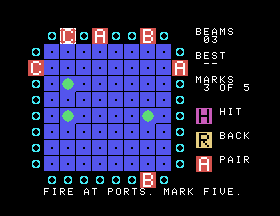 |
|
|
Seven flying saucers swarm over your laser base, darting in random directions. Shoot them all to clear the wave for 100 points; the next wave is faster. A saucer is worth 5 to 25 points when hit, the higher it is the more, and one shot can bring down several. You have one shot in the air at a time. A saucer that dives onto your base destroys it, and the whole swarm of seven comes back. You have three bases, and levels go on up to 99. A base that sits still for four seconds turns grey and scores nothing until it moves again. Your score and the high score are shown.
Controls: Use controller 1 or 2. The stick moves the base left and right, and either button fires; hold it to keep firing. ColecoVision version credited in the source to Claude (an AI made by Anthropic) for Amy Studio, in Amy, the language by Amy Bienvenu, 2026: a reimagined adaptation of the published rules. From COMPUTE!'s Gazette, February 1984: original Commodore 64 program by Charles Brannon. A VIC-20 version followed on the April 1985 disk. This is a modern homebrew adaptation, not a commercial Coleco release. Original Amy Studio release file: 032 - Astro-Panic! - by Charles Brannon - COMPUTE! Gazette - February 1984.rom |
Amy Studio/Amy Purple (Bienvenu) | 10kb | 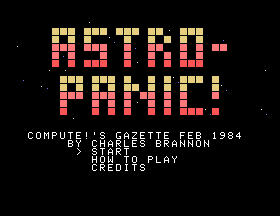 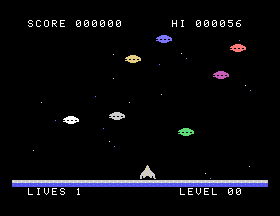 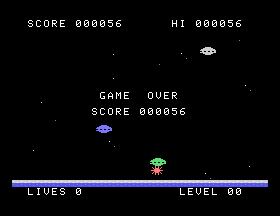 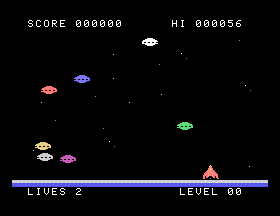 |
|
|
Two teams of two jumping heads play volleyball with their heads. One stick moves both heads of a team together, even in the air, and the button makes both jump. The ball floats until it is first headed, then gravity takes it. A head that meets the ball standing still sends it back up as fast as it came; one rising in a jump speeds it up and one falling slows it, and the side of the head steers it. The ball bounces off both walls and the ceiling. Each team has three touches, and a fourth loses the rally, as does the ball landing on your side. Only the serving team scores; otherwise the serve changes sides. First to 15 wins. One player takes the right team against the computer, or two play each other.
Controls: With one player, either joystick plays the right team; with two, joystick 1 is the left team and joystick 2 the right. Push left and right to move both heads, and press either side button to jump; hold it to keep jumping. ColecoVision version credited in the source to Claude (an AI made by Anthropic) for Amy Studio, in Amy, the language by Amy Bienvenu, 2026: a reimagined adaptation of the published rules. From COMPUTE!'s Gazette, June 1988: original Commodore 64 program by Rhett Anderson and David Hensley, Jr.. This is a modern homebrew adaptation, not a commercial Coleco release. Original Amy Studio release file: 185 - Arcade Volleyball - by R. ANDERSON & D. HENSLEY JR - COMPUTE! Gazette - June 1988.rom |
Amy Studio/Amy Purple (Bienvenu) | 9kb | 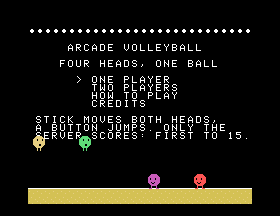 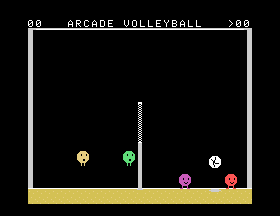 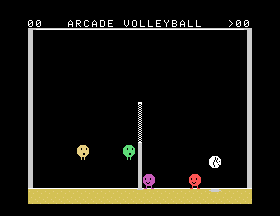 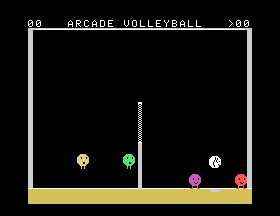 |
|
|
The pitcher throws one of four pitches, a fastball, a slow ball or a curve either way, and you press the button to swing, once a pitch. Where the bat meets the ball sends it left, centre or right: early swings pull it left, late ones push it right. The ball flies to a row of zones along the top, 1B, OUT, 2B, OUT, 3B, OUT, 2B, OUT, 1B, and a ball hit straight back over the pitcher's mound is a home run. A miss is a strike, three strikes are an out, and three outs end the half inning. On a hit every runner moves up as many bases as the hit is worth. PRACTICE gives 20 pitches, 1 PLAYER one inning against the computer's pitching, and 2 PLAYERS three innings, with extra innings on a tie.
Controls: Use the joystick and side buttons. The batter presses a button to swing. In a two-player game the pitcher aims with the stick (up or centre fastball, down slow ball, left or right a curve) and throws with a button. On the title, up and down choose and a button starts. ColecoVision version credited in the source to Claude (an AI made by Anthropic) for Amy Studio, in Amy, the language by Amy Bienvenu, 2026: a reimagined adaptation of the published rules. From COMPUTE!'s Gazette, May 1986: original Commodore 64 program (no author named in the issue). This is a modern homebrew adaptation, not a commercial Coleco release. Original Amy Studio release file: 117 - Arcade Baseball - by Kevin Mykytyn and Mark Tuttle - COMPUTE! Gazette - May 1986.rom |
Amy Studio/Amy Purple (Bienvenu) | 11kb | 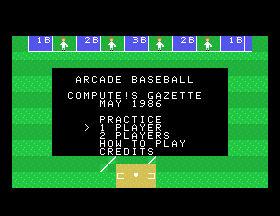    |
|
|
Willie walks left through a walled garden at night, picking up apples. Birds swoop in from the left, some flying high and some low, and a worm crawls along the path; touching any of them costs a life. Duck under the high birds, and jump over the low birds and the worm. Apples lie still on the path: walk into them to pick them up, at 10 points each. Willie stays in place while the garden scrolls past as he walks, and standing still is no defence, since every creature comes to him. You have three lives, and after a lost life the round starts again with your score kept.
Controls: Use controller 1 or 2. Push left to walk, down to duck, and press either button to jump; held down, it jumps again on landing. On the title, up and down choose and a button chooses. ColecoVision version credited in the source to Claude (an AI made by Anthropic) for Amy Studio, in Amy, the language by Amy Bienvenu, 2026: a reimagined adaptation of the published rules. From COMPUTE!'s Gazette, April 1990: original Commodore 64 program (no author named in the issue). A program from the April 1990 Gazette disk (machine language with a BASIC loader). This is a modern homebrew adaptation, not a commercial Coleco release. Original Amy Studio release file: 234 - Apple Willie - by Hubert Cross - COMPUTE! Gazette - April 1990.rom |
Amy Studio/Amy Purple (Bienvenu) | 20kb | 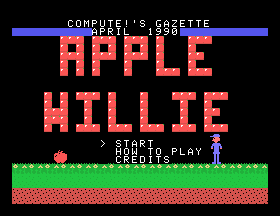    |
|
|
You are a smiling face in a forest. Eat the apples and avoid the trees and the monster, which wanders at random and eats any tree, apple or ruby it walks over. Walking into a tree or meeting the monster costs a man. Five apples finish a wave, and a ruby finishes it at once for 3000 points; apples are worth 50 to 500 each. Time is short: the time bar turns red near the end, a wave finished before then earns a time bonus, and running out costs a man. A zap destroys everything in the eight cells around you and resets the time; catch the monster in it for 1000 points and the wave is over. Each wave has more trees, the edges wrap around, and an extra man and zap come every five waves.
Controls: Use either controller. The stick moves the face, which keeps walking while the stick is held, and either button lets off a zap. ColecoVision version credited in the source to Claude (an AI made by Anthropic) for Amy Studio, in Amy, the language by Amy Bienvenu, 2026: a reimagined adaptation of the published rules. From COMPUTE!'s Gazette, April 1985: original Commodore 64 program (no author named in the issue). This is a modern homebrew adaptation, not a commercial Coleco release. Original Amy Studio release file: 083 - Apple Hunt - by James Arlet - COMPUTE! Gazette - April 1985.rom |
Amy Studio/Amy Purple (Bienvenu) | 10kb | 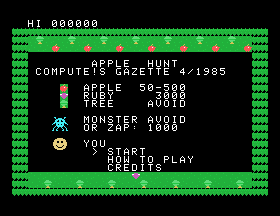 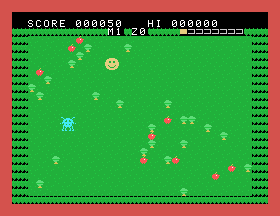 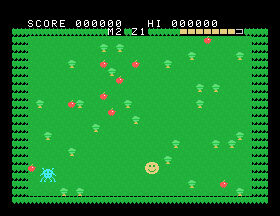 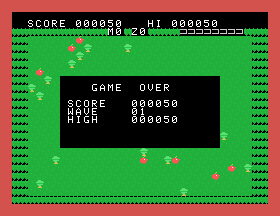 |
|
|
A memory game. A board of 36 keys, laid out like a typewriter keyboard, hides 18 animals, each twice, dealt at random. Pick a key and its animal and name appear in the first box; pick another for the second box. When both keys hide the same animal the pair is taken off the board; otherwise the keys close again. In KEYS ONLY any matching pair counts. In KEYS AND SHAPES the pair must also be the animal shown in the FIND box, which changes on a timer through all 18 animals in a fixed order, from the snail to the ladybug, faster with every pair found; each full round of the 18 adds one to CYCLE. The game ends when all 18 pairs are found, and a lower CYCLE is better.
Controls: Use either joystick. Move the yellow frame over the keys and press the left button to pick one. On the title the stick chooses and a button starts. ColecoVision version credited in the source to Claude (an AI made by Anthropic) for Amy Studio, in Amy, the language by Amy Bienvenu, 2026: a reimagined adaptation of the published rules. From COMPUTE!'s Gazette, December 1987: original Commodore 64 program (no author named in the issue). This is a modern homebrew adaptation, not a commercial Coleco release. Original Amy Studio release file: 167 - Animal Match - by David Wright - COMPUTE! Gazette - December 1987.rom |
Amy Studio/Amy Purple (Bienvenu) | 10kb | 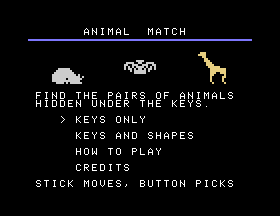 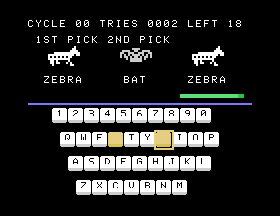 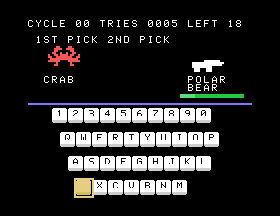 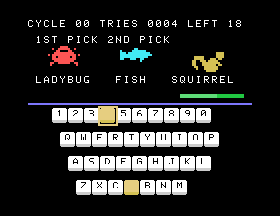 |
|
|
An alphabet shooting game. A letter appears somewhere in the night sky; slide your cannon along the ridge and shoot it, and the letter lights up in the alphabet below the ground. Shoot all 26 to finish. There are four games. RANDOM LETTERS brings the 26 in a random order, each once; A TO Z brings them in alphabetical order; YOUR CHOICE lets you choose each letter before it appears; and CRAWLING LETTERS sends random letters crawling to the right, row after row, starting again at the top. Only one shot flies at a time. Your time and your number of shots are counted, and the best time for each game is kept.
Controls: Use either controller. Push left and right to move the cannon and press either button to fire. In YOUR CHOICE, up and down pick a letter and a button places it. On the title, up and down choose a game and a button starts. ColecoVision version credited in the source to Claude (an AI made by Anthropic) for Amy Studio, in Amy, the language by Amy Bienvenu, 2026: a reimagined adaptation of the published rules. From COMPUTE!'s Gazette, January 1984: original Commodore 64 program (no author named in the issue). This is a modern homebrew adaptation, not a commercial Coleco release. Original Amy Studio release file: 027 - Alpha-Shoot - by Author not named - COMPUTE! Gazette - January 1984.rom |
Amy Studio/Amy Purple (Bienvenu) | 9kb | 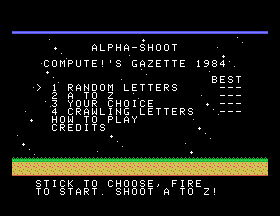 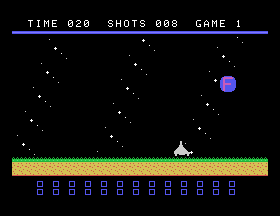 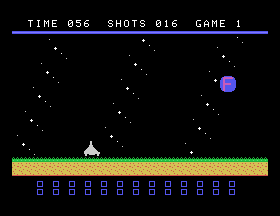 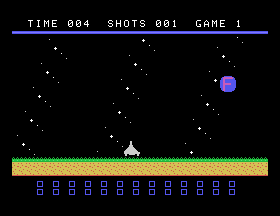 |
|
|
The letters A to Y hide under the 25 panels of a five by five board, and the cursor shows the letter beneath whichever panel it is on. Press the button on the letters in order, A, B, C and on to Y, before the clock runs out. A letter you find stays uncovered; a wrong one costs ten seconds. Clear the board and a new shuffled one appears, with a time limit worked out from how fast you were. Each letter is worth 10 points. After six boards the order turns round, Y back to A, and from the eleventh board the NEXT LETTER box disappears, so you must remember the order yourself. The game ends when the time runs out.
Controls: Use either controller. The stick moves the cursor and either button picks the letter under it. On the title, up and down choose and a button starts. ColecoVision version credited in the source to Claude (an AI made by Anthropic) for Amy Studio, in Amy, the language by Amy Bienvenu, 2026: a reimagined adaptation of the published rules. From COMPUTE!'s Gazette, March 1985: original Commodore 64 program (no author named in the issue). This is a modern homebrew adaptation, not a commercial Coleco release. Original Amy Studio release file: 080 - Alpha Anxiety - by Author not named - COMPUTE! Gazette - March 1985.rom |
Amy Studio/Amy Purple (Bienvenu) | 11kb | 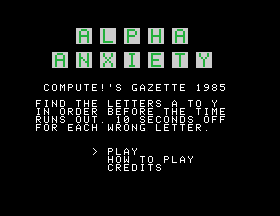 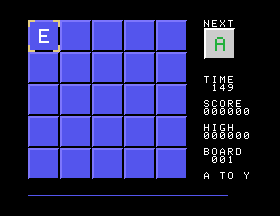 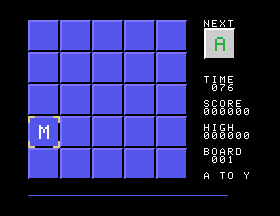 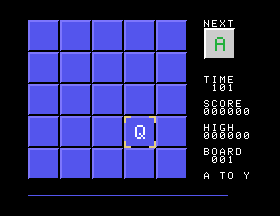 |
|
|
You are a Zargian star warrior. Above you the Gorg mothership hides behind four rows of guard droids, and each droid takes three hits, going from whole to dented to cracked to gone. Dig a hole through the wall under the mothership and hit it with one laser shot for 5000 points and a new wave. Meanwhile a bomb drops at the spot where you stand, a bird swoops down and four aliens home in on you, and anything that lands on your ship costs a ship. From 10,000 points a smartbomb joins them, homing in fast, and your laser cannot stop it. Bombs, birds, aliens and droid hits all score. Levels 0 to 4 give five ships and levels 5 to 9 give three.
Controls: Use controller 1 or 2. The stick moves the ship left and right, and either button fires; hold it to keep firing. On the title, up and down choose, left and right change the level, and a button chooses. ColecoVision version credited in the source to Claude (an AI made by Anthropic) for Amy Studio, in Amy, the language by Amy Bienvenu, 2026: a reimagined adaptation of the published rules. From COMPUTE!'s Gazette, May 1985: original Commodore 64 program by John Matias. This is a modern homebrew adaptation, not a commercial Coleco release. Original Amy Studio release file: 087 - Alien Armada - by J.MATIAS - COMPUTE! Gazette - May 1985.rom |
Amy Studio/Amy Purple (Bienvenu) | 10kb | 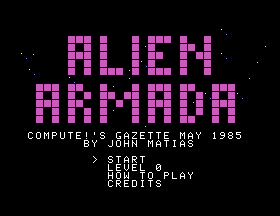 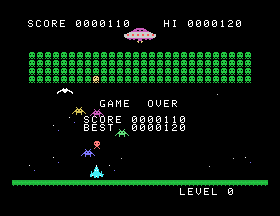 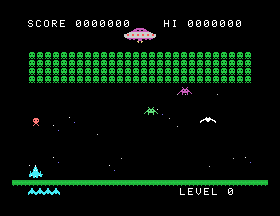 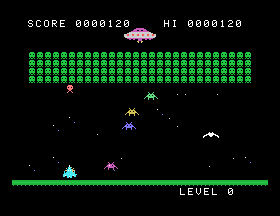 |
|
|
Andromedan aardvarks attack ten cities with 26 kinds of bombs. Their mothership glides over the cities and drops a bomb, and your radar shows which kind it is as a large blocky letter. First name the bomb by picking its letter from A to Z, then save the city by firing the gun under the bomb's column. The sooner you do both, the more the save scores. A wrong letter or a shot at the wrong city makes the bomb drop a row at once. A bomb that lands knocks one block off its city if you named it and two if you did not, and a bomb falling on a city already flattened ends the game. There are nine levels, from novice to expert, and a high score is kept.
Controls: Use either controller. Until the bomb is named, the stick moves a box over the letters and a button names it; then left and right move the gun and a button fires. On the title, up and down choose, left and right set the level, and a button starts. ColecoVision version credited in the source to Claude (an AI made by Anthropic) for Amy Studio, in Amy, the language by Amy Bienvenu, 2026: a reimagined adaptation of the published rules. From COMPUTE!'s Gazette, October 1983: original VIC-20 program by Todd Heimarck. The Commodore 64 version followed in November 1983; both listings were read. This is a modern homebrew adaptation, not a commercial Coleco release. Original Amy Studio release file: 012 - Aardvark Attack - by TODD HEIMARCK - COMPUTE! Gazette - October 1983.rom |
Amy Studio/Amy Purple (Bienvenu) | 10kb | 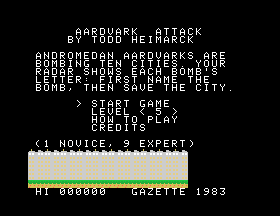 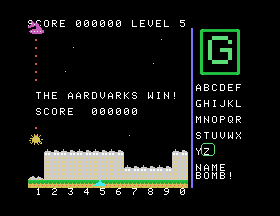 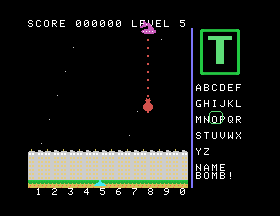 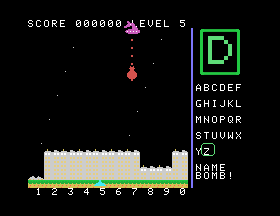 |
|
|
Tic tac toe on a three by three by three cube, shown as three square boards stepping down from the top layer to the bottom. Two players take turns claiming cells, X for player 1 and O for player 2. Three in a row along any of the cube's 49 lines wins the round: rows, columns and diagonals within a layer, pillars straight down through the three layers, and the slanting lines between them. The winning cells flash, the board is cleared, and the other player opens the next round. A match lasts the number of rounds chosen on the title, from 1 to 9, and whoever wins more rounds takes it. Since the opener can win by taking the centre, an OPENING option can bar the centre from the first move.
Controls: Either controller plays for the player whose turn it is. Left and right move the cursor one cell, up and down a whole row, and a button claims the cell. On the title, up and down choose, left and right change ROUNDS and OPENING, and a button starts. ColecoVision version credited in the source to Claude (an AI made by Anthropic) for Amy Studio, in Amy, the language by Amy Bienvenu, 2026: a reimagined adaptation of the published rules. From COMPUTE!'s Gazette, June 1984: original Commodore 64 program (no author named in the issue). This is a modern homebrew adaptation, not a commercial Coleco release. Original Amy Studio release file: 046 - 3-D Tic Tac Toe - by Mark Doyle - COMPUTE! Gazette - June 1984.rom |
Amy Studio/Amy Purple (Bienvenu) | 9kb | 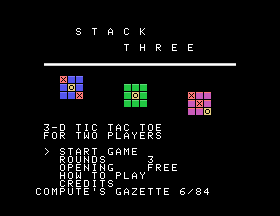 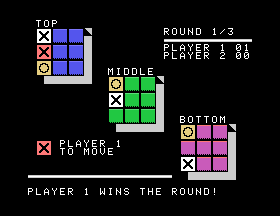 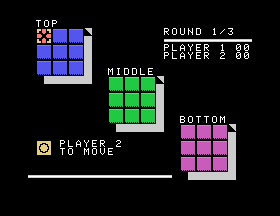 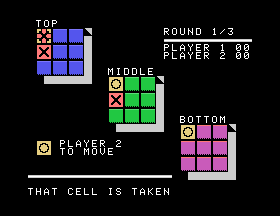 |
|
|
Drive alone on a ring road marked by posts across a wide valley, with mountains on the horizon. Hold the button to speed up and steer with the stick. Two other cars come down the road as you overtake them, wandering from lane to lane, and posts stand along both edges. Touch a car or a post and you spin out, losing your speed and some time while the clock keeps running. A lap is 250 posts. The first lap gives you 46 seconds and each lap after that 3 seconds less, and when the clock runs out the race is over. Your score is the distance driven, shown during the race, and the best score is kept.
Controls: Use either joystick. The stick steers left and right; hold either button to speed up. On the title, up and down choose and a button starts. ColecoVision version credited in the source to Claude (an AI made by Anthropic) for Amy Studio, in Amy, the language by Amy Bienvenu, 2026: a reimagined adaptation of the published rules. From COMPUTE!'s Gazette, April 1988: original Commodore 64 program by Chris Ulmer. This is a modern homebrew adaptation, not a commercial Coleco release. Original Amy Studio release file: 179 - 3-D Speedway - by CHRIS ULMER - COMPUTE! Gazette - April 1988.rom |
Amy Studio/Amy Purple (Bienvenu) | 14kb | 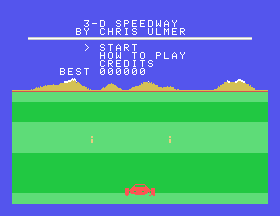 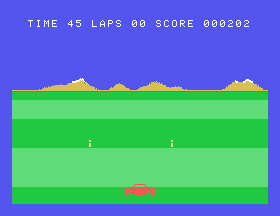 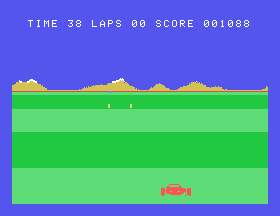 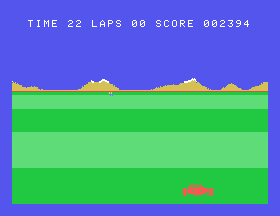 |
|
|
Sam, an orange basketball, and Ed, a blue one, both with arms, legs and faces, play one-on-one. You run left and right and jump, choosing left, right or straight up as you press, with no control once you are in the air. To score you must go through a hoop yourself, and the only way to reach one is by bouncing off your opponent, the floor or a backboard. There are three goals, worth two points each. A game is four periods of 10 game minutes; when a period ends the players lose control, but a goal before they stop bouncing still counts, and a tie goes to overtime. Play against a friend, or against the computer playing Ed.
Controls: With one player, either joystick plays Sam. With two, Sam is joystick 1 and Ed joystick 2. Push left and right to run; the left button jumps and the right button pauses. ColecoVision version credited in the source to Claude (an AI made by Anthropic) for Amy Studio, in Amy, the language by Amy Bienvenu, 2026: a reimagined adaptation of the published rules. From COMPUTE!'s Gazette, July 1987, page 53: original Commodore 64 program by Rhett Anderson and David Hensley, Jr.. Built from the article's rules; the original was machine language and its code was not used. This is a modern homebrew adaptation, not a commercial Coleco release. Original Amy Studio release file: 154 - Basketball Sam & Ed - by Rhett Anderson and David Hensley Jr - COMPUTE! Gazette - July 1987.rom |
Amy Studio/Amy Purple (Bienvenu) | 10kb | 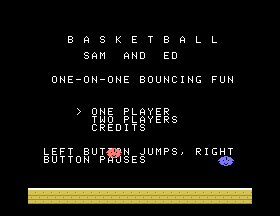 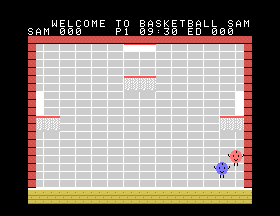 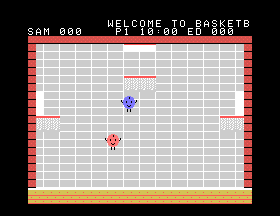 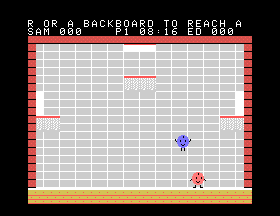 |
|
|
Find your way through a labyrinth seen in first person, room by room, as fast as you can. You start in the north-west corner facing north, beside the START sign on the wall, and the way out is the FINISH sign in the south-east corner: stand in the last room facing south. The labyrinth is a grid of rooms with stone pillars and stones dropped at random, always with a way through. Your time is counted in seconds. You can look at the map, YOU ARE HERE, whenever you like, but each look adds 10 seconds. A compass shows which way you face. A second game, MAZE, digs a perfect maze with only one way between any two rooms. The best time of each game is kept.
Controls: Use either joystick. Up walks forward one room, down turns you round, and left and right turn. The button shows the map; press a button again to go back. The keypad is not used. ColecoVision version credited in the source to Claude (an AI made by Anthropic) for Amy Studio, in Amy, the language by Amy Bienvenu, 2026: a reimagined adaptation of the published rules. From COMPUTE!'s Gazette, December 1984: original Commodore 64 program by John Stilwell. One BASIC listing serves both the Commodore 64 and the VIC-20. This is a modern homebrew adaptation, not a commercial Coleco release. Original Amy Studio release file: 068 - 3-D Labyrinth - by JOHN STILWELL - COMPUTE! Gazette - December 1984.rom |
Amy Studio/Amy Purple (Bienvenu) | 10kb | 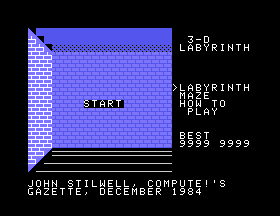 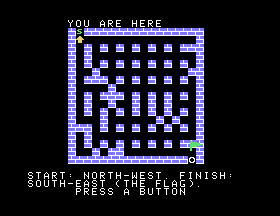   |
|
|
Two fireflies, green starting at the left and purple at the right, each leave a deadly trail of light behind them. Steer yours so that the other bumps into a trail, its own or yours, and you score a point; if both crash together, nobody scores. The fireflies wrap around the edges of the field and speed up as a round goes on. Hold the button to turn your light off and leave gaps in your trail, which either firefly can slip through. The first round waits for a button, and later rounds start by themselves after a crash. The first to 10 wins. Play a friend, or play green against the computer.
Controls: Green is joystick 1 and purple is joystick 2; against the computer either joystick steers green. Push the stick to turn (you cannot reverse) and hold either button to switch your light off. ColecoVision version credited in the source to Claude (an AI made by Anthropic) for Amy Studio, in Amy, the language by Amy Bienvenu, 2026: a reimagined adaptation of the published rules. From COMPUTE!'s Gazette, July 1987: original Commodore 64 program by Stephen Shull. Built from the article's rules; the original was machine language and its code was not used. This is a modern homebrew adaptation, not a commercial Coleco release. Original Amy Studio release file: 155 - Squeeze - by Stephen Shull - COMPUTE! Gazette - July 1987.rom |
Amy Studio/Amy Purple (Bienvenu) | 9kb | 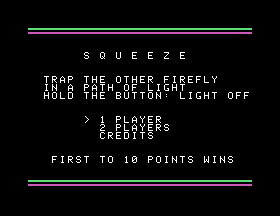 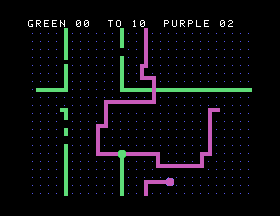 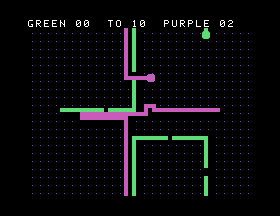 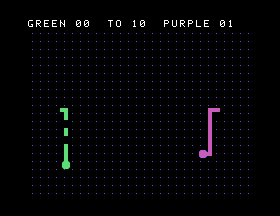 |
|
|
Survive 16 waves of 15 enemies each. Your ship starts at the top left and drifts on its momentum as you thrust, and everything bounces off the edges of the screen and off the status board in the middle. Hold the button and push the stick to turn, so you can fly one way and shoot another. Dark blue drifters are harmless, cyan bombers leave mines, nets and bombs behind them, yellow destroyers are twice as fast and fire at you, and in the last three waves orange battle satellites fire, bomb and bounce fast. Most bombs can be shot for points, but the indestructo cannot. A lost ship restarts the wave. Clearing a wave on the first try earns 1000, and bonus ships come after waves 4, 8 and 12. There are four skill levels, from ROOKIE to EXPERT.
Controls: Use either joystick. The stick thrusts. Hold the left button and push the stick to turn the ship; the left button also fires, again and again while held. The right button pauses. The keypad is not used. ColecoVision version credited in the source to Claude (an AI made by Anthropic) for Amy Studio, in Amy, the language by Amy Bienvenu, 2026: a reimagined adaptation of the published rules. From COMPUTE!'s Gazette, April 1987, page 44: original Commodore 64 program by Sean Wagle. Built from the article's rules; the original was machine language and its code was not used. This is a modern homebrew adaptation, not a commercial Coleco release. Original Amy Studio release file: 150 - Omicron - by Sean Wagle - COMPUTE! Gazette - April 1987.rom |
Amy Studio/Amy Purple (Bienvenu) | 13kb | 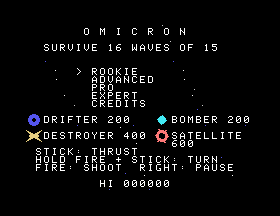    |
|
|
A music toy, not a game. A xylophone of ten coloured bars plays an improvised tune over a two-voice oom-pah accompaniment, and the notes are chosen so that nothing ever sounds wrong. There are four modes. RANDOM plays a random note each beat. COMPOSE makes up new tunes from the improvisations it remembers. PLAY ALONG lets you strike the bars yourself with a mallet while the accompaniment plays. SHORT-TUNES plays sixteen ready-made 32-note improvisations, and then the Grand Improvisor says that is all he will play for now. A mallet strikes each bar as it sounds, the bar lights up and notes dance up from it. The tempo can be set to slow, normal or fast.
Controls: Use either joystick. On the menu, up and down choose and the button selects; left, right or the button change the tempo. In PLAY ALONG, left and right move the mallet and the button strikes a bar, which rings on while held. The right button goes back to the menu. ColecoVision version credited in the source to Claude (an AI made by Anthropic) for Amy Studio, in Amy, the language by Amy Bienvenu, 2026: a faithful adaptation of the published rules. From COMPUTE!'s Gazette, April 1987, page 46: original Commodore 64 program by Donald Eddington. Not a game: a music toy. This is a modern homebrew adaptation, not a commercial Coleco release. Original Amy Studio release file: 149 - Improvisor - by DONALD EDDINGTON - COMPUTE! Gazette - April 1987.rom |
Amy Studio/Amy Purple (Bienvenu) | 9kb |     |
|
|
You are the light blue skidder in a closed universe. Four other skidders fly about at high speed, getting faster and faster, and a single touch from any of them means you lose. Fly off any edge and you come back on the opposite side. A striped yellow wall surrounds the middle of the field: it slows you to a crawl while you cross it, and you are STUCK, but the others stream through it untouched. Your skidder stops when you let go of the stick, while the others never stop. Survive for 40 seconds to win; a bar fills one cell every two seconds to show how long you have lasted.
Controls: Use either joystick. The stick moves your skidder, which stops when you let go. The button starts a game and returns to the title afterwards. ColecoVision version credited in the source to Claude (an AI made by Anthropic) for Amy Studio, in Amy, the language by Amy Bienvenu, 2026: a faithful adaptation of the published rules. From COMPUTE!'s Gazette, April 1987, page 52: original Commodore 128 program by I. J. Lyles, Jr.. This is a modern homebrew adaptation, not a commercial Coleco release. Original Amy Studio release file: 151 - Skidders - by I. J. LYLES, JR - COMPUTE! Gazette - April 1987.rom |
Amy Studio/Amy Purple (Bienvenu) | 8kb | 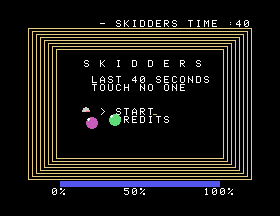 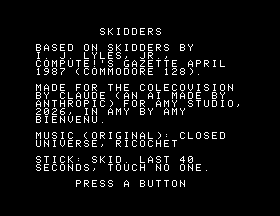 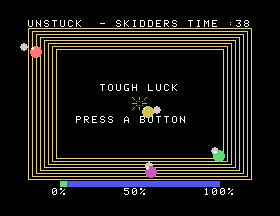 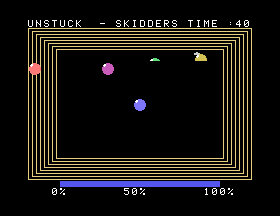 |
|
|
Fly a new spaceship down a winding canyon whose walls keep closing in. After a countdown you launch from the base, and the canyon twists at random as you go. About every 13 seconds it grows narrower and your rank goes up, and the ship changes colour with the width to warn you. Now and then an asteroid sits in the canyon. Touch a wall or an asteroid and you crash. Your rating is the rank you reached, one of eleven, from STARTER all the way up to HAN SOLO, and the time flown is shown while you fly. There is no other score: the game is how long you can last.
Controls: Use either joystick. Push left and right to steer. The keypad is not used. ColecoVision version credited in the source to Claude (an AI made by Anthropic) for Amy Studio, in Amy, the language by Amy Bienvenu, 2026: a faithful adaptation of the published rules. From COMPUTE!'s Gazette, January 1984, page 190: original VIC-20 program by Thomas Catsburg. This is a modern homebrew adaptation, not a commercial Coleco release. Original Amy Studio release file: 028 - Canyon Cruiser - by THOMAS CATSBURG - COMPUTE! Gazette - January 1984.rom |
Amy Studio/Amy Purple (Bienvenu) | 6kb | 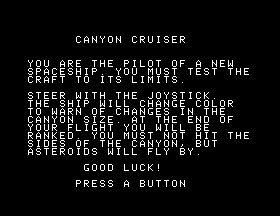 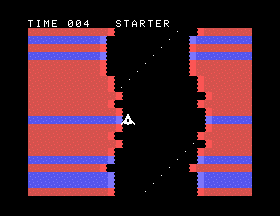 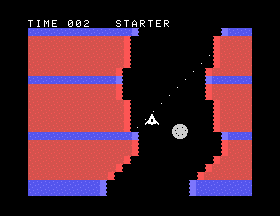  |
|
|
Four levels of girders joined by ladders rise above you, and at the top sits a pile of 12 barrels that roll down one at a time, falling off the ends, down some ladders and through holes in the girders. Pick up the 16 toolboxes for 150 points each without being hit, and jump over a barrel for 1000. Collect every toolbox to earn 100 for each barrel left and move to a harder screen, with more holes and more broken ladders. You lose a climber if a barrel hits you, if you walk off a girder, or if all 12 barrels roll away before you finish. You start with three climbers and get one more every 10,000 points.
Controls: Use either joystick. Left and right walk, up and down climb, and the left button jumps the way you last walked. The keypad is not used. ColecoVision version credited in the source to Claude (an AI made by Anthropic) for Amy Studio, in Amy, the language by Amy Bienvenu, 2026: a faithful adaptation of the published rules. From COMPUTE!'s Gazette, January 1984, page 196: original Commodore 64 program by Chris Lesher. This is a modern homebrew adaptation, not a commercial Coleco release. Original Amy Studio release file: 030 - Hardhat Climber - by CHRIS LESHER - COMPUTE! Gazette - January 1984.rom |
Amy Studio/Amy Purple (Bienvenu) | 7kb |     |
|
|
You are the new foreman of a mine where a cave-in is coming. Explore every tunnel in a first-person view and find the trapped miners, who wait in dead ends and appear in the tunnels as you approach them. Your map shows the mine, with a circle marking the way out. When the last miner is found the cave-in begins, and you have 60 seconds, shown as they run down, to get back to the entrance before the falling rock traps you. In the advanced game the map is lost the moment the cave-in starts, so you must remember the way. The mine is a new seven by seven maze every game.
Controls: Use either joystick. Up steps forward, down steps back, and left and right turn. The button shows the map; press a button again to go back. The keypad is not used. ColecoVision version credited in the source to Claude (an AI made by Anthropic) for Amy Studio, in Amy, the language by Amy Bienvenu, 2026: a reimagined adaptation of the published rules. From COMPUTE!'s Gazette, January 1984, page 80: original VIC-20 program by Paul L. Bupp and Stephen P. Drop. The printed listing is headed 'for 64' but is the VIC-20 version. This is a modern homebrew adaptation, not a commercial Coleco release. Original Amy Studio release file: 029 - Cave-In - by BUPP AND DROP - COMPUTE! Gazette - January 1984.rom |
Amy Studio/Amy Purple (Bienvenu) | 8kb | 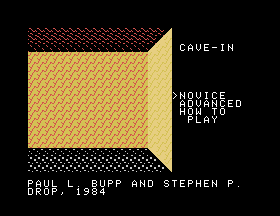 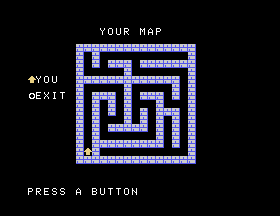   |
|
|
You are trapped inside the Power Grid, a tilted lattice of diamond-shaped nodes joined by wires, and somewhere in one of them your Commodore 64 is hidden. The SONAR line grows shorter as you get closer. Walk the wires: each side of a node you walk for the first time is worth 10 points, and a node whose four sides you have walked is boxed in blue. Box the node where the 64 hides to find it and earn a bonus for every node you left unboxed. Power spikes roam the wires, and touching one costs a life; you start with five, and STAMINA shows those in reserve. Each new grid adds a spike, from two up to seven. Speed and EASY or HARD are chosen before play.
Controls: Use either joystick. The grid is tilted, so the stick is too: up goes up-right, right goes down-right, down goes down-left and left goes up-left. The right button pauses. Before a game, up and down set the speed (1 to 9), left and right choose EASY or HARD, and the left button starts. The keypad is not used. ColecoVision version credited in the source to Claude (an AI made by Anthropic) for Amy Studio, in Amy, the language by Amy Bienvenu, 2026: a reimagined adaptation of the published rules. From COMPUTE!'s Gazette, December 1983, page 74: original Commodore 64 program by Eric Brandon. Built from the article's rules; the machine-language program was not used. This is a modern homebrew adaptation, not a commercial Coleco release. Original Amy Studio release file: 024 - Spike - by Eric Brandon - COMPUTE! Gazette - December 1983.rom |
Amy Studio/Amy Purple (Bienvenu) | 14kb | 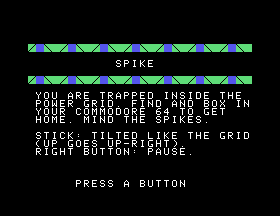 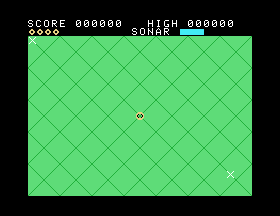   |
|
|
Two spaceships face each other from opposite sides of the screen, moving up and down and firing laser bursts across at each other. A hit is worth 10 points, but every shot costs one, so a hit nets nine and wild firing loses points. The first to the target score wins, chosen before the game as 80 or 500. A hit sets off an explosion and the screen flashes. The ships glide smoothly and move faster the longer you hold the stick. Each ship has one laser burst in flight at a time, and a score never drops below zero. Two players duel each other, or one player flies the left ship against the computer.
Controls: Joystick 1 flies the left ship and joystick 2 the right: up and down move, and the left button fires. With one player the computer flies the right ship. Before a game, up and down choose one or two players, left and right the target score, and the left button starts. The keypad is not used. ColecoVision version credited in the source to Claude (an AI made by Anthropic) for Amy Studio, in Amy, the language by Amy Bienvenu, 2026: a reimagined adaptation of the published rules. From COMPUTE!'s Gazette, December 1983, page 80: original VIC-20 program by Andy Hayes. Built from the article's rules; the programs were not studied. This is a modern homebrew adaptation, not a commercial Coleco release. Original Amy Studio release file: 022 - Space Duel - by ANDY HAYES - COMPUTE! Gazette - December 1983.rom |
Amy Studio/Amy Purple (Bienvenu) | 6kb |     |
|
|
A hostile saucer orbits overhead and fires at your gun turret, and its shots come down at a slant, wrapping around the sides of the screen. Shoot a shot out of the air for 100 points or hit the saucer itself for 500. A shot that reaches the ground leaves a pile of atomic waste, and running your turret into a pile destroys it. Only one bullet flies at a time, and firing again starts a new one. Your turret moves twice as fast as the saucer and wraps around the edges of the screen, and a shot landing on the turret leaves it unharmed. You have four turrets, and the session's high score is kept.
Controls: Use either joystick. Left and right move the turret, which wraps around the edges, and the left button fires; held, it fires again and again. The keypad is not used. ColecoVision version credited in the source to Claude (an AI made by Anthropic) for Amy Studio, in Amy, the language by Amy Bienvenu, 2026: a faithful adaptation of the published rules. From COMPUTE!'s Gazette, December 1983, page 233: original VIC-20 program by Ron Watts. This is a modern homebrew adaptation, not a commercial Coleco release. Original Amy Studio release file: 021 - Saucer Shooter - by RON WATTS - COMPUTE! Gazette - December 1983.rom |
Amy Studio/Amy Purple (Bienvenu) | 6kb | 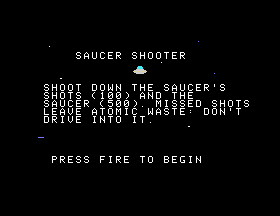 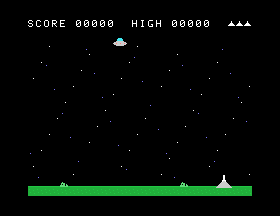 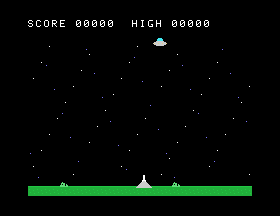 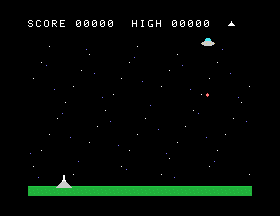 |
|
|
Bowling for one to three players over ten frames. The ball rides up and down the near end of the lane, and you press the button to roll it at the right moment. It rolls straight down its row: the first pin in that row falls together with the pins on the two diagonals behind it, up to three back, and then any pin further along the row. The middle row is a strike and the two outer rows are the gutters. A second ball goes at the pins left standing. The tenth frame gives one extra ball after a spare and two after a strike, and the score sheet shows the marks and a running total by the usual bowling rules. Each player enters a name of up to six letters.
Controls: Use either joystick. Press the left button to roll the ball. Before a game, up and down set the number of players; then spell each name with the stick (up and down a letter, left and right the place) and press the left button. The keypad is not used. ColecoVision version credited in the source to Claude (an AI made by Anthropic) for Amy Studio, in Amy, the language by Amy Bienvenu, 2026: a faithful adaptation of the published rules. From COMPUTE!'s Gazette, December 1983, page 205: original Commodore 64 program by Joseph Ganci. This is a modern homebrew adaptation, not a commercial Coleco release. Original Amy Studio release file: 020 - Bowling Champ - by JOSEPH GANCI - COMPUTE! Gazette - December 1983.rom |
Amy Studio/Amy Purple (Bienvenu) | 7kb | 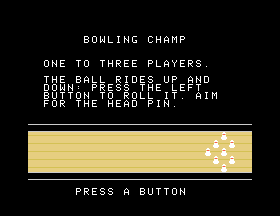 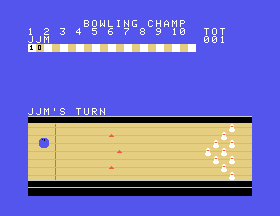   |
|
|
An arithmetic game for practising subtraction. Terrorists have filled a building with time bombs, and you walk into each bomb to disarm it by working out a subtraction: the top number minus the bottom number. Dial in the right answer and the bomb is safe; get it wrong and it blows up, with the right answer shown, and three blasts bring the building down. Each story must be cleared within five minutes, and each has ten more bombs than the one below, from 10 up to 60 across six stories. The skill level, 1 to 100, sets how big the numbers are. Stepping onto the blue line takes you up four rows, and walking off one side brings you round to the other.
Controls: Use either joystick. The stick walks; at a bomb, up and down change the digit under the cursor, left and right move the cursor, and the left button gives the answer. Before the game, up and down set the skill level and the left button starts. The keypad is not used. ColecoVision version credited in the source to Claude (an AI made by Anthropic) for Amy Studio, in Amy, the language by Amy Bienvenu, 2026: a faithful adaptation of the published rules. From COMPUTE!'s Gazette, December 1983, page 231: original VIC-20 program by Kevin Dewey. This is a modern homebrew adaptation, not a commercial Coleco release. Original Amy Studio release file: 019 - BLAM! - by KEVIN DEWEY - COMPUTE! Gazette - December 1983.rom |
Amy Studio/Amy Purple (Bienvenu) | 7kb | 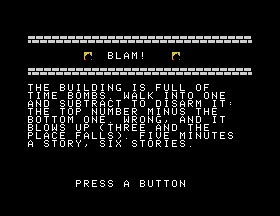 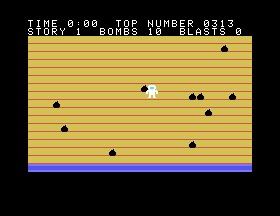  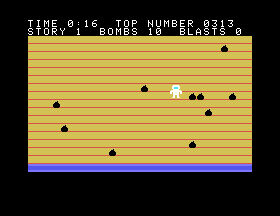 |
|
|
A text adventure. You are held in a cell aboard a Martian ship. To escape you must get past the force field, find a key, a uniform and a Geiger counter, and use what the ship's garden grows to blow up the ship from the fuel room, getting away in a life-craft. Commands are built by choosing a verb and then a noun from menus, and each of the eight rooms has its own picture above the story. A guard comes into the cell one turn in four, guards in the north hall take you back if you have no uniform, one guard shoots, and a plant in the garden kills you if you eat it. Some doors only work one way. After the end, a button returns to the title.
Controls: Use either joystick. Up and down choose a verb; push right or press the left button to move to the nouns, choose one with up and down, and press the left button to do it. Push left or press the right button to go back to the verbs. The keypad is not used. ColecoVision version credited in the source to Claude (an AI made by Anthropic) for Amy Studio, in Amy, the language by Amy Bienvenu, 2026: a reimagined adaptation of the published rules. From COMPUTE!'s Gazette, November 1983, page 185: original Commodore 64 program by Alan Poole. One listing for both the VIC-20 and the Commodore 64 (Program 1: VIC/64 Martian Prisoner). This is a modern homebrew adaptation, not a commercial Coleco release. Original Amy Studio release file: 017 - Martian Prisoner - by ALAN POOLE - COMPUTE! Gazette - November 1983.rom |
Amy Studio/Amy Purple (Bienvenu) | 19kb | 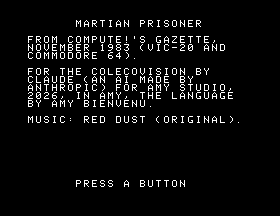 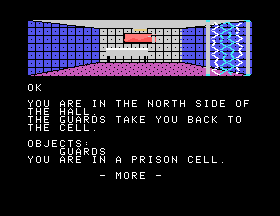 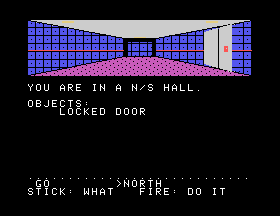 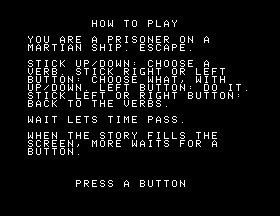 |
|
|
The sky really is falling. Thirty pieces of it hang overhead and come down one at a time, in order, blown left and right by the wind. Move Chicken Little about the farmyard at the bottom of the screen and throw rocks at them: 50 points for a falling piece, 10 for one still resting in the sky. A rock thrown before the last one has landed is lost, so time your throws. A piece that lands on your head costs a chicken. When nine pieces have reached the ground the sky has fallen and the game is over, and each new level allows one fewer. Clear the whole sky to go up a level, where the pieces fall faster. After the sky has fallen, a button starts a new game.
Controls: Use either joystick. The stick moves Chicken Little about the farmyard and the button throws a rock. The keypad is not used. ColecoVision version credited in the source to Claude (an AI made by Anthropic) for Amy Studio, in Amy, the language by Amy Bienvenu, 2026: a faithful adaptation of the published rules. From COMPUTE!'s Gazette, November 1983: original Commodore 64 program by Jeff Wolverton. This is a modern homebrew adaptation, not a commercial Coleco release. Original Amy Studio release file: 016 - Chicken Little - by JEFF WOLVERTON - COMPUTE! Gazette - November 1983.rom |
Amy Studio/Amy Purple (Bienvenu) | 7kb | 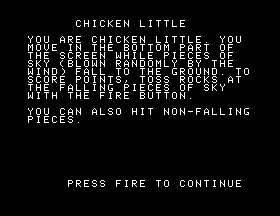 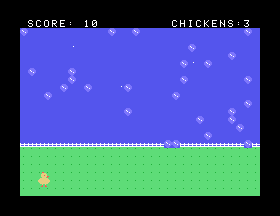 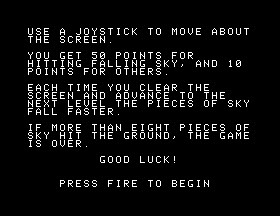 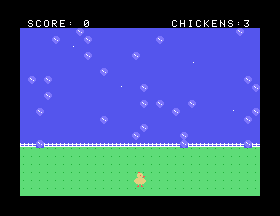 |
|
|
A clock, not a game: it tells the time the way the plastic rolling-ball clocks do. You set the time, and every minute a ball rides an elevator up the right side, runs along the top and drops onto the minute rack. The fifth ball tips that rack and goes on to the five-minute rack, while the other four roll down a chute to the bottom. The twelfth five-minute ball moves on to the hour rack, and the thirteenth hour ball empties it back to one o'clock. Read the hour on the bottom rack, then add the five-minute and minute racks. Thirty balls are in the clock, and a fast mode runs a minute every four seconds so you can watch the racks fill and tip.
Controls: Use either joystick. Set the time with the stick and the button, and press the button again while the clock runs to set it again. The stick turns the sound off and on, and the title offers a fast mode. ColecoVision version credited in the source to Claude (an AI made by Anthropic) for Amy Studio, in Amy, the language by Amy Bienvenu, 2026: a faithful adaptation of the published rules. From COMPUTE!'s Gazette, July 1983, page 74: original VIC-20 program by Joseph D. Wright. Not a game: a rolling-ball clock program. The listing is headed 'Rolling-Ball Clock'. This is a modern homebrew adaptation, not a commercial Coleco release. Original Amy Studio release file: 004 - VIC Timepiece - by Joseph D. Wright - COMPUTE! Gazette - July 1983.rom |
Amy Studio/Amy Purple (Bienvenu) | 6kb |    |
|
|
You are P. J. Uing, oil man. Move your rig over a column, drill down through the dirt to reach the oil and pump it: every pocket of oil joined to the end of the pipe, beside it or above it, comes out, and the deeper it lies the more it is worth. Shale wears your pipe away, a devil hiding in the oil blows the rig up, and gas may be waiting in the empty spaces you have pumped. Dynamite blasts whatever is under the pipe, but there are only a few sticks for each rig. You start with five rigs and win another for each $100,000 and one more for every field pumped dry. There are eight levels, and from level 5 the shale is hidden.
Controls: Use either joystick. Left and right move the rig, down drills and up pulls the pipe up a length. The button pumps when the pipe's end is in oil or an empty space, drops dynamite in dirt, or, with the pipe all the way up, gives up the rig for a new one. The keypad is not used. ColecoVision version credited in the source to Claude (an AI made by Anthropic) for Amy Studio, in Amy, the language by Amy Bienvenu, 2026: a faithful adaptation of the published rules. From COMPUTE!'s Gazette, October 1983: original Commodore 64 program by Gordon F. Wheat. This is a modern homebrew adaptation, not a commercial Coleco release. Original Amy Studio release file: 013 - Oil Tycoon - by GORDON F. WHEAT - COMPUTE! Gazette - October 1983.rom |
Amy Studio/Amy Purple (Bienvenu) | 9kb |     |
|
|
Your starship crosses a universe of nebulae, spiral galaxies, stars and double spiral galaxies, worth 5, 10, 15 and 20 energy units. Shoot them with matter conversion torpedoes to take their energy, but never fly into one. A Quasar arrives with a deep warning: destroy it in about 12 seconds for 100 units, or lose 500. Now and then a Demon Star comes instead, in a blinding flash with a roar. It shortens your torpedoes' range, and failing to destroy it in time costs your ship; it is worth 500. Every 1000 units brings 100 more and a new universe, and past 3000 the universe grows denser. The ship and torpedoes wrap around the edges. Running out of energy also ends the game.
Controls: Use either joystick. The stick flies the ship in eight directions, and it keeps going the way it last went; the button fires, and held, fires again and again. The keypad is not used. ColecoVision version credited in the source to Claude (an AI made by Anthropic) for Amy Studio, in Amy, the language by Amy Bienvenu, 2026: a faithful adaptation of the published rules. From COMPUTE!'s Gazette, September 1983, page 60: original VIC-20 program by Stan McDaniel. This is a modern homebrew adaptation, not a commercial Coleco release. Original Amy Studio release file: 009 - Demon Star - by Stan McDaniel - COMPUTE! Gazette - September 1983.rom |
Amy Studio/Amy Purple (Bienvenu) | 7kb |   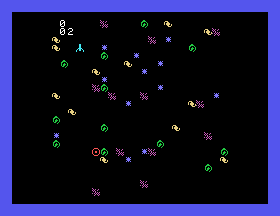 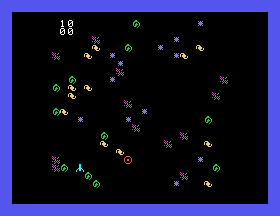 |
|
|
Four invaders cross the screen from the right toward your side. Move your base up and down the left edge and fire along your row: the first invader in that row is destroyed for 10 points, and another appears on the right. A shot that hits nothing costs 5 points, so line up before you fire. Several invaders can share a row, and a new one may appear on top of another. Your base turns from red to white after its first shot. Once you pass 500 points the invaders come twice as fast. The game ends as soon as one reaches your side, when the whole column flashes red at the breach. Afterwards you can try again or return to the title.
Controls: Use either joystick. The stick moves the base up and down, and the button fires; holding it fires once. The button also starts the game and answers questions. The keypad is not used. ColecoVision version credited in the source to Claude (an AI made by Anthropic) for Amy Studio, in Amy, the language by Amy Bienvenu, 2026: a faithful adaptation of the published rules. From COMPUTE!'s Gazette, September 1983, page 120: original VIC-20 program by C. Regena. This is a modern homebrew adaptation, not a commercial Coleco release. Original Amy Studio release file: 008 - Defend - by C. Regena - COMPUTE! Gazette - September 1983.rom |
Amy Studio/Amy Purple (Bienvenu) | 5kb |  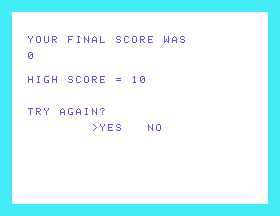 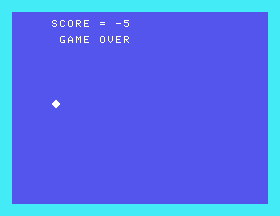 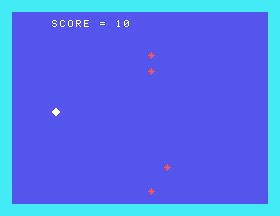 |
|
|
An alphabet game for small children learning their letters. Five bugs wait at the start of their lanes, and the screen asks for a letter, shown in brackets. Pick the right one from the strip of letters at the bottom of the screen and the bugs race toward the post, each taking a step or none at random every turn. Each bug gets its place, 1 to 5, as it arrives. On the title you choose whether the letters come in order from A or at random, and whether the bugs race all the way to the post or move one step for each right letter. After a race you can play again or go back to the title.
Controls: Use either joystick. Push left or right along the strip of letters at the bottom of the screen and press the button to choose one. The title choices are made with the stick and the button. ColecoVision version credited in the source to Claude (an AI made by Anthropic) for Amy Studio, in Amy, the language by Amy Bienvenu, 2026: a faithful adaptation of the published rules. From COMPUTE!'s Gazette, July 1983, page 120: original VIC-20 program by Michael Wasilenko. Includes, as an option, the change printed in the Bug-Swatter column of September 1983. This is a modern homebrew adaptation, not a commercial Coleco release. Original Amy Studio release file: 001 - Alfabug - by Michael Wasilenko - COMPUTE! Gazette - July 1983.rom |
Amy Studio/Amy Purple (Bienvenu) | 4kb |  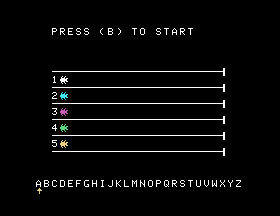 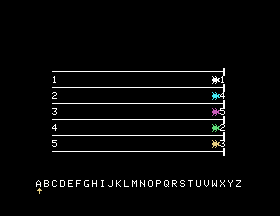 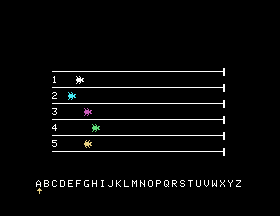 |
|
|
Your red car drives the city streets filling potholes, at five points each. The street commissioner's blue car wants them back. He waits a while, then drives three blocks' worth toward you, stops, looks where you are and sets off again. Your car moves only while you hold the stick, and a turn into a block is ignored. If the cars meet, or the commissioner runs into anything that is not a street, you lose a car and all the potholes are dug up again, though your score stays. Fill all 150 for a bonus of twenty times the pothole value, and from then on each pothole is worth five more. You have three cars.
Controls: Use either joystick. Hold the stick to drive and let go to stop; a turn into a block is ignored and the car keeps going. The button answers in the menus. The keypad is not used. ColecoVision version credited in the source to Claude (an AI made by Anthropic) for Amy Studio, in Amy, the language by Amy Bienvenu, 2026: a faithful adaptation of the published rules. From COMPUTE!'s Gazette, September 1983, page 64: original VIC-20 program by Joe W. Rocke. This is a modern homebrew adaptation, not a commercial Coleco release. Original Amy Studio release file: 010 - Potholes - by Joe W. Rocke - COMPUTE! Gazette - September 1983.rom |
Amy Studio/Amy Purple (Bienvenu) | 6kb |   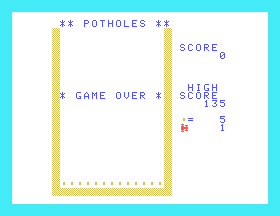 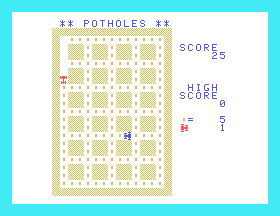 |
|
|
The space station Alpha sits in the middle of the screen, guarding a nuclear reactor, and Cylon fighters launch at random from all four edges to fly straight at it on suicide runs. Push the stick toward a fighter to fire that side's laser; the button sets off a smart bomb that destroys every fighter on the screen, and you start with three. Each fighter is worth a point. At 30 points the launches come twice as often and the side fighters speed up; at 50 the top and bottom ones do too and you win a bomb; at 60, 110 and 150 you earn a bonus station and bomb. A fighter reaching the reactor destroys the station, and losing three ends the game. The five best scores are kept with their initials.
Controls: Use either joystick. Push the stick toward a fighter to fire the laser on that side, and press the button for a smart bomb. Initials for the high-score table are chosen with the stick. The keypad is not used. ColecoVision version credited in the source to Claude (an AI made by Anthropic) for Amy Studio, in Amy, the language by Amy Bienvenu, 2026: a faithful adaptation of the published rules. From COMPUTE!'s Gazette, August 1983, page 48: original VIC-20 program by Mark Dudley. This is a modern homebrew adaptation, not a commercial Coleco release. Original Amy Studio release file: 006 - Cylon Zap - by Mark Dudley - COMPUTE! Gazette - August 1983.rom |
Amy Studio/Amy Purple (Bienvenu) | 9kb | 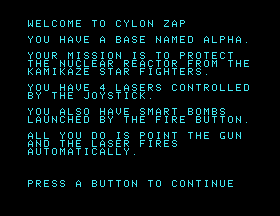 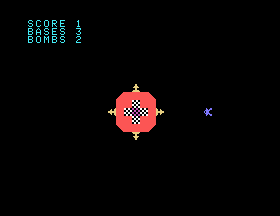   |
|
|
The Viper races around the screen eating asterisks, and each one makes it two segments longer. It keeps moving the way you last pushed the stick, so the challenge is steering a head with an ever longer body behind it. Hitting a wall, the maze or your own body ends the game, and turning straight back onto yourself counts as a crash. Choose one of nine speeds and one of three courses: an open field, an easy maze worth twice the points, or a hard maze worth five times. Your score is the asterisks eaten times the skill level times the maze's factor. The Viper waits, still, until you first push the stick, and it stops growing once it is very long.
Controls: Use either joystick. Push the stick to turn the Viper, which keeps going the way it was last pushed; diagonals are ignored. In the menus the stick chooses and the button confirms. The keypad is not used. ColecoVision version credited in the source to Claude (an AI made by Anthropic) for Amy Studio, in Amy, the language by Amy Bienvenu, 2026: a faithful adaptation of the published rules. From COMPUTE!'s Gazette, August 1983, page 42: original VIC-20 program by Dave and Casey Gardner. This is a modern homebrew adaptation, not a commercial Coleco release. Original Amy Studio release file: 007 - The Viper - by Dave and Casey Gardner - COMPUTE! Gazette - August 1983.rom |
Amy Studio/Amy Purple (Bienvenu) | 5kb |   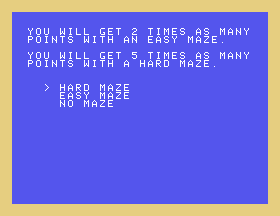  |
|
|
A garden is planted with 150 poisonous plants, and your snake starts in the top left corner. Guide it to the escape hole at the bottom right before time runs out. Every move adds a segment in a new colour and scores a point, so the snake grows longer the further it goes. The snake moves only while you hold the stick, but the clock keeps running when you stop. The time allowed depends on the skill level you choose before each snake: 60, 45, 30 or 15 seconds. Reaching the hole earns a bonus that grows with the level. Touching a plant, running into your own body or running out of time costs a snake, and you have three. Leave the right edge and you come back on the left, one row down.
Controls: Use either joystick. The snake moves while the stick is held and stops when you let go, though the clock keeps running; the button answers the menus. The keypad is not used. ColecoVision version credited in the source to Claude (an AI made by Anthropic) for Amy Studio, in Amy, the language by Amy Bienvenu, 2026: a reimagined adaptation of the published rules. From COMPUTE!'s Gazette, July 1983, page 54: original VIC-20 program by Daryl Biberdorf. This is a modern homebrew adaptation, not a commercial Coleco release. Original Amy Studio release file: 003 - Snake Escape - by Daryl Biberdorf - COMPUTE! Gazette - July 1983.rom |
Amy Studio/Amy Purple (Bienvenu) | 6kb | 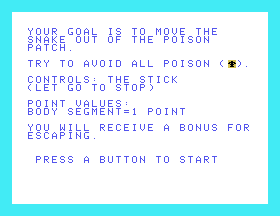 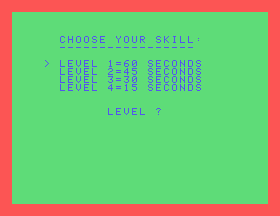 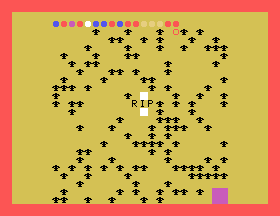 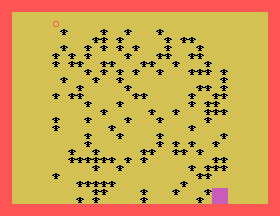 |
|
|
An airplane crosses the sky, and before you jump you choose a landing pad: 5X, 10X or 2X, the bigger bonus going with the smaller pad. If you take longer than 15 seconds the computer picks one for you. Press the button to leave the plane, fall a few rows, then steer the open parachute against the wind. Land on the yellow part of the pad you chose to score the pad's multiple times the bonus value; land anywhere else and you lose a skydiver. Every two good landings the bonus goes up by 50, and the parachute falls faster and steers more slowly. Drift off one side and you come back on the other, a row lower. An extra skydiver comes at 5000 points.
Controls: Use either joystick. Push left or right to choose a pad and press the button to confirm; press the button to jump, then push left or right to steer the parachute. The keypad is not used. ColecoVision version credited in the source to Claude (an AI made by Anthropic) for Amy Studio, in Amy, the language by Amy Bienvenu, 2026: a reimagined adaptation of the published rules. From COMPUTE!'s Gazette, July 1983, page 52: original VIC-20 program by Alan Crossley. This is a modern homebrew adaptation, not a commercial Coleco release. Original Amy Studio release file: 002 - Skydiver - by Alan Crossley - COMPUTE! Gazette - July 1983.rom |
Amy Studio/Amy Purple (Bienvenu) | 6kb | 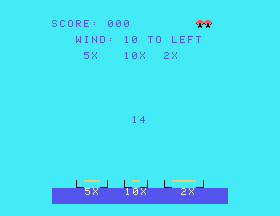 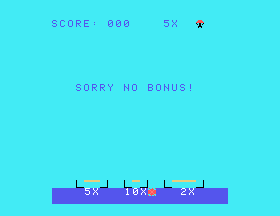   |


